
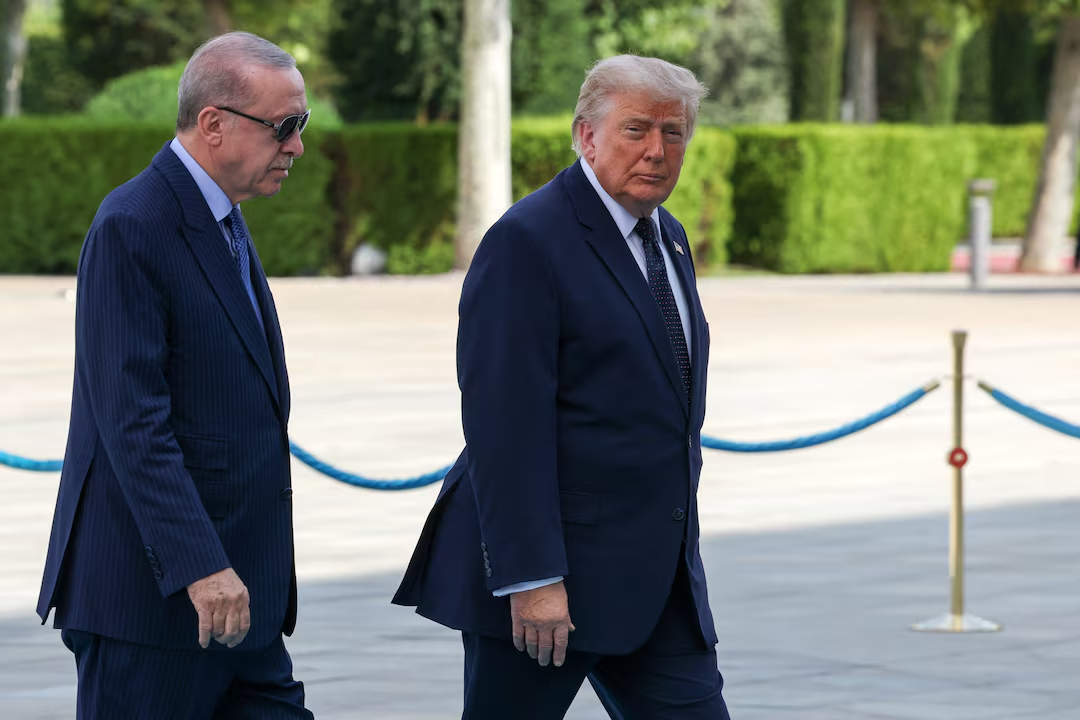
President Donald Trump’s latest overseas visit has sparked plenty of headlines, but one of the most talked-about claims has nothing to do with NATO meetings, international diplomacy, or security agreements. Instead, attention has turned to an unusual report suggesting that even the president’s biological waste will not remain in the country he is visiting.
According to multiple reports, every time Trump uses the bathroom during his trip to Turkey, his waste will reportedly be collected using a specialized portable toilet system and transported back to the United States under the supervision of the Secret Service. While the claim has gone viral online because of how strange it sounds, security experts say the reasoning behind it is rooted in protecting sensitive presidential information rather than simple preference.
The report, first highlighted by Turkish media and later repeated by several international outlets, claims the procedure is part of a broader security protocol used to protect the president during foreign travel. Rather than allowing biological material to enter another country’s sewage system, it is allegedly collected, secured, and returned to the United States.
Although many people initially assumed the story was satire, similar claims have surfaced involving several world leaders over the years. The idea behind the practice is that biological waste can reveal far more than most people realize.
Medical experts have long known that stool samples can provide valuable information about a person’s overall health. Laboratory testing can identify illnesses, infections, digestive disorders, medications, dietary habits, and even aspects of a person’s microbiome. Intelligence agencies have reportedly considered this type of information potentially valuable when it concerns the leader of a major world power.
For that reason, presidential security teams are said to treat biological material as sensitive information. Preventing it from falling into foreign hands reduces the possibility that another government could conduct its own medical analysis or attempt to gather intelligence about the president’s health.
While the reports surrounding Trump’s visit have generated widespread discussion, this is not believed to be a newly created policy.
Similar stories have appeared during previous presidential trips overseas. During President George W. Bush’s visit to Vienna in 2006, reports claimed that his security detail followed comparable procedures. Some accounts even suggested that used toilet paper was collected and transported to Ramstein Air Base in Germany before eventually returning to the United States rather than being discarded locally.
The United States is not the only country reportedly linked to such precautions.
Investigative journalists have previously claimed that Russian President Vladimir Putin’s security team follows an even stricter protocol while traveling abroad. According to those reports, Putin’s waste is collected in specially designed containers or bags before being flown back to Russia, preventing foreign governments from accessing any biological material.
Historical accounts have also referenced similar practices decades ago. Some reports have alleged that Soviet leader Joseph Stalin once ordered Mao Zedong’s biological waste to be examined in an effort to gather intelligence about the Chinese leader’s health. Although historians continue to debate some of these claims, they illustrate that biological intelligence has long been viewed as valuable by governments.
Trump’s reported bathroom arrangements represent only a small part of the enormous security operation surrounding his visit.
Whenever a sitting US president travels overseas, thousands of personnel become involved in planning and executing the trip. Every movement is carefully coordinated months in advance, with extensive cooperation between American security agencies and the host nation.
Reports indicate that approximately 1,400 members of the US delegation are attending the NATO summit alongside Trump, making it one of the largest delegations present. The group includes Secret Service agents, military personnel, communications specialists, intelligence officials, medical teams, diplomatic staff, and logistical support crews responsible for ensuring every aspect of the visit runs smoothly.
The president’s heavily armored limousine—commonly known as “The Beast”—has also reportedly been transported overseas for the trip. Designed to withstand a wide range of threats, the vehicle serves as Trump’s primary mode of transportation while abroad and accompanies him on virtually every foreign visit.
Accommodation arrangements are similarly extensive. Reports suggest the president’s hotel has been reserved exclusively for members of the US delegation, while nearby hotels house additional American personnel stationed close to the US Embassy throughout the summit.
Although the reported practice of flying the president’s waste back to the United States has generated countless jokes and social media reactions, security analysts note that it reflects the extraordinary measures taken to protect a sitting commander in chief.
From transporting armored vehicles across continents to deploying thousands of security personnel—and even reportedly safeguarding biological material—presidential travel involves layers of protection that most people never see.
Whether unusual or not, the reports serve as another reminder that virtually every aspect of a US president’s overseas visit is carefully managed, especially when national security and intelligence concerns are involved. What initially sounds like an unbelievable rumor may simply be one more example of the extraordinary precautions taken whenever the world’s most closely protected political leaders travel abroad.

Emily Johnson is a critically acclaimed essayist and novelist known for her thought-provoking works centered on feminism, women’s rights, and modern relationships. Born and raised in Portland, Oregon, Emily grew up with a deep love of books, often spending her afternoons at her local library. She went on to study literature and gender studies at UCLA, where she became deeply involved in activism and began publishing essays in campus journals. Her debut essay collection, Voices Unbound, struck a chord with readers nationwide for its fearless exploration of gender dynamics, identity, and the challenges faced by women in contemporary society. Emily later transitioned into fiction, writing novels that balance compelling storytelling with social commentary. Her protagonists are often strong, multidimensional women navigating love, ambition, and the struggles of everyday life, making her a favorite among readers who crave authentic, relatable narratives. Critics praise her ability to merge personal intimacy with universal themes. Off the page, Emily is an advocate for women in publishing, leading workshops that encourage young female writers to embrace their voices. She lives in Seattle with her partner and two rescue cats, where she continues to write, teach, and inspire a new generation of storytellers.