


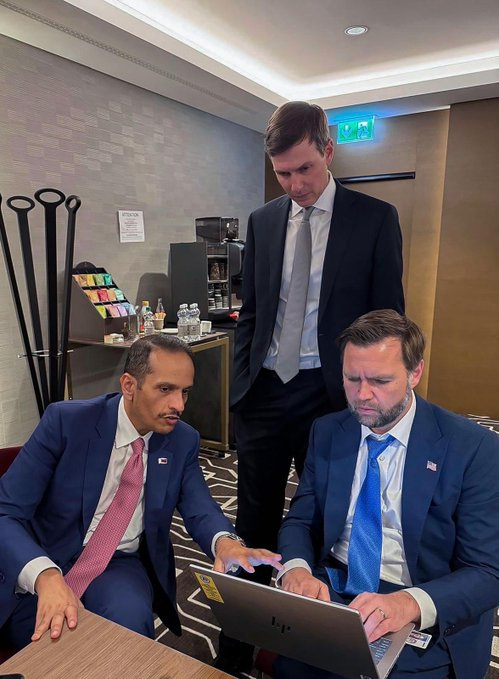
A photograph taken during high-level diplomatic talks in Switzerland has ignited widespread speculation online after social media users claimed to notice an unusual detail involving a senior American official.
The image was shared by a prominent Middle Eastern leader following discussions related to ongoing tensions between the United States and Iran. While the photograph initially appeared to capture a routine moment from the negotiations, internet users quickly focused on a small detail visible on a laptop being used during the meeting.
The picture showed a senior U.S. representative seated at a conference table, apparently working on a computer as other participants stood nearby. At first glance, nothing seemed out of the ordinary. However, eagle-eyed observers noticed what appeared to be a Common Access Card, commonly known as a CAC card, inserted into the laptop.
CAC cards are secure identification credentials typically issued to members of the U.S. military, Department of Defense employees, and authorized government contractors. They are used for identification purposes and to access secure government networks, facilities, and computer systems.
While the use of such a card is generally routine in government settings, the controversy centered on the image visible on the card itself. Several social media users claimed the photograph displayed on the credential appeared to show a woman rather than the male official sitting at the laptop.
The observation quickly spread across social media platforms, with screenshots of the image circulating widely. Within hours, users were debating whether the card actually belonged to the individual using the computer or whether the appearance of a female photograph was simply the result of image distortion, lighting conditions, or the angle from which the picture was taken.
As the discussion intensified, some online commentators began questioning whether the image had been posted intentionally with the detail left visible. Others argued that the theory was being overblown and that there was insufficient evidence to draw any conclusions from a single photograph.
Among those commenting on the image was journalist and social science researcher Caroline Orr Bueno. In a post on social media, she questioned what message, if any, might have been intended by publishing the photograph.
She suggested there could be symbolic significance behind the image and wrote that she would like to know the intended meaning of showing a senior American official apparently logging into a laptop using someone else’s CAC card. She further suggested there was likely a message hidden between the lines, fueling additional speculation among observers.
Only after the image had already generated significant discussion did many people realize who was actually pictured.
The individual seated at the laptop was U.S. Vice President JD Vance, who has increasingly become one of the most prominent figures in the Trump administration. Standing nearby was Jared Kushner, President Donald Trump’s son-in-law and longtime adviser, who has remained influential in international affairs despite no longer serving in an official White House role.
The photograph itself was shared by Qatari Prime Minister Mohammed bin Abdulrahman bin Jassim Al Thani, who has been involved in diplomatic efforts surrounding regional conflicts and negotiations.
While much of the online conversation centered on the card visible in the image, others focused on the identities of the people participating in the meeting.
Political commentator Tim Miller, host of The Bulwark Podcast and an MSNBC analyst, questioned why Kushner was present during such an important diplomatic gathering. Referring to Kushner’s close relationships with Gulf leaders during Trump’s first administration, Miller publicly raised concerns about his involvement in discussions related to U.S. policy in the region.
His comments generated additional debate about the role of unofficial advisers and outside figures in sensitive diplomatic negotiations.
Other observers questioned the presence of Qatari officials at the talks, while some wondered whether key American officials were absent from the meeting. Particular attention was paid to Secretary of State Marco Rubio, who did not appear in the photograph despite playing a major role in the administration’s foreign policy efforts.
The absence prompted speculation online about who was directly involved in the negotiations and how responsibilities were being divided among members of the administration.
Despite the growing controversy, there has been no official indication that any security protocols were violated. Experts frequently caution that conclusions drawn from photographs can be unreliable, particularly when images are zoomed in, cropped, or compressed for online sharing.
Details that appear obvious to viewers can often be misleading due to reflections, shadows, image quality, or visual distortions. In many cases, objects captured in photographs may look dramatically different when viewed from another angle or at a higher resolution.
As a result, some observers have urged caution before assuming the card shown in the image belonged to someone other than the Vice President. Others argue that without a clearer image or official explanation, the online theories remain speculative.
At the time of writing, neither the White House nor the office of Vice President Vance had publicly responded to the claims surrounding the photograph. Likewise, no official statement had been issued addressing the identity of the card visible in the image.
Nevertheless, the photograph has become one of the most talked-about moments to emerge from the diplomatic discussions. What began as a routine image from a high-level meeting quickly evolved into a viral online mystery, attracting attention from journalists, political commentators, and thousands of social media users.
Whether the detail that sparked the controversy ultimately proves significant or simply turns out to be a misunderstanding, the reaction highlights how even the smallest element in a widely shared photograph can dominate public discussion and overshadow the larger events taking place behind the scenes.

Emily Johnson is a critically acclaimed essayist and novelist known for her thought-provoking works centered on feminism, women’s rights, and modern relationships. Born and raised in Portland, Oregon, Emily grew up with a deep love of books, often spending her afternoons at her local library. She went on to study literature and gender studies at UCLA, where she became deeply involved in activism and began publishing essays in campus journals. Her debut essay collection, Voices Unbound, struck a chord with readers nationwide for its fearless exploration of gender dynamics, identity, and the challenges faced by women in contemporary society. Emily later transitioned into fiction, writing novels that balance compelling storytelling with social commentary. Her protagonists are often strong, multidimensional women navigating love, ambition, and the struggles of everyday life, making her a favorite among readers who crave authentic, relatable narratives. Critics praise her ability to merge personal intimacy with universal themes. Off the page, Emily is an advocate for women in publishing, leading workshops that encourage young female writers to embrace their voices. She lives in Seattle with her partner and two rescue cats, where she continues to write, teach, and inspire a new generation of storytellers.