


We Came Home to Find Our Century-Old Tree Gone—Then We Checked the Security Footage
When we came back from vacation, one of our ancient trees was gone. But the real shock came when we checked the footage.
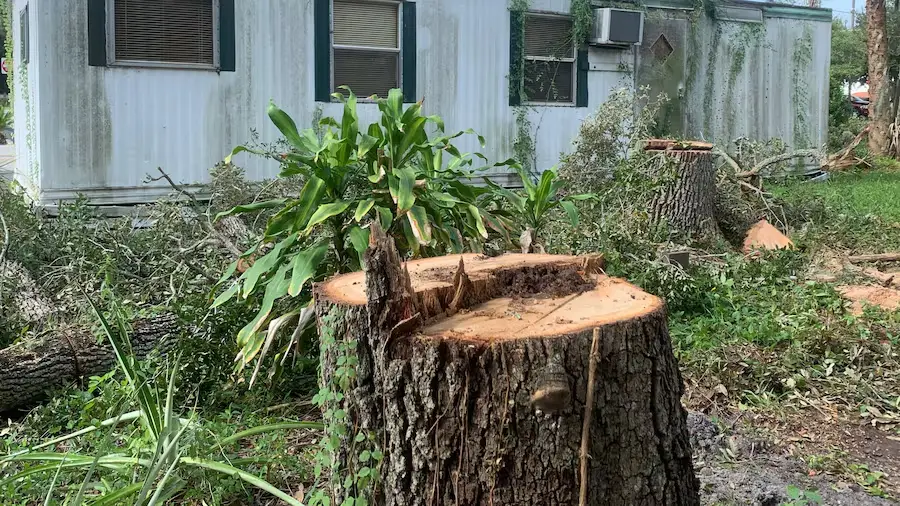
It was broad daylight when we saw it. The sun was high, the sky painfully blue, birds still chirping like nothing was wrong. But in the middle of our backyard, where shade had ruled the land for generations, there was only a massive stump. Flat. Fresh. Silent.
My mother placed her palm on the cut surface, as if touching it might undo what had happened. My father stood a few steps back, staring at the rings—decades stacked inside each other like a timeline someone had just erased.
That tree had been older than the house. Older than the fence. It had survived storms, heat waves, and three generations of our family. My great-grandfather had planted it as a sapling when he first bought this property in 1924. I’d grown up climbing its branches, reading books in its shade, carving my initials into its bark when I was twelve.
And somehow, it had vanished while we were gone for just four days.
No fallen branches. No sawdust trail. No note. No explanation.
The first thing we did was walk next door. Our neighbor, Mr. Collins, answered the door slowly. He looked surprised to see us, then uncomfortable when my father asked the question none of us wanted to ask.
“Did you cut our tree?”
Mr. Collins stiffened. He swore he hadn’t. Said he’d been home all week, yes, but he hadn’t touched it. Claimed he loved that tree. Said it blocked the afternoon sun just right, kept his house cool during summer months.
Still, the cut was clean. Professional. And the stump sat just inches from the property line—close enough to cause disputes, far enough to make things legally complicated.
Back inside, my father pulled up the security camera footage. We’d installed the system last year after some break-ins in the neighborhood. The camera faced our backyard and part of the fence, recording continuously during daylight hours.
11:03 AM—the tree stood tall, its shadow stretching across the grass like it had every morning for nearly a century.
11:41 AM—a white pickup truck appeared at the edge of the frame, parking on the street behind our house.
11:42 AM—two men stepped out, wearing plain clothes, no company logos, no safety vests. One carried a chainsaw. The other had ropes and cutting tools.
They didn’t rush. They didn’t look around nervously. One of them pointed toward the tree. The other nodded. They moved with the efficiency of professionals who knew exactly what they were doing.
11:58 AM—the tree was falling.
No argument. No hesitation. Just the soundless image of decades crashing down in seconds. The massive trunk hit the ground with what must have been a thunderous impact, though the camera recorded no audio.
The men worked efficiently, like they’d done this before. They cut the trunk into manageable sections, loaded everything into their truck, raked up the debris. By 12:36 PM, our yard was clear except for the stump.
But before leaving, one of the men walked straight up to the fence separating our yard from Mr. Collins’ house and knocked on his gate.
A moment later, Mr. Collins appeared on the other side of the fence. He spoke to them calmly, gesturing toward where the tree had been. Even smiled. The man handed him something—an envelope or papers.
The timestamp froze on Mr. Collins’ satisfied face as he shook hands with the tree removal crew.
We stared at the screen in stunned silence. Mr. Collins—our neighbor of fifteen years, the man who’d helped us move furniture when we’d hurt our backs, who’d watched our house during previous vacations—had lied directly to our faces.
That evening, my father received a message from the city: “No permit found for tree removal at your address.” Which meant not only had Mr. Collins hired someone to cut down our tree, he’d done it without the proper permits that would have required our permission as the property owners.
And at that exact moment, as if summoned by cosmic irony, Mr. Collins’ backyard lights turned on, illuminating his newly expanded view. Where once our tree’s branches had reached over the fence, creating natural privacy, now there was open sky. His yard suddenly felt twice as large.
We sat at the kitchen table that night, the glow of the laptop screen highlighting my father’s furrowed brow. The footage was paused on Mr. Collins’ smiling face—a picture of deceit we couldn’t reconcile with the genial man we’d known for years.
It felt like more than theft. It was betrayal. Not just the loss of the tree, but the erosion of trust with someone who lived just a stone’s throw away.
“We can’t let this go,” my mother said, her voice resolute. “That tree wasn’t just wood and leaves. It was part of our family history. Part of this neighborhood’s history.”
My father nodded, the lines on his forehead deepening. “We’ll need to report this to the authorities. It’s not just about the tree—it’s about what’s right.”
But first, we decided to confront Mr. Collins with the evidence.
The next morning, my father knocked on his door, laptop in hand. When Mr. Collins answered, Dad simply turned the screen toward him and pressed play.
We watched his face change as he saw himself on camera, shaking hands with the tree removal crew. The color drained from his cheeks. His mouth opened and closed without sound.
“You want to explain this?” my father asked quietly.
Mr. Collins looked around nervously, as if checking whether neighbors were watching. “Can we… can we talk inside?”
In his living room, the truth finally came out. Mr. Collins had been planning this for months. The tree, he claimed, was dropping leaves in his pool, blocking satellite reception, and making his yard too shady for the vegetable garden his wife wanted to plant.
“I was going to talk to you about it,” he said weakly. “But I knew you’d say no. That tree meant too much to your family. So when you left for vacation, I thought… I thought if it was just gone, you’d eventually get over it.”
“Get over it?” My mother’s voice was ice-cold. “Get over a hundred-year-old tree? Get over you trespassing on our property and destroying something irreplaceable?”
Mr. Collins shifted uncomfortably. “I’ll pay for a replacement. A new tree.”
“You can’t replace a century of growth,” my father said. “You can’t replace the history, the ecosystem, the carbon storage. You can’t replace what that tree meant to our family.”
What made it worse was the calculation behind it. Mr. Collins hadn’t acted impulsively. He’d researched tree removal companies, gotten quotes, planned the timing for when we’d be away. He’d methodically plotted the destruction of something that wasn’t his to destroy.
We left his house with nothing resolved and headed straight to the municipal office. With copies of the footage and a detailed account of what had happened, we laid our case before a sympathetic official named Sarah Chen.
She listened attentively, her expression shifting from mild curiosity to concern as our story unfolded.
“Property disputes can be messy,” she admitted, “but unauthorized removal of a tree from someone else’s land is theft and destruction of property. The lack of permits makes it even worse. We’ll investigate this immediately.”
What followed was two weeks of legal complexity that made our heads spin. Tree law, as we discovered, is surprisingly intricate. Our oak had been classified as a “heritage tree” due to its age and size, which meant its removal required special permits and community input. Mr. Collins had violated multiple city ordinances.
The investigation revealed that Mr. Collins had told the tree removal company he owned the tree and had permission to remove it. When they asked for documentation, he’d shown them a property survey that was deliberately misleading about the location of the property line.
During this time, our backyard remained a daily reminder of what we’d lost. The space felt exposed and empty. The tree had been more than just shade—it had been a habitat for countless birds, squirrels, and insects. Our yard had become unnaturally quiet.
Mr. Collins avoided us completely. If he saw us outside, he’d quickly retreat indoors. His wife, Martha, looked embarrassed whenever she encountered us at the grocery store or post office. Their adult children stopped visiting, perhaps to avoid the awkwardness.
Then, three weeks after our return from vacation, we received a formal notice. The city had determined that Mr. Collins owed us compensation for the tree’s replacement value, calculated at $15,000 based on the tree’s age, size, and species. He also faced fines totaling $8,000 for permit violations and unauthorized removal of a heritage tree.
But money couldn’t fix what really bothered us—the relationship with our neighbors had been permanently damaged. The tree would take decades to replace, but trust, once broken, might never grow back.
Mr. Collins eventually approached us with a formal apology and an offer to pay additional compensation beyond what the city required. He’d spoken to a mediator who specialized in neighborhood disputes, hoping to find a way forward.
“I know I can’t undo what I did,” he said, standing awkwardly on our front porch. “But I want to try to make it right.”
The offer included payment for a new tree of our choosing, professional landscaping to restore our yard, and coverage of our legal fees. It wouldn’t replace the decades lost, but it was something. A gesture acknowledging the magnitude of what he’d destroyed.
We accepted, not because it was enough, but because sometimes moving forward is the only option available. Holding onto anger would have poisoned our daily life without bringing back our tree.
The new tree—a young oak sapling with potential—was planted that fall. The landscaper explained it would grow quickly for the first few years, then settle into steady, patient growth that might, in fifty or sixty years, begin to approximate what we’d lost.
As we stood watching the small tree sway gently in the breeze, I realized our roots, like those of trees, run deep. They could withstand storms and betrayals. Though the landscape had changed, our connection to this place remained strong.
Mr. Collins never quite looked us in the eye after that. When he moved away two years later, he left no forwarding address. The new neighbors were kind people who appreciated the mature landscaping and asked thoughtful questions about the young oak tree growing near the property line.
We told them the whole story—about the ancient tree, the betrayal, the legal battle, and the slow process of rebuilding trust in our community. They listened with the kind of attention that suggested they understood trees represent more than just property value.
Five years later, our replacement oak stands fifteen feet tall, its trunk thick enough that I can no longer wrap my arms around it. Birds nest in its branches now. Squirrels chase each other up and down its bark. It casts genuine shade on summer afternoons.
It’s not the tree we lost, and it won’t be truly majestic for decades yet. But it’s alive, growing, reaching toward the sky with the same patient determination that characterizes all oak trees.
Sometimes I catch myself calculating how old I’ll be when this tree reaches the size of the one we lost. The math is sobering—I’ll likely be gone before it achieves that grandeur. But my children, if I have them, might sit in its shade. Their children almost certainly will.
That’s the real tragedy of what Mr. Collins did. He didn’t just steal wood and leaves. He stole time—decades of growth, seasons of beauty, generations of shade and shelter. He took something that belonged not just to us, but to the future.
But trees, I’ve learned, are patient. They don’t hurry or worry or seek revenge. They just grow, day by day, ring by ring, reaching toward light and weather whatever storms come their way.
In that way, they’re better than people. They’re certainly better than neighbors who mistake convenience for entitlement, who prioritize their satellite reception over a century of growth, who believe that wanting something badly enough justifies taking it.
Our new tree will outlive us all. And maybe, in its eventual grandeur, there will be some small justice for the ancient oak that fell to one man’s impatience and selfishness.
Some violations can be made right with money and apologies. But some losses are permanent, no matter how sincere the regret or generous the compensation.
The security footage remains on our hard drive—a digital memorial to both the tree we lost and the trust that died with it. Sometimes the most important evidence isn’t what happened, but what was destroyed in the process.

Sarah Mitchell is a bestselling novelist recognized for her insightful and emotionally resonant stories that explore the complexities of human relationships. Originally from Denver, Colorado, Sarah grew up in a family of teachers who nurtured her curiosity and love for storytelling. She studied psychology at Stanford University, where she became fascinated by the intricacies of human behavior—an interest that would later shape her writing career. Sarah’s novels are praised for their nuanced characters, intricate plots, and ability to capture the subtle tensions that define love, friendship, and family ties. Her breakthrough novel, The Spaces Between Us, became an instant bestseller, lauded for its honest portrayal of strained family relationships and the fragile bonds that hold people together. Since then, she has published several works that continue to captivate audiences around the world. Outside of her writing career, Sarah is passionate about mental health advocacy and often partners with organizations to promote awareness and support for those struggling with emotional well-being. Her personal life is quieter—she enjoys hiking in the Colorado mountains, practicing yoga, and spending time with close friends. With each new book, Sarah Mitchell cements her reputation as a writer who illuminates the beauty and struggles of human connection.