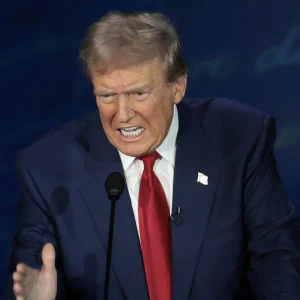
President Donald Trump has broken his own record—but not in a way his administration would welcome. New polling data suggests that Trump’s approval ratings have fallen to their lowest point yet in his second term, raising serious questions about Republican prospects as the 2026 midterm elections draw closer.
Once buoyed by strong early support following his return to the White House, Trump now finds himself facing mounting public dissatisfaction across nearly every major policy area. According to recent surveys, his overall job approval has dropped sharply from approximately 50 percent at the start of his second administration to the mid- to high-30s, marking the steepest sustained decline of his presidency to date.
Political analysts say the numbers are “eye-opening,” particularly given Trump’s historical resilience in polling and his ability to maintain loyal support even during turbulent periods.
A Steep Decline in Public Confidence
One of the most striking figures comes from recent job performance polls, which show Trump’s approval rating hovering around 36 percent. That represents a decline of roughly 14 points since he took office, a drop that mirrors — and in some cases exceeds — downturns seen during contentious moments of his first term.
While presidential approval ratings often fluctuate, the sustained downward trend has drawn attention from both parties. Polling experts note that Trump’s numbers have now fallen for several consecutive months, a pattern that typically signals deeper voter dissatisfaction rather than temporary backlash.
“This isn’t a one-off dip,” one analyst said. “It’s a broad erosion of support across multiple demographics and issue areas.”
Tariffs and Economic Anxiety
A central driver of Trump’s declining popularity appears to be economic policy—specifically, the sweeping tariffs introduced earlier this year. While the president framed the measures as necessary to protect American industries and jobs, critics argue they have instead contributed to rising consumer prices and renewed inflationary pressures.
Polling data suggests voters are increasingly concerned about the cost of living. Approval of Trump’s handling of the economy has dropped to around 36 percent, a notable reversal for a president who has long positioned himself as a strong steward of economic growth.
Economists warn that while tariffs can offer targeted benefits, their broader impact often falls on consumers and small businesses. For many Americans, those effects are now being felt at the grocery store, gas pump, and in monthly household bills.
Immigration: A Once-Strong Issue Weakens
Immigration has traditionally been one of Trump’s strongest policy areas, particularly among Republican and independent voters. However, new polling indicates that even this cornerstone issue is losing traction.
Only about 36 percent of respondents now approve of Trump’s handling of immigration, according to recent surveys. Images of intensified enforcement actions and large-scale ICE raids have sparked protests in several major cities, fueling criticism from civil liberties groups and local leaders.
While Trump’s base continues to support a hardline approach, broader public opinion appears increasingly uneasy with the tone and scope of enforcement measures during his second term.
Rising Disapproval and Power Concerns
Beyond policy-specific criticism, overall disapproval of Trump’s leadership style is also on the rise. A Quinnipiac University survey found that more than half of respondents—approximately 54 percent—believe Trump has overstepped his presidential authority during his first year back in office.
Concerns about executive power, governance norms, and institutional checks have resurfaced as central themes in political discourse, particularly among independent voters.
“These findings suggest that voters are not just reacting to individual policies,” one polling analyst noted. “They’re reacting to how power is being exercised.”
Warning Signs for Republicans
The political implications of Trump’s declining approval ratings are already becoming visible. Democrats have flipped 25 state-level legislative seats over the past year, and high-profile victories—such as Zohran Mamdani’s election as mayor of New York—have energized the opposition.
While midterm elections are still months away, historical patterns suggest that a president with low approval ratings often drags down candidates from his own party. If current trends continue, Republicans could face significant losses in Congress, potentially shifting the balance of power.
Democratic strategists are already framing the midterms as a referendum on Trump’s leadership, betting that voter dissatisfaction will translate into turnout.
Trump Dismisses the Polls
Despite the unfavorable data, Trump has publicly rejected the notion that his support is eroding. Responding to recent surveys, the president took to Truth Social to declare that his poll numbers are “great,” citing alternative polling that shows him with a positive approval margin.
Critics argue that the president is selectively highlighting favorable data while dismissing broader trends. Still, Trump’s response is consistent with his long-standing approach to polling—challenging unfavorable results and promoting numbers that align with his narrative.
White House allies have echoed this stance, emphasizing Trump’s continued strength among Republican voters, rural communities, and working-class supporters.
A Divided Electorate
While Trump remains popular within key segments of the Republican base, national polling paints a picture of a deeply divided electorate. Approval remains strongest among white, male, rural voters aged 25 to 44, while opposition has grown among suburban voters, younger Americans, and independents.
On foreign policy, Trump’s handling of the Ukraine–Russia war has drawn particularly low marks, with approval hovering in the low 30s. Analysts say voters are frustrated by the lack of visible progress and uncertainty surrounding U.S. strategy.
Looking Ahead
As the midterms approach, the central question is whether Trump can reverse the downward trajectory of his approval ratings—or whether dissatisfaction will harden into electoral consequences.
Supporters argue that polling volatility is inevitable and that economic improvements or major policy wins could shift public opinion. Critics counter that the breadth of the decline suggests deeper challenges that cannot be easily reversed.
What is clear is that Trump’s second term is entering a pivotal phase. With approval ratings at record lows and political pressure mounting, the months ahead may determine not only the outcome of the midterms but the long-term direction of his presidency.
For now, the numbers tell a stark story: Donald Trump has broken his own record—and the political fallout is only beginning.

Emily Johnson is a critically acclaimed essayist and novelist known for her thought-provoking works centered on feminism, women’s rights, and modern relationships. Born and raised in Portland, Oregon, Emily grew up with a deep love of books, often spending her afternoons at her local library. She went on to study literature and gender studies at UCLA, where she became deeply involved in activism and began publishing essays in campus journals. Her debut essay collection, Voices Unbound, struck a chord with readers nationwide for its fearless exploration of gender dynamics, identity, and the challenges faced by women in contemporary society. Emily later transitioned into fiction, writing novels that balance compelling storytelling with social commentary. Her protagonists are often strong, multidimensional women navigating love, ambition, and the struggles of everyday life, making her a favorite among readers who crave authentic, relatable narratives. Critics praise her ability to merge personal intimacy with universal themes. Off the page, Emily is an advocate for women in publishing, leading workshops that encourage young female writers to embrace their voices. She lives in Seattle with her partner and two rescue cats, where she continues to write, teach, and inspire a new generation of storytellers.