



Eleanor Mitchell had spent forty-one years learning the precise distance between what Richard said and what he meant, so when he held her hand in that hospital room and told her to do what was right rather than what was easy, she understood he was not offering comfort. He was issuing instruction. He was doing what he had always done, which was to see the problem clearly and address it directly, even when the problem was their son and the addressing of it would cost everyone in the room something real.
She did not cry until she was in the parking garage afterward, alone in the car with the engine running, and even then she cried with the controlled economy of a woman who had learned that grief, like most things, was best handled in private and in portions.
Richard had been ill for fourteen months. The company had continued running because Richard had built it to run, because the people he had hired over four decades were competent and loyal and understood the work in a way that did not depend on his physical presence in the building. Mitchell Shipping had started as a single dock lease in Baltimore, a younger Richard with a borrowed truck and a handshake agreement and the specific stubbornness of someone who has decided that failure is not one of the available outcomes. By the time the illness came, it employed several thousand people across eleven states, and Richard knew most of them by name, not as a performance of approachability but because he had always believed that the people doing the work were the work, that the spreadsheets and the projections were only useful insofar as they described real human effort.
Thomas had been given every opportunity to understand this.
Eleanor watched it not take hold over the course of thirty years, which is a long time to watch something not take hold, long enough that you develop a complex relationship with the watching. She had loved Thomas with the complete and sometimes irrational love of a mother, and she had also known, in the private accounting she kept behind the love, that he had grown into someone she did not entirely recognize as her own making. He had taken everything Richard and she gave him, the education and the introduction and the position and the patience, and metabolized it into a quality of entitlement so smooth and so complete that it had become invisible to him. He did not experience himself as entitled. He experienced himself as deserving, which is entitlement with better posture.
His wife Victoria understood money the way certain people understand light, as something that illuminated whatever she chose to stand near, as an environment rather than a resource. She was beautiful in the particular way of people who have always been treated as beautiful and have organized their entire selfhood around the fact of it. Eleanor had never disliked Victoria, exactly. She had recognized her, the way you recognize a weather pattern, and understood what the pattern meant.
The call came on a Thursday morning, Richard’s third week of final decline. Thomas was in Aspen. His wife’s birthday, he explained to Eleanor over the phone, something they had planned for months, deposits and arrangements, people coming from considerable distances, impossible to cancel at this stage. He said he would come as soon as he could get away. His voice had the quality it always had when he was asking for accommodation he had already decided he deserved, which was warm and slightly hurried, projecting the assumption of agreement.
Eleanor told him to come now.
He said he would come as soon as he could get away.
She understood then, the way she understood some things, not all at once but in a wave, that the conversation she was in was not the conversation she had believed she was in. She had thought she was communicating urgency. He had heard her communicating a preference, and he was weighing her preference against his wife’s birthday party, and the birthday party was winning.
Richard died on a Sunday evening with Eleanor beside him and Thomas in Aspen, photographed at a dinner that his wife later posted to social media with a caption about celebrating the people you love. The photograph was taken at approximately the time the monitor in Richard’s hospital room completed its long tone.
Eleanor sat with her husband’s hand in hers for some time after the nurses came and she answered the questions they needed answered and she made the calls that needed to be made. She called Charlotte, their daughter, who lived in Portland and who arrived at the hospital within four hours, who sat beside Eleanor in the waiting area with her head on her mother’s shoulder and said nothing for a long time, which was the right thing to do and which Charlotte had always known how to do and which Thomas had never learned.
She did not call Thomas again. He would find out when he found out.
The funeral was held on a gray November afternoon with rain coming in cold, level sheets that required umbrellas and made everyone’s faces difficult to read. Several hundred people came. Dock workers and executives and drivers and the families of people Richard had helped over decades, people whose children’s educations had been funded quietly, whose medical emergencies had been resolved through a phone call Richard made without mentioning it afterward. The man had accumulated loyalty the way other men accumulated money, through consistent investment over time, and the return on that investment was visible in the parking lot, in the overflow crowd standing beyond the canopy in the rain because there was not enough covered space for everyone who had come.
The chair beside Eleanor was empty.
She had reserved it for Thomas. She had believed, even that morning, that he would arrive. She had told herself a story about his car and the traffic and the flight and the way people sometimes moved slower than you needed them to, and she had held the story with the practiced grip of a woman who had been holding similar stories for thirty years.
He did not come.
At some point during the service, which Eleanor attended with her spine straight and her face composed and her hand holding Charlotte’s with a grip that communicated what she could not say aloud, she stopped holding the story. She set it down gently, the way you set down something you have been carrying for a long time and have finally admitted you cannot carry anymore. She set it down, and in the space where it had been, she felt something clarify that had been blurred for years.
Tell the pastor to begin, she said.
Her voice was steady.
The attorney’s name was Walter Hensley, and he had handled Richard’s affairs for twenty years. He was a precise, unhurried man who understood that his job in situations like the one he was in required him to deliver difficult information with clarity and without editorial comment, and he was good at his job. He read the will in a conference room at his office the following morning, with Eleanor and Charlotte and Thomas and Thomas’s lawyer on one side and Walter on the other.
Thomas had arrived in a suit that communicated his understanding of the occasion, which was that he was about to receive something very large and that the appropriate response to receiving something very large was to present yourself as equal to the occasion. He looked the way he always looked in professional settings, which was composed and slightly remote and certain of the outcome before it was announced.
Walter read the relevant clause.
The inheritance was contingent. It depended on Eleanor’s assessment of Thomas’s character and conduct, a clause that Richard had included and that his attorney had counseled him against and that Richard had retained anyway because Richard, when he had decided something, was very difficult to move. If Eleanor judged the conduct unworthy, the assets would be redirected according to a specific alternative distribution. Thirty percent to the Mitchell Foundation, thirty percent to the employee pension fund, thirty percent to Charlotte, ten percent to Eleanor, and to Thomas, his father’s original office furniture, which had been a card table that Richard used in the back of the dock office in Baltimore in 1974, and a selection of books on ethics and organizational leadership.
Thomas asked what that meant.
Walter said it meant precisely what it said, and asked Eleanor whether she wished to invoke the clause.
The room was very quiet. Eleanor looked at her son, and she took the time to look at him fully, not with the soft lens of maternal love through which she had been viewing him for thirty years, but with the clearer vision that had been coming into focus since the empty chair at the funeral. She saw a man in an expensive suit who had chosen a birthday party over his father’s burial and who was sitting in this room now with the body language of someone who expected to be given a very large thing.
She said yes. She invoked the clause.
Thomas’s composure broke for a moment, briefly and visibly, before it reassembled itself into something harder. He looked at his mother the way people look when they are deciding whether the person in front of them is rational. He looked at Charlotte, who was looking at the table. He looked at Walter, who was looking at the papers in front of him.
He called his own attorney that afternoon.
The lawsuit was filed within the week.
The grounds were what Eleanor had expected them to be: undue influence, grief-induced instability, manipulation of a dying man’s wishes, a characterization of Eleanor as someone who had used her position at Richard’s bedside to insert a punitive clause that did not represent his genuine intentions. Thomas gave interviews. His lawyer was skilled at selecting the framing that would generate the most sympathetic coverage, which was considerable. A son disinherited because he missed a funeral. A grief-stricken mother making permanent decisions in temporary pain. A family destroyed by one woman’s bitterness.
Eleanor did not give interviews.
She had Walter release a single statement noting that the will had been drafted eighteen months prior to Richard’s death, that it had been reviewed and updated several times in that interval, and that Richard had been of entirely sound mind throughout and had expressed his wishes with great deliberateness. The statement did not address Thomas by name.
What the lawsuit did not anticipate was the scope of what Richard had prepared.
He had recorded himself three times in the eighteen months between the will’s drafting and his death. The recordings were kept with Walter. In the first, made at home in his study on a Sunday afternoon, Richard explained in his own voice why he had written the clause and what it was intended to accomplish. His voice was calm and clear and slightly tired, the way voices sound when someone is carrying an illness but has not yet been fully diminished by it.
He said: this is not about the day of my funeral. One day does not make a character. What one day reveals is what character has already been built or failed to be built, and I have watched my son fail to build the things that matter for longer than I was willing to admit out loud. He said: I gave him everything except the consequences that teach a person who they actually are. I gave him money when he needed difficulty. I gave him position when he needed to earn it. I gave him my defense when I should have let him face the results of his own decisions. He said: the people who work for this company have families and mortgages and medical bills and futures that depend on this company being led by someone who understands that a business is a responsibility before it is an asset.
He said: I love my son. What I am doing, I am doing because I love him.
Thomas watched the recordings in Walter’s office, with his lawyer present, and Eleanor watched Thomas watch them. She watched his face move through the recognition that the lawsuit had no foundation to stand on, that his father had been meticulous and deliberate and entirely sane, that the person who had anticipated this exact challenge and prepared for it was the same person Thomas had called easily manipulated and in declining mental capacity.
The lawsuit was dropped before it reached the discovery phase.
Victoria left the same week.
Eleanor heard this from Charlotte, who heard it from Thomas, who called Charlotte at eleven o’clock on a Tuesday night in December, which was itself unusual enough to signal that something had fundamentally changed in his relationship to the ordinary management of his emotions. Victoria had left with efficiency and without particular drama, which was characteristic of her. She had identified the situation accurately, which was that the financial foundation of the marriage had been removed, and she had made her decision accordingly. She was not villainous in this. She was honest in a way she had perhaps not been during the marriage, honest in the way that people are honest when there is no longer anything to be gained by the performance of feeling something other than what they feel.
Thomas came to Eleanor on a morning in January.
He did not call ahead. He arrived at the house in the clothes he had apparently slept in, without the particular grooming that had always been part of his presentation of himself to the world. Eleanor opened the door and looked at him for a moment, taking in the absence of the armor, and then she stepped back and let him in.
They sat in the kitchen because Eleanor spent most of her mornings in the kitchen and because the kitchen was the room in the house that was least shaped by the idea of impression, where things were simply what they were. She made coffee. He sat at the table and looked at his hands.
He said Victoria was gone.
She said she knew.
He said she had been right, which was a sentence that cost him something visible in the saying of it. He said Victoria had not loved him but had loved what he had, and that he had known this on some level for a long time and had preferred not to know it consciously because knowing it consciously would have required him to examine why he had chosen someone who loved his money over someone who loved him, and that examination would have led somewhere he was not yet ready to go.
He placed something on the table. It was a notebook, old and soft-covered, the leather worn at the corners. Eleanor recognized it immediately. She had seen Richard write in it for years, had teased him about it, had understood without being told that it was private in a way that the rest of his life was not.
Inside, written in Richard’s careful handwriting, were not financial projections or company strategy but something quieter. He had written what he wished for Thomas. He had written the wishes with the same precision he brought to everything, specifically and honestly, without the protective softening that love sometimes requires you to apply in person but that you can remove when you are writing alone and no one will read it until you are gone.
He wished Thomas would find purpose that did not come from wealth, because he had watched his son organize his entire sense of self around financial power and had understood that this was a fragile architecture, a building with no foundation, which would fall the moment the external support was removed. He wished Thomas would learn to earn the respect of the people he worked with rather than assuming it as a function of his position, because respect assumed is not respect but compliance, and compliance looked like loyalty right up until the moment it didn’t. He wished Thomas would value Charlotte before she stopped waiting for him, because Richard had watched his daughter extend patience toward her brother for years, and Richard knew the limits of patience better than Thomas did. He wished Thomas would understand that people were not instruments. He had written this simply and without elaboration, trusting that the simplicity of it was itself the point.
Thomas read in silence. Eleanor watched him read and watched the silence change quality as he moved through the pages, from the silence of someone receiving information to the silence of someone being reached by it. She watched something in his face that she had not seen before, which was the expression of a person whose defenses have finally been bypassed not by an argument but by grief, specifically by the grief of understanding that the person who knew you best also saw you clearly and loved you anyway and wanted something different for you than what you had made.
He said, quietly, that he had not known his father.
She said he had. He just hadn’t listened.
The months that followed were not dramatic. Transformation rarely is, from the inside. It is mostly the slow replacement of one habit with another, the daily practice of a different response, the accumulation of small choices that compound across time into something that eventually resembles a person.
Thomas withdrew the lawsuit. He apologized to Eleanor, not as a negotiation or a request for restoration, but because he owed it to her and he had finally arrived at the understanding that debts of that kind need to be acknowledged even when you cannot repay them. He apologized to Charlotte in a phone call that lasted an hour and a half, during which he mostly listened, which was something he had not been good at and which required him to resist the instinct to explain himself and instead to simply receive what she was telling him about what his absence had meant and what it had cost her.
He resigned his title at the company, which he had retained nominally through the transition. He asked Walter if there was a way he could contribute to the foundation, not in a leadership capacity but in whatever capacity was actually useful. Walter called the foundation’s director, a woman named Sonia who had worked with Richard for a decade and who had her own opinions about Thomas that she held with the straightforwardness of someone who had nothing to prove to anyone. She told Thomas to come in on Monday morning and to wear clothes he was comfortable working in because they were doing a supply delivery to three community centers.
He came in on Monday morning.
He did the supply delivery.
He came in on Tuesday.
He learned the names of the people he was working with, which was harder than it sounds because he had spent most of his professional life moving through rooms full of people whose names he had not bothered to learn. He visited schools where the foundation funded programs and sat in on the programs and watched teachers work with the focused efficiency of people doing difficult work for limited resources, and he understood something about the relationship between effort and outcome that his own education had not equipped him to understand.
A dockworker named Gerald, who had worked for Mitchell Shipping since before Thomas could drive, told him once, directly and without cruelty, that his father had known every man on the dock by name and that Thomas had referred to the same men as labor units in a strategy presentation six years earlier. Thomas did not argue or explain or redirect the conversation. He said he was sorry and he meant it in the specific, unprotected way of someone who has removed the armor and discovered that existing without it is uncomfortable but survivable.
His relationship with Charlotte rebuilt itself slowly and without ceremony, which was how Charlotte preferred things. She did not perform forgiveness or make declarations about second chances. She called him more often. She invited him to dinner when she was visiting their mother. She introduced him to her partner, Marcus, which was itself a kind of trust, and Thomas understood it as such and treated Marcus with the attention and courtesy of someone who knows they are on probation and is committed to earning rather than assuming.
There were bad weeks. There were weeks when the discipline of becoming a different person felt like too much to maintain and Thomas retreated briefly into the old posture, the old expectations, the old sense of himself as someone to whom things should be given. He recognized these retreats more quickly as time went on, which was the progress, not the absence of the retreats but the shortening of them, the quicker recognition and the quicker return.
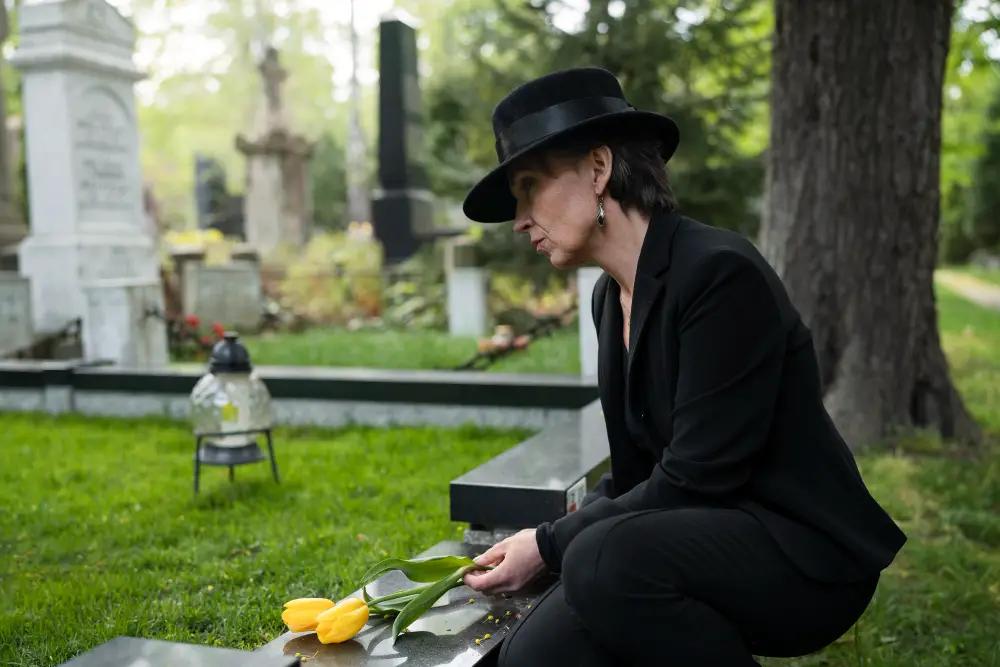
One year after the funeral, Eleanor drove to the cemetery on a November morning that was cold and clear, nothing like the gray rain of the burial. Thomas and Charlotte met her there. They stood at the headstone in the specific silence of people who have agreed not to pretend that the occasion is less heavy than it is.
Thomas said he had missed the burial. He said he did not know how to live with that.
Eleanor said the way to live with it was to become someone who would not make that choice again, not to undo the choice, which could not be undone, but to let it be the last of its kind.
He nodded. He looked at the headstone for a long time.
Charlotte took his hand, which was small and unmistakable and which Eleanor saw and thought: there it is. Not forgiveness as a statement but as a gesture, the kind that costs something and means something because it costs something.
The foundation center that opened in Richard’s name three years after his death was not large. It occupied a renovated warehouse near the Baltimore waterfront, close to the original dock lease where everything had started. It served students who needed tutoring, families who needed resources, workers who needed support between jobs. It was the kind of institution that does not attract much attention because it is not designed to attract attention but to be useful, which had been Richard’s approach to most things he built.
Thomas stood at the opening not at the podium in the center of the room, where the cameras were pointed, but at the side, in the position of someone who is present without being the subject. He had been asked to say a few words. He said them simply, without the polish he had once deployed automatically in professional settings. He said his father had not left him money but had left him responsibility, and that he had spent three years learning the difference between inheriting a responsibility and earning the right to carry it. He said the foundation was not a monument to his father’s wealth but an expression of what his father had actually valued, which was the people who did the work and the communities those people came from.
Eleanor stood in the front of the room and watched her son speak. She held her hand over her heart not as a gesture but because something in her chest required the pressure, the steadiness of her own hand against the particular emotion of watching a person arrive at themselves after a long journey in the wrong direction.
She had not saved Thomas by invoking the clause. She had not fixed him. You cannot save people or fix them, which was a lesson she had learned too slowly but had learned completely. What she had done was stop preventing the consequences that were the only real teachers available to him. She had withdrawn the protection that had kept him from the information his life was trying to deliver, and she had let him receive it.
Richard had understood this before she did. He had built it into the document and recorded himself explaining it so that it could not be mischaracterized after he was gone. He had seen what she had struggled to see, which was that the love that rescues someone from their own choices is not the same as the love that trusts them to survive those choices and grow past them. He had understood that what Thomas needed was not more provision but more consequence, not a larger inheritance but the loss of one.
She had thought, at first, that invoking the clause was an act of severity. She had done it because Richard asked her to, because she had promised to do what was right rather than what was easy. She had not been certain, in that conference room with Walter reading and Thomas listening, that she was not destroying her son. She had been afraid of that. She had done it anyway.
What she understood now, watching Thomas at the podium, was that severity and love are not opposites. That the truest love she had ever offered her son was the moment she had stopped making it easy for him to be less than he was capable of being. That the inheritance Richard had left Thomas was not the card table or the ethics books, though both were sincere, but the loss itself, which was the specific and necessary experience of having nothing to hide behind, of being finally, fully, inescapably accountable to his own life.
After the ceremony, the three of them walked to the waterfront. The harbor was gray and cold and the cranes at the far docks moved in their slow mechanical rhythms. Eleanor had walked this waterfront with Richard dozens of times over the years, in every season, in conversations that covered everything and sometimes said nothing at all. She had held his hand on these walks and he had squeezed hers sometimes for no reason except that she was there and he was glad.
She walked now between her children, Thomas on her left and Charlotte on her right, and the harbor moved and the cranes moved and the city made its constant noise behind them.
Thomas said, after a while, that he was thinking about the dockworker, Gerald, who had told him about the labor units. He said he thought about that conversation a lot. He said he had gone back and looked at the presentation where he had used that phrase and had tried to understand how he had been so completely unable to see the people his words were describing.
Charlotte said she thought it was because he had never needed them to be people. He had only needed them to be a function.
Thomas said yes. That was exactly it.
Eleanor said nothing. She walked between her children and listened to them talk with the specific quality of attention she had always brought to moments she knew she would want to remember, and the harbor was gray and cold and entirely itself, and the afternoon was enough.
A legacy is not what you leave for people to spend, Richard had said. It is what you leave for them to become. He had meant Thomas when he said it, she thought. He had also meant Charlotte, who had become someone who extended her hand at the right moment. He had also meant Eleanor herself, who had learned what she was capable of withstanding and what kind of love had always been available to her if she stopped confusing it with rescue.
He had meant all of them.
He had meant, perhaps, that the whole enterprise of building something and passing it on was not about the thing you built but about what the building and the passing taught the people you loved about who they were and what they were for.
The cranes moved.
The harbor was gray.
Eleanor walked between her children and felt the cold air on her face and thought: yes. This. This is what was meant.

Emily Johnson is a critically acclaimed essayist and novelist known for her thought-provoking works centered on feminism, women’s rights, and modern relationships. Born and raised in Portland, Oregon, Emily grew up with a deep love of books, often spending her afternoons at her local library. She went on to study literature and gender studies at UCLA, where she became deeply involved in activism and began publishing essays in campus journals. Her debut essay collection, Voices Unbound, struck a chord with readers nationwide for its fearless exploration of gender dynamics, identity, and the challenges faced by women in contemporary society. Emily later transitioned into fiction, writing novels that balance compelling storytelling with social commentary. Her protagonists are often strong, multidimensional women navigating love, ambition, and the struggles of everyday life, making her a favorite among readers who crave authentic, relatable narratives. Critics praise her ability to merge personal intimacy with universal themes. Off the page, Emily is an advocate for women in publishing, leading workshops that encourage young female writers to embrace their voices. She lives in Seattle with her partner and two rescue cats, where she continues to write, teach, and inspire a new generation of storytellers.