Elon Musk’s estranged daughter has publicly weighed in following the release of the latest batch of Jeffrey Epstein documents, offering corroboration on some of the material and providing her perspective on the highly scrutinized correspondence involving her father.
Vivian Wilson, 21, the eldest child of Elon Musk and his first wife, Justine Wilson, has had a strained relationship with her father since publicly coming out as transgender in 2020. Over the years, she has become outspoken on social media about her experiences and about her criticisms of her father’s behavior. In the wake of the most recent disclosure of Epstein-related materials, she took to Threads to share her perspective and confirm certain aspects of the documents that had generated significant media attention.
The Department of Justice recently released 3.5 million documents as part of an ongoing effort to provide transparency around Epstein’s activities. These releases, mandated by a congressional transparency law passed the previous year, include a trove of communications, financial records, and internal notes from Epstein and his associates. Among the materials were private emails between Musk and Epstein, including discussions about a potential visit to Little St. James, the U.S. Virgin Islands property commonly referred to as Epstein Island.
The emails indicate that Musk reached out to Epstein in December 2013, noting that his family would be in the British Virgin Islands and St. Barts during the holidays. In his message, Musk asked Epstein if there was a convenient time to visit. Epstein responded, proposing early January 2014 and stating, “Any day [January] 1st-8th. Play it by ear if you want. Always space for you.” Musk appeared to settle on January 1, with Epstein suggesting January 2 or 3 would be ideal and offering to personally escort him.
Despite the correspondence, the visit ultimately did not occur. Epstein’s assistant, Lesley Groff, sent a reminder on New Year’s Eve regarding Musk’s inquiry, and Epstein followed up on January 1, proposing an alternative meeting in St. Thomas. Musk declined, citing logistical issues. Later information from Epstein’s daily agenda, released in 2025 by Democrats on the House Oversight Committee, suggested Musk was scheduled to visit the island again in December 2014, but this visit, too, did not happen.
A source close to Musk told the New York Post that he “never went” to Epstein’s island and maintained “no social relationship whatsoever” with Epstein. Musk himself addressed the situation on X (formerly Twitter), acknowledging that while he had some correspondence with Epstein, he declined repeated invitations to visit Epstein’s properties or fly on the infamous “Lolita Express.” Musk emphasized that although his emails could potentially be misinterpreted, he had “very little correspondence with Epstein” and “no social relationship” with him.
“I don’t care about that, but what I do care about is that we at least attempt to prosecute those who committed serious crimes with Epstein, especially regarding heinous exploitation of underage girls,” Musk wrote. His statement underlined a long-standing effort on his part to distinguish himself from any alleged wrongdoing and to focus public attention on accountability for Epstein’s criminal network.
Vivian Wilson, meanwhile, provided her own perspective on Threads. She began by recounting personal memories associated with the locations mentioned in the emails, referencing a childhood boat ride from St. Vincent to St. Barts around the holiday season. “I remember the sea being so dark at night,” she wrote, evoking the family experiences that coincided with the dates referenced in the correspondence.
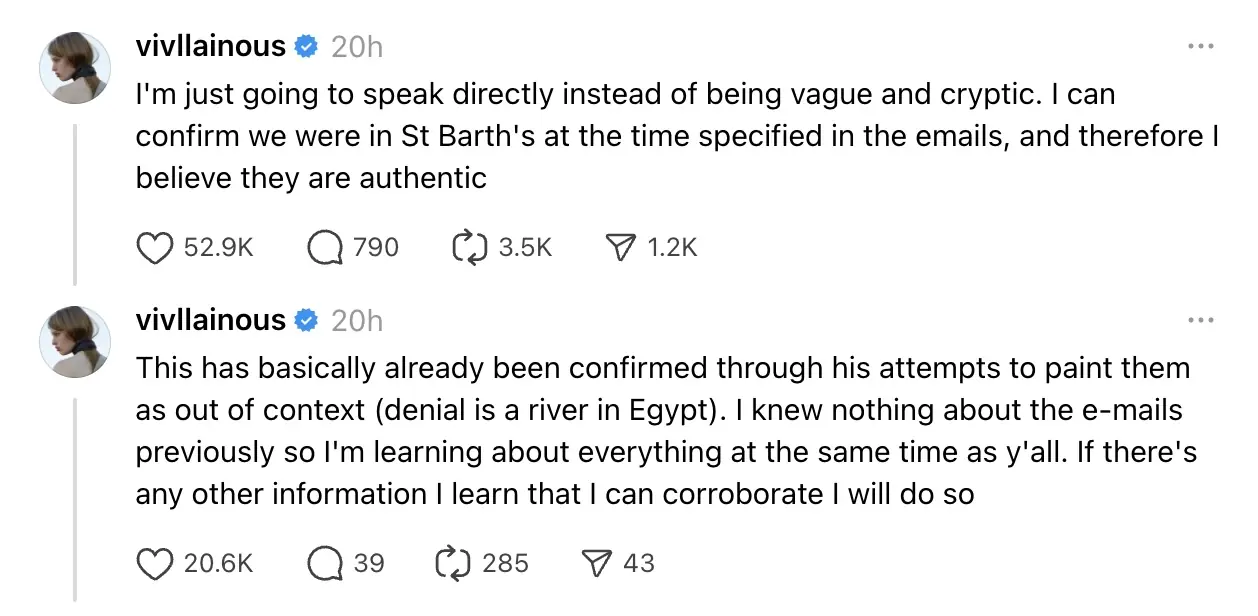
Later, she elaborated, stating: “I’m just going to speak directly instead of being vague and cryptic. I can confirm we were in St. Barth’s at the time specified in the emails, and therefore I believe they are authentic.” She clarified that while she had not previously known about the emails, she was learning about them alongside the public. Her statement reinforced the authenticity of the materials and corroborated the travel details mentioned in the documents without suggesting any wrongdoing by Musk.
Wilson concluded her posts with a candid expression of disbelief at the situation, writing, “Literally what the f**k is my life lol.” Her comments underscored the unusual position she found herself in — navigating public attention and family history while commenting on a major legal and media event.
Although Musk’s emails have drawn attention due to the notorious context of Epstein’s activities, there is no indication in the documents of any illegal behavior on his part. The correspondence largely concerns logistical arrangements and holiday travel, and sources close to Musk have reiterated that he never visited Epstein’s private island or participated in any of Epstein’s criminal activities.
The ongoing release of the Epstein files has drawn scrutiny toward numerous public figures who had varying levels of contact with Epstein over the years. The 3.5 million documents include financial records, flight logs, and personal communications, creating a detailed picture of Epstein’s network and activities. While many of the emails highlight attempts to establish social connections, the documents do not necessarily indicate participation in criminal behavior.
Musk’s daughter’s statement adds an additional layer of transparency, offering direct familial verification of details contained in the emails. Her confirmation of travel locations and her belief in the authenticity of the correspondence help clarify the record and counter speculation that the documents might be misleading or taken out of context. By speaking publicly, she has contributed to the broader understanding of the timeline and interactions referenced in the latest Epstein disclosures.
Experts in digital and media verification note that corroborating testimony from credible sources, such as family members, can provide significant context when assessing complex document dumps like the Epstein files. While such statements do not absolve anyone of potential scrutiny, they are instrumental in distinguishing between logistical correspondence and any implication of illegal activity.
The release of the Epstein files and the subsequent reactions from those mentioned underscore the continuing impact of the scandal on high-profile figures. Musk’s measured response, emphasizing a lack of wrongdoing and a focus on pursuing justice against actual perpetrators, reflects an ongoing effort to navigate public perception while cooperating with transparency initiatives. Meanwhile, Vivian Wilson’s candid posts illustrate the personal and familial dimensions of the situation, revealing the challenges faced by individuals connected to the public figures named in the documents.
As the public and the media continue to analyze the Epstein files, Musk’s communications and his daughter’s corroboration provide a case study in the interpretation of high-profile correspondence. The situation also highlights the importance of context, timing, and corroborative testimony when evaluating allegations or insinuations arising from large-scale document releases.
For Elon Musk, the combination of his own clarifying statements and his daughter’s public confirmation helps to establish a factual baseline that separates social or professional contact from any implication of criminal involvement. Meanwhile, the broader Epstein investigations continue to shed light on the far-reaching network of individuals who interacted with the disgraced financier, emphasizing the need for careful analysis before conclusions are drawn.
In conclusion, the latest release of the Epstein files has reignited public attention on Elon Musk due to emails suggesting potential interactions with Epstein. However, Musk’s own clarifications, supported by corroboration from his daughter Vivian Wilson, make it clear that no visit to Epstein Island occurred, and that the correspondence largely reflected logistical arrangements rather than participation in criminal conduct. The statements provide both factual context and a personal perspective, illustrating the complexities of interpreting high-profile document releases while maintaining accountability for those who committed actual crimes.

Emily Johnson is a critically acclaimed essayist and novelist known for her thought-provoking works centered on feminism, women’s rights, and modern relationships. Born and raised in Portland, Oregon, Emily grew up with a deep love of books, often spending her afternoons at her local library. She went on to study literature and gender studies at UCLA, where she became deeply involved in activism and began publishing essays in campus journals. Her debut essay collection, Voices Unbound, struck a chord with readers nationwide for its fearless exploration of gender dynamics, identity, and the challenges faced by women in contemporary society. Emily later transitioned into fiction, writing novels that balance compelling storytelling with social commentary. Her protagonists are often strong, multidimensional women navigating love, ambition, and the struggles of everyday life, making her a favorite among readers who crave authentic, relatable narratives. Critics praise her ability to merge personal intimacy with universal themes. Off the page, Emily is an advocate for women in publishing, leading workshops that encourage young female writers to embrace their voices. She lives in Seattle with her partner and two rescue cats, where she continues to write, teach, and inspire a new generation of storytellers.