



The National Basketball Association has issued one of its most significant disciplinary actions of the season, suspending a veteran superstar for a substantial portion of the schedule after determining that he violated the league’s anti-drug policy. The decision, which carries both competitive and financial consequences, has sent ripples through the league, raising questions about player health, accountability, and the complex intersection between mental health treatment and professional sports regulations.
The suspension spans 25 games and is being enforced without pay, immediately sidelining one of the league’s most recognizable and highly compensated players. For his team, the absence represents a major setback during a critical stretch of the season. For the league, the case underscores the NBA’s strict adherence to collectively bargained rules governing substance use, even when violations occur under complicated personal circumstances.
League officials have declined to disclose the specific substance or medication involved, stating only that the player was found to have violated the terms of the NBA/NBPA Anti-Drug Program. That lack of detail has fueled speculation, though both the team and the player have emphasized that the issue did not involve recreational drug use in the conventional sense.
Immediate Impact on the Team and Season
The suspension takes effect immediately, forcing the player to miss a large segment of the regular season and reshaping his team’s short-term plans. Coaches must now adjust rotations, redistribute scoring responsibilities, and rely more heavily on younger or less experienced players to fill the void left by a cornerstone of the roster.
From a financial perspective, the penalty is equally significant. With a salary that places him among the league’s highest earners, a 25-game suspension without pay translates into tens of millions of dollars forfeited. For a player in the latter stages of his career, the loss is notable not only in monetary terms but also in missed opportunities to contribute on the court and shape his legacy.
Despite the severity of the punishment, the league’s action aligns with precedent. The NBA’s anti-drug policy, negotiated with the players’ union, mandates automatic suspensions for violations, regardless of intent. The policy is designed to ensure consistency, transparency, and fairness, even in cases where mitigating circumstances may exist.
A Statement of Responsibility
In a public statement released shortly after the suspension was announced, the player acknowledged the violation and accepted responsibility. He described the incident as a “mistake” made while seeking treatment for a personal mental health issue, emphasizing that his actions were not intended to gain a competitive advantage.
He explained that, in the course of addressing his mental health, he took a medication that was not properly cleared under league rules. While he did not specify the medication or the nature of his condition, he stressed that his decision stemmed from a desire to improve his well-being rather than disregard league policy.
The statement struck a tone of accountability and contrition. He apologized to his organization, teammates, and fans, acknowledging the disappointment and disruption caused by his absence. At the same time, he framed the suspension as an opportunity to focus on his physical and mental health, with the goal of returning in better condition once eligible to play again.
Mental Health and Professional Sports
The case has reignited discussion about how professional sports leagues handle mental health treatment within rigid regulatory frameworks. In recent years, the NBA and its players have spoken more openly about anxiety, depression, and other mental health challenges, encouraging athletes to seek help without stigma.
However, this incident highlights a potential tension between that encouragement and the practical realities of league compliance. Medications that may be legally prescribed or recommended by healthcare providers can still violate league rules if not properly approved or documented. Players are required to consult team doctors and the league before taking certain substances, even for legitimate medical reasons.
Advocates argue that the process can be confusing and that the league should continue refining its protocols to better support players navigating mental health treatment. Critics counter that the rules are clear and that professional athletes, with access to extensive medical and legal resources, bear responsibility for ensuring compliance.
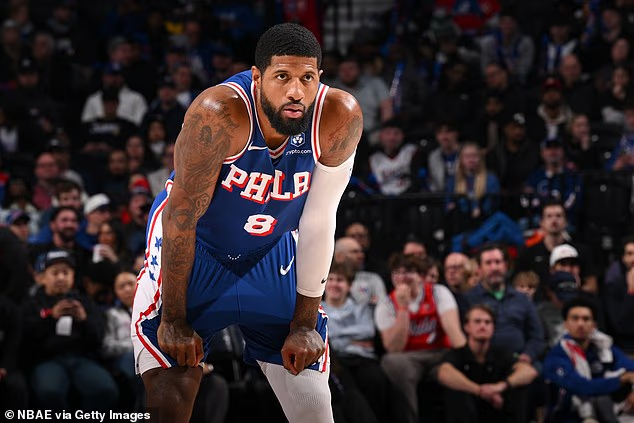
The athlete is Paul George, a nine-time NBA All-Star and one of the most accomplished two-way players of his generation. At 35 years old, George remains a central figure for the Philadelphia 76ers, a team with championship aspirations and a roster built to compete at the highest level.
George joined Philadelphia after signing a four-year, fully guaranteed contract worth more than $211 million, a deal that underscored both his on-court value and his stature within the league. Known for his smooth scoring ability, defensive versatility, and leadership, George has been a key component of his team’s identity since his arrival.
His suspension therefore carries weight far beyond a routine disciplinary matter. It affects playoff positioning, locker-room dynamics, and long-term planning for a franchise that invested heavily in his presence.
A Career Marked by Excellence and Resilience
George entered the NBA as a high lottery pick and quickly established himself as a rising star. Over the years, he built a reputation as one of the league’s premier wing players, capable of impacting games on both ends of the floor. His career includes multiple deep playoff runs, individual accolades, and memorable performances on some of the sport’s biggest stages.
He has also faced adversity, including significant injuries that threatened to derail his career. Each time, he returned with renewed determination, earning respect for his resilience and professionalism. That history makes the current suspension particularly jarring for fans and observers accustomed to viewing George as a model of consistency and dedication.
Those close to the situation have emphasized that the violation does not reflect a pattern of behavior, but rather an isolated lapse in judgment during a period of personal vulnerability. Even so, the league’s disciplinary process leaves little room for discretion once a violation is confirmed.
The League’s Position
The NBA has maintained a measured tone in addressing the suspension, reiterating its commitment to upholding the collectively bargained anti-drug program. League officials have stressed that the policy exists to protect the integrity of the game and the health of its players, and that enforcement must be even-handed to maintain credibility.
At the same time, the league has continued to promote mental health resources and support systems for players, encouraging them to seek help through approved channels. The George case may prompt further internal discussions about how those systems can be made clearer and more accessible, particularly for veterans managing the pressures of long careers.
The players’ union has not publicly challenged the suspension, suggesting that the process followed established guidelines. That silence reflects the union’s role in negotiating the very rules that now govern the outcome.
What Comes Next
For Paul George, the path forward is both clear and challenging. He will serve the suspension, forgo a significant portion of his salary, and work toward reinstatement once the penalty is complete. In the meantime, he has pledged to focus on his health and preparation, aiming to return ready to contribute at a high level.
For the 76ers, the task is to navigate the season without one of their leaders, balancing competitiveness with patience. For the NBA as a whole, the incident serves as a reminder that even well-intentioned actions can carry serious consequences in a tightly regulated professional environment.
Ultimately, the suspension underscores a broader reality of modern sports: the growing emphasis on mental health must coexist with strict rules designed to ensure fairness and integrity. Finding the right balance remains an ongoing challenge, one that cases like this bring sharply into focus.

Emily Johnson is a critically acclaimed essayist and novelist known for her thought-provoking works centered on feminism, women’s rights, and modern relationships. Born and raised in Portland, Oregon, Emily grew up with a deep love of books, often spending her afternoons at her local library. She went on to study literature and gender studies at UCLA, where she became deeply involved in activism and began publishing essays in campus journals. Her debut essay collection, Voices Unbound, struck a chord with readers nationwide for its fearless exploration of gender dynamics, identity, and the challenges faced by women in contemporary society. Emily later transitioned into fiction, writing novels that balance compelling storytelling with social commentary. Her protagonists are often strong, multidimensional women navigating love, ambition, and the struggles of everyday life, making her a favorite among readers who crave authentic, relatable narratives. Critics praise her ability to merge personal intimacy with universal themes. Off the page, Emily is an advocate for women in publishing, leading workshops that encourage young female writers to embrace their voices. She lives in Seattle with her partner and two rescue cats, where she continues to write, teach, and inspire a new generation of storytellers.