

House Minority Leader Hakeem Jeffries is facing criticism for refusing to characterize the recent violent events in Los Angeles as “riots,” instead referring to them more mildly as “unrest” during a press interaction on Monday.
When asked by a reporter from the Daily Caller News Foundation how he would vote on a Republican-sponsored resolution condemning the violence, Jeffries responded, “Obviously I disagree with the classification of the notion that there were riots in Los Angeles—certainly there was unrest.”
He also deflected the question by criticizing Republicans: “We will not be lectured by extreme MAGA Republicans about questions of law and order. Are you kidding me?”
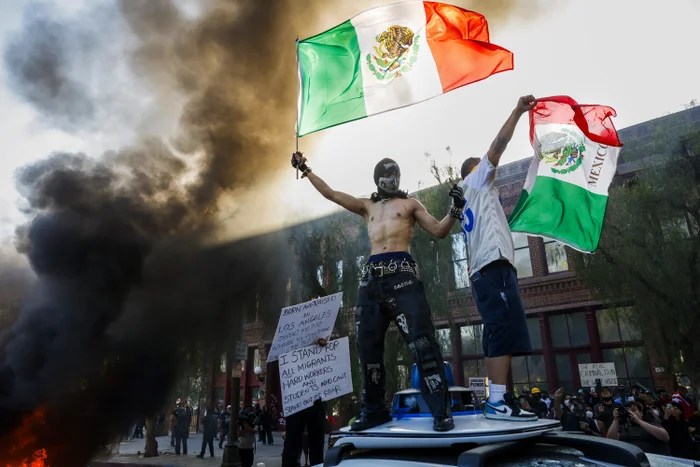
The protests erupted in response to recent immigration enforcement actions and quickly escalated into violent clashes between demonstrators and law enforcement. Protesters reportedly used commercial-grade fireworks, assaulted federal agents, and caused widespread property destruction.
The aftermath has left parts of Los Angeles grappling with the financial toll. City officials report that the unrest has led to millions of dollars in property damage and emergency response costs.
Republican lawmakers have introduced a resolution in the House condemning the violence and showing support for law enforcement officers who responded to the disturbances. The resolution, introduced by Rep. Young Kim (R-CA) and backed by other California Republicans, accuses Democrats of downplaying the severity of the events for political reasons.
Kim emphasized that the actions in Los Angeles went far beyond peaceful protest. “These weren’t isolated incidents of dissent,” she said. “They were coordinated attacks on law enforcement and private property, and they deserve to be called what they were.”
Despite growing concern and video evidence of aggressive confrontations between protesters and federal agents, Jeffries has so far declined to take a clear stance on the resolution or acknowledge the events as riots.
The debate comes amid rising national tensions over how to handle large-scale demonstrations that cross into violence. Democrats and Republicans continue to clash over terminology, tactics, and the role of law enforcement in managing protest activity.
Former DHS official Chad Wolf weighed in, saying, “Refusing to call these events what they clearly were sends the wrong message—not just to law enforcement, but to the country.”
With video footage of the confrontations circulating widely on social media and local news, pressure is mounting on Democrats, especially those from California, to take a firm stance. As the resolution moves through Congress, how lawmakers choose to describe and respond to the unrest may reveal deep partisan divides over public safety, political protest, and accountability.
James Jenkins is a celebrated Pulitzer Prize-winning author whose work has reshaped the way readers think about social justice and human rights in America. Raised in Atlanta, Georgia, James grew up in a community that instilled in him both resilience and a strong sense of responsibility toward others. After studying political science and creative writing at Howard University, he worked as a journalist covering civil rights issues before dedicating himself fully to fiction. His novels are known for their sharp, empathetic portraits of marginalized communities and for weaving personal stories with broader political realities. Jenkins’s breakout novel, Shadows of Freedom, won national acclaim for its unflinching look at systemic inequality, while his more recent works explore themes of identity, resilience, and the fight for dignity in the face of oppression. Beyond his novels, James is an active public speaker, lecturing at universities and participating in nonprofit initiatives that support literacy and community empowerment. He believes that storytelling is a way to preserve history and inspire change. When not writing, James enjoys jazz music, mentoring young writers, and traveling with his family to explore cultures and stories around the world.