
“Walk Yourself”—My Parents Laughed and Called My Fiancé a “Nobody.” Then the Mayor Stood Up.
The first time I imagined my wedding day, I was eight years old, sitting cross-legged on my pink bedroom carpet, cutting pictures out of bridal magazines my mother had finished with. In every little collage I made, there were always the same pieces: a long white dress, my father’s arm linked with mine, my mother dabbing at the corner of her eye with a lace handkerchief as we walked down a grand aisle filled with flowers and approving smiles.
I didn’t imagine fluorescent staff room lights or stacks of ungraded papers. I didn’t imagine standing alone in a cramped bridal suite, listening to my own parents laugh at me.
Yet that is where my story really begins.
“My God, Clara, you’re actually going to do this.”
My mother’s voice sliced through the soft rustle of chiffon like a knife. I was standing in front of an old-fashioned vanity, veil pinned in my hair, hands clasped to stop them from shaking. The bridal suite was small—nothing like the palatial, chandeliered room my mother would have deemed appropriate—but it was warm, cozy, with exposed brick and a big window that looked out over the courtyard strung with fairy lights.
My bridesmaids were scattered around me in various states of readiness: Jenna, my maid of honor, was in the corner coaxing a curl to behave; Angela and Priya were fussing with their bouquets; Megan was taking a dozen photos from different angles, insisting she had to capture “the moment” for Instagram. There was laughter, perfume in the air, the faint sound of violins tuning up in the courtyard below.
And then my parents arrived and sucked all the air out of the room.
My mother stood in the doorway, clad in a pale silver dress that probably cost more than my whole wedding. Dad loomed behind her in his perfectly tailored suit, the thin line of his mouth already set in disapproval. It was almost funny: they looked like the stock photo of “proud parents at their daughter’s prestigious event,” except for their eyes.
Their eyes were cold.
Mom let her gaze flick over me, head to toe. Not in the way I’d secretly hoped—soft, sentimental, maybe even a little teary—but like she was appraising an outfit on a sale rack.
“It’s… simple,” she said finally.
I forced a little smile. “That’s kind of the point, Mom. It’s me.”
“It’s beautiful,” Jenna shot back before my mother could reply. “She looks perfect.”
Mom ignored her and stepped further into the room, Dad at her shoulder. He did a slow sweep of the space, taking in the mismatched chairs, the small bouquet of wildflowers on the table, the DIY touches I’d spent weeks working on with my friends.
“This venue is smaller than I expected,” he remarked.
“It’s perfect for us,” I said quickly. “It fits everyone we care about.”
“For you, maybe,” Mom muttered under her breath, but loud enough for everyone to hear.
The girls exchanged glances over my shoulder. I could feel Jenna’s eyes on me. I straightened my spine under their scrutiny, the lace of my dress suddenly feeling more fragile than intricate.
My name is Clara. I’m twenty-six years old. On weekdays I teach seventh graders in an underserved neighborhood school that smells like bleach and crayons and cafeteria pizza. I spend my days coaxing essays out of kids who don’t believe their voices matter, dodging spitballs, buying granola bars for the ones who pretend they’re “not hungry” when they’ve obviously skipped breakfast.
I love my job. I love my kids.
And today, I was supposed to be marrying the man who understood exactly what that meant: Daniel.
Daniel, who could calm the angriest teenager with a quiet word. Daniel, who spent his evenings running after-school programs and his weekends visiting kids in juvenile detention so they wouldn’t feel forgotten. Daniel, who had once shown up at my door with a grocery bag of food after I’d mentioned one of my students’ families didn’t have money for dinner.
He is not rich. He does not own a suit that costs more than my car. He did not go to an Ivy League school or work on the top floor of a glass skyscraper.
But he has more heart than anyone I’ve ever met.
My parents hated him on sight.
They’d always had a script for my life, one that started with the right college, continued with the right internship, the right job, the right husband. They weren’t monsters—they’d kept a roof over my head, paid for piano lessons and orthodontist appointments—but love, in our house, was measured in achievements and appearances.
My older brother Todd did exactly what they wanted. He got the business degree, married a lawyer, moved into a large house in the suburbs with a manicured lawn and a golden retriever. My parents adored him. Their faces lit up when he walked into a room.
With me, their expressions always seemed… evaluative. Like they were constantly checking a mental checklist and finding me lacking.
I still remember the day I told them I was changing my major from pre-law to education. We were at the dining table, my father hidden behind the business section of the paper, my mother scrolling on her phone.
“I want to teach,” I’d said, heart pounding. “Middle school, maybe.”
My mother actually laughed. “You’re joking.”
Dad lowered the paper just enough for me to see his raised eyebrow. “There’s no money in teaching, Clara.”
“There’s meaning,” I’d said quietly.
Mom rolled her eyes. “Meaning doesn’t pay for a decent house or college for your kids. You’re throwing away your future.”
They argued. I cried. At the end of it, I still changed my major, and they never quite forgave me. Every holiday dinner after that somehow turned into a referendum on my choices.
So when I brought Daniel home for the first time—a man with a beat-up Honda, a closet full of thrifted clothes, and a job at a youth nonprofit in one of the city’s roughest neighborhoods—I suppose I should have known how it would go.
Mom had taken one look at his calloused hands and worn shoes and mentally labeled him. Dad asked polite, sharp questions about “career trajectory” and “long-term financial plans.” Daniel, bless him, had answered honestly: he wanted to grow the nonprofit, reach more kids, create sustainable community programs. He wasn’t interested in climbing corporate ladders.
They heard: no ambition, no money.
After he left, Mom had pulled me into the kitchen.
“Clara, he seems… nice,” she said, making the word sound like an insult. “But you can’t seriously be thinking long-term with someone like that.”
“Someone like what?” I’d snapped.
“Someone who works with… delinquents,” she whispered, as if the word might stain the marble countertops. “You’ve always been soft-hearted, but this is your life. You could have had anything. A partner who matches you. A comfortable life. Not this.”
“This,” I’d said quietly, “makes me happy.”
And that had been the beginning of the quiet war.
They didn’t scream or forbid me to see him. That would have made them look unreasonable even in their own eyes. Instead they sighed and shook their heads and made snide comments when they thought I wasn’t listening. They introduced me to sons of their friends at country club charity galas, nudged me toward men whose watches cost more than my rent.
Whenever I mentioned something Daniel had done—helping a kid get a scholarship, organizing a neighborhood cleanup, speaking at a local school—my mother would find a way to twist it.
“That’s… nice,” she’d say. “But exhausting. You’ll get burned out. You’ll see.”
So when Daniel proposed, on a picnic blanket in the park with a modest ring he’d saved up for for months, I said yes with my whole heart.
And my parents did not celebrate.
They tried to talk me out of it at first.
“Just wait,” Mom pleaded one Sunday while we sat in their pristine living room, the sound of golf commentators murmuring in the background. “Give it a year or two. Maybe you’ll meet someone else. You’re still young.”
“I’m not waiting for someone else,” I said. “I’m marrying Daniel.”
Dad steepled his fingers. “We’re not saying you can’t marry him. We’re saying… don’t rush. Marriage is a serious commitment.”
“I know that,” I said through clenched teeth. “I’m ready.”
He sighed. “You’re refusing a safety net. You understand that.”
That was when they dangled the money.
“We’re offering to help you,” Mom said. “Financially. If you postpone. We’ll pay for a proper wedding someday. When you’ve come to your senses.”
Their “proper wedding” meant a ballroom, string quartet, five-course plated dinner, and a groom with a six-figure salary.
I sat on the edge of their expensive leather couch and looked at my mother, her manicured hand resting on my knee, and realized that she truly believed she was being generous.
“Thank you,” I said slowly. “But no. I’m not postponing. I’m marrying him. With or without your blessing.”
Something in her eyes closed off then, like a door silently clicking shut.
After that, they stopped trying to change my mind. But they didn’t start supporting me, either.
Planning the wedding became a strange, disorienting experience. My friends squealed and sent Pinterest boards; my coworkers slipped me tips about affordable caterers and great photographers. Daniel and I spent evenings drinking cheap wine at our wobbly kitchen table, comparing quotes and laughing over how wildly expensive bridal bouquets could be.
My parents kept their distance. When I texted to ask about their guest list, my mother responded curtly: “Send us the link to the registry.” No heart emojis, no questions about the dress, no offers to help.
Part of me hoped they’d soften as the day got closer. That they’d show up and, faced with the reality of me in white and Daniel waiting at the end of the aisle, something maternal and paternal would flare up in them and burn away their disappointment.
Hope is a stubborn thing.
On the morning of the wedding, I woke before my alarm. Pale winter light filtered through the thin curtains of the small Airbnb where we’d spent the night, the city just beginning to stir outside. My stomach was a tight, fluttering knot of nerves and excitement.
By nine, my bridesmaids had arrived at the venue. There were donuts and coffee and a playlist of early 2000s hits playing from someone’s phone. The makeup artist arrayed her brushes on the table like tiny, glittering instruments of war. The hair stylist twisted and pinned and sprayed while Megan narrated the process like a sports commentator.
“You’re getting married,” Jenna whispered into my ear as the stylist fixed the final pin in my updo. “You realize that, right? Like, in a few hours you will be a Wife.”
I grinned in the mirror. “It keeps hitting me in waves.”
“Good. Let it keep hitting you. You deserve every happy wave.”
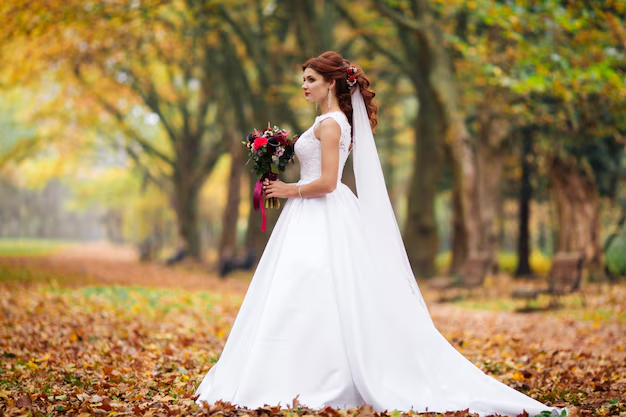
My dress hung from a hook on the back of the door, simple and elegant—ivory chiffon that flowed when I moved, a lace bodice with cap sleeves, nothing flashy or over the top. When I slipped it on, stepping carefully into the pool of fabric as my friends lifted it around me, something inside me went very still.
I looked like a bride.
Not the magazine brides I used to cut out, not the meticulously styled women on my mother’s friends’ Christmas cards, but me. Clara, the girl who spent most of her days in sensible shoes and work cardigans, now in a dress that somehow felt like an extension of herself.
I was still staring at my reflection when the door opened and my parents walked in.
“It’s simple,” Mom said, and I felt the first crack in my day.
“Mom,” I began, forcing cheer into my tone, “you look nice.”
She did. The silver dress brought out the coolness in her gray eyes and set off her jewelry tastefully. Dad’s tie matched her gown, of course. They looked coordinated, like they’d been styled for a photo shoot.
Dad gave me a perfunctory nod. “Clara.”
For a moment, I waited. Waited for the comment that should follow—You look beautiful, or Even if we don’t agree, we’re here. Something.
Silence stretched.
Jenna, bless her fearless soul, stepped into the void. “Don’t you think she looks stunning?” she said brightly.
Mom’s lips flattened. She turned to me instead. “It’s not too late to postpone,” she said.
My heart gave a painful jerk. “What?”
“You heard me.” She glanced at the others in the room but didn’t lower her voice. “Your father and I talked. We’d be willing to help you plan something better. With someone better.”
The room went so still I could hear the faint hum of the venue’s air conditioning.
“Mom,” I said slowly, “I’m getting married in twenty minutes.”
Dad crossed his arms over his chest. “We’re just saying this Daniel guy… he’s got no future. You’re settling.”
The words hit all the old bruises. I felt them like physical blows.
“He’s a good man,” I managed. My voice sounded small even to my own ears.
“Good doesn’t pay bills,” Mom scoffed.
There was a knock, and the photographer poked her head in, camera already around her neck. “Hey! Ready for some family photos before the ceremony?”
No one answered for a beat.
My father checked his watch. “We need to talk about the aisle walk,” he said.
A tiny ember of hope sparked. Maybe this was it—the compromise, the gesture, the moment where they’d accept that this was happening and decide to stand by me anyway.
I moved toward them, the chiffon of my dress whispering over the worn wooden floor. “Okay,” I said. “How do you want to do it?”
Dad didn’t move. His eyes were cool, his jaw firm. “Your mother and I decided we’re not comfortable walking you down.”
The words were so unexpected that at first I didn’t understand them.
“What?” My laugh came out brittle. “What do you mean, not comfortable?”
Mom waved a hand, like she was batting away a mosquito. “It would feel like we’re endorsing this mistake, Clara. We can’t do that in front of everyone.”
My stomach dropped. “You’re serious.”
“Don’t be dramatic,” she said. “You made your choice. Walk yourself.”
She laughed—a small, sharp sound that made my skin prickle. “Guess that’s what happens when you marry a nobody.”
Dad joined in with a low chuckle. “At least Todd gave us a wedding we could be proud of.”
Something inside me snapped.
Jenna stepped forward, eyes blazing. “You can’t be serious,” she said. “She’s your daughter.”
Mom pivoted to face her, frost in her expression. “This is family business.”
No one had ever made “family” sound less inviting.
I looked at my reflection in the mirror—at my pale face, the way my shoulders had begun to curl inward—and suddenly I saw another version of myself: one who begged, who pleaded, who tried to twist herself into a shape that would fit their expectations.
I was so, so tired of being that girl.
I lifted my chin, feeling something like steel slide into place along my spine.
“Fine,” I said quietly. “Then I’ll walk myself.”
The room seemed to exhale with me. Dad shrugged. “Suit yourself.”
They turned and walked out.
The silence they left behind roared in my ears.
My bridesmaids swarmed me, a flurry of hands and voices.
“Clara, I’m so sorry—”
“They’re unbelievable—”
“You don’t have to let them—”
“It’s okay,” I said, surprising myself with how steady I sounded. “Really. It’s okay.”
Jenna caught my eyes, studying me. After all these years, she could read me better than anyone.
“You sure?” she asked softly.
I took a breath. It trembled, but it was still a breath.
“I’m sure,” I said. “I don’t need them to walk me down. I can walk.”
Here’s the thing my parents didn’t know—because they’d never bothered to ask:
Daniel wasn’t just “a guy who worked with delinquents.” He’d founded the youth nonprofit where he worked. Started it in his early twenties with a borrowed office space and a handful of volunteers, driven by the memory of his own friends who’d fallen through the cracks in neighborhoods like the one he came from.
Over the years, he’d built it into an organization that provided tutoring, mentorship, job training, and safe spaces for kids who had nowhere else to go. He’d written grants, lobbied the city council, partnered with local businesses. He’d been featured in a couple of national articles about innovative community programs. A university had even invited him to speak on a panel about youth engagement.
He never made a big deal of any of it. If I hadn’t stumbled across one of the articles while Googling him early in our relationship, I might not have known half of what he’d done.
“It’s not about me,” he’d said when I confronted him, article pulled up on my phone. “It’s about the kids. Besides, you already know who I am. I don’t need a write-up to prove it.”
My parents never asked about his work beyond “so what do you do again?” They certainly never Googled him. He wasn’t the kind of impressive they cared about.
What they also didn’t know was that a few weeks before the wedding, my principal had called me into her office, her eyes suspiciously shiny.
“Close the door, Clara,” she’d said. “I have some news.”
I’d sat down, heart in my throat, wondering if one of my students had done something disastrous.
“You’ve been selected as Teacher of the Year for the district,” she’d announced. “The ceremony’s next month. They want you to give a speech.”
I’d stared at her, stunned. Me? The girl whose parents still acted like she’d chosen teaching because she couldn’t hack “real work”?
I hadn’t told them. I didn’t want to hand them another thing to weaponize or dismiss, another achievement they could claim credit for while sneering at the life I’d built around it.
And because Daniel and I existed in the world of community work and public service, our guest list looked very different from the country club weddings my parents were used to. Yes, we had coworkers and friends and some of my students’ families. But we also had people who’d seen the impact of what we did firsthand.
People like the mayor, who’d cut the ribbon on Daniel’s new youth center.
People like the state senator, who’d co-sponsored a bill inspired by a youth advocacy group Daniel helped organize.
People like the superintendent of schools, who’d observed my classroom and seen what could happen when kids from “bad neighborhoods” were given a teacher who refused to write them off.
People like the nationally known child psychologist who’d partnered with Daniel’s nonprofit on trauma-informed programming, and the best-selling author who’d mentored me through my first article about teaching in underfunded schools.
To my parents, our wedding was a small, embarrassing affair in a modest venue with buffet-style catering and DIY centerpieces.
They had no idea who would be sitting in those “small” chairs.
“The music is starting,” the coordinator said, appearing at the end of the hallway. “We’re lining up. Are you ready?”
I took a deep breath. My fingers tightened around my bouquet; the stems were cool and slightly damp against my palm.
“Yes,” I said. “I’m ready.”
I wasn’t, of course. No one is ever really ready for the moment their life splits into Before and After. But I wanted to step into that moment anyway.
Jenna squeezed my hand once, hard, then stepped forward as the doors to the ceremony space cracked open. She was my maid of honor, my anchor, the one who’d seen me through awkward middle school crushes and ugly breakups and nights spent crying over papers I didn’t know how to grade. Now she straightened her shoulders, lifted her bouquet, and walked down the aisle alone.
I waited behind the closed doors, heart pounding so hard I could feel it in my throat.
Inside, the guests rose to their feet. The music swelled—a familiar classical piece, Canon in D—which my mother had picked for Todd’s wedding and then mocked when I’d chosen it too.
“At least it’s traditional,” she’d said then.
Now, the same notes that once sounded like distant wedding bells in someone else’s life wrapped around me like a protective cloak.
The coordinator pressed a finger to her earpiece. “Everyone’s seated,” she murmured, almost to herself. Then, louder: “Bride is ready. Opening doors in three… two…”
The doors swung open.
For a heartbeat, everything went widescreen and slow-motion. The room beyond the doors glowed with warm light, candles flickering on each table, fairy lights strung along the ceiling. The wooden chairs were filled, every row occupied by faces turned toward me.
I felt the collective gaze of a hundred people land on me all at once.
I took my first step.
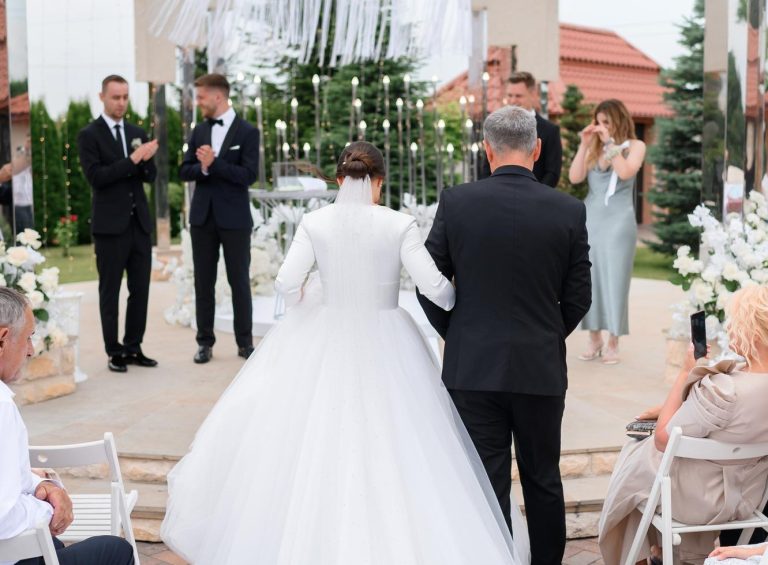
No father at my side. No mother gripping my arm. Just the soft swish of my dress, the steady beat of the music, and the sound of my own breathing in my ears.
At the front row, I saw my parents. Mom’s mouth was set in a thin line, Dad’s hands clasped tightly together. Their expressions were pinched, like they were enduring a root canal.
And then their eyes started to dart around. I watched as recognition dawned.
In the third row on the left, Mayor Patterson—short, energetic, her signature bob slightly mussed—stood with the rest of the guests, her eyes shining. Next to her, Senator Williams, distinguished and serious, smiled in my direction. On the other side of the aisle, the superintendent of schools gave me a little nod, the kind we shared in the hallways when she popped in to observe classes.
Scattered among them were faces my parents might have recognized from the local news, from the framed photos hanging in city hall, from the society pages they obsessed over for evidence of their friends’ social climbing.
The chief of police, who’d collaborated with Daniel on community-based policing initiatives. The renowned child psychologist, whose books lined the shelves of professionals my parents considered “respectable.” A nationally known activist, the very one my mother had once gushed about after seeing her interviewed on television.
And, near the aisle, the best-selling author who’d taken an interest in my work after reading an op-ed I’d written. She gave me a small, conspiratorial smile as I passed, as if to say: Show them.
Everywhere I looked, people were watching me not with pity or disapproval, but with pride. Some mouthed “You’ve got this.” Others simply beamed, their faces open and warm.
My mother’s complexion had gone ashen. She leaned toward my father, her mouth moving rapidly. I couldn’t hear what she said over the music, but I saw the word form on her lips: mayor.
Dad’s jaw clenched. He didn’t respond.
I kept walking.
Each step felt like a declaration. Not just I am getting married, but I exist. I chose this. I am not ashamed.
Halfway down the aisle, I caught sight of Daniel at the altar.
He looked devastatingly handsome in a simple navy suit and tie, his dark hair slightly unruly no matter how much gel he’d used. His eyes were locked on me, wide and bright, his expression a mixture of awe and something like… reverence. Like he couldn’t quite believe I was real and walking toward him.
The nerves that had been buzzing under my skin settled. Everything else fell away—the stares, the whispers, the hurt ricocheting through my ribs. In that moment, there was only him.
By the time I reached the front, my legs felt steadier. My heart still hammered, but not with fear now—with something fierce and defiant and alive.
Daniel reached out and took my hands in his. His palms were warm and slightly calloused, familiar in a way that anchored me immediately.
“You okay?” he whispered, so quietly no one else could hear.
I thought of saying, My parents refused to walk me down the aisle. They tried to uninvite your guests. They laughed at me. They called you a nobody.
Instead, I looked into his eyes—the eyes that had watched me grade papers until midnight, that had crinkled with laughter when one of his kids made a dark joke, that had filled with tears when a young man he’d mentored was killed.
“I am now,” I whispered back.
The officiant cleared his throat and began the ceremony. His words rolled over us in a gentle tide:
“We are gathered here today to celebrate the union of Clara and Daniel…”
I barely heard him. My mind drifted in flashes—my first day in front of a classroom, Daniel’s hand brushing mine in a staff meeting at the community center, late-night conversations about what we wanted our lives to look like beyond the chaos of our jobs.
When it was time for our vows, we’d agreed to keep them short. We both work with teenagers; we know the limits of attention spans.
Still, when Daniel unfolded the small piece of paper from his pocket, his hands trembled.
“Clara,” he began, “you are the bravest person I know.”
I snorted softly, and a ripple of laughter moved through the crowd. Brave was not how I’d felt up to this point.
“You walked into a classroom of kids everyone else had given up on,” he continued, “and you refused to see them as anything less than brilliant. You fight for them every day, even when no one is watching. You’ve taught me more about patience and hope than any training or workshop ever could.”
His voice shook on the last sentence. I saw movement in the front row; my mother shifting in her seat, my father staring at Daniel like he was a puzzle he hadn’t realized he needed to solve.
When it was my turn, I unfolded my own crumpled paper.
“Daniel,” I said, and my voice softened around his name. “The first time I saw you, you were sitting on a tiny plastic chair in a crowded rec room, listening to a thirteen-year-old talk about his favorite video game like it was the most important thing in the world. And you were listening. Really listening. You’ve never once looked at those kids and seen a statistic or a lost cause. You see them the way you see everyone—with possibility.”
I paused, my throat thick.
“You’ve shown me that love isn’t about grand gestures or big houses. It’s about showing up, over and over, even when it’s hard. It’s making grilled cheese at midnight for the kid who stayed late. It’s editing lesson plans on your day off because you want to get it right. It’s staying. And you’ve stayed, Daniel. With them. With me. I promise to stay, too.”
We slipped rings onto each other’s fingers. My hands didn’t shake this time.
“By the power vested in me,” the officiant said, “I now pronounce you husband and wife. You may kiss the bride.”
He didn’t need to say it twice. Daniel leaned in and kissed me, and the room erupted in applause.
For a second, eyes closed, lips pressed to his, I could almost forget that my parents were sitting mere feet away, their approval still withheld.
Almost.
The reception flowed around us in a blur of music and clinking glasses and warm hugs. The caterers laid out platters of food; kids darted between tables, squealing, their parents halfheartedly calling after them. My students who’d been invited clustered together near the back, their eyes huge at the sight of me out of context, not in dress-code-approved slacks but in a wedding gown.
“Miss L!” one of them yelled across the room. “You look like an actual princess!”
I laughed and blew them a kiss.
My parents maintained a careful distance at first, hovering near the bar, talking in low tones to a couple of relatives who’d flown in from out of state. Todd lingered somewhere between us, his face tight with conflict.
I watched them out of the corner of my eye as I moved through the crowd, greeting guests.
When Mayor Patterson pulled me into a hug, my mother’s gaze snapped toward us.
“Clara, this is beautiful,” the mayor said, stepping back to look at me. “You look radiant. Thank you for inviting me.”
“Thank you for coming,” I said, genuinely touched. “I know how busy you are.”
She waved a hand. “For you and Daniel? I’d clear my schedule.” Her voice dropped just a bit. “The work you’re doing at that school? It matters, Clara. Don’t let anyone tell you otherwise.”
Over her shoulder, I saw my mother’s lips part slightly. She looked like someone had thrown a bucket of cold water on her.
Before I could fully process that, Senator Williams joined us, his hand extended.
“Congratulations,” he said. “Daniel’s told us so much about you. Your students are lucky to have you.”
“We’re both lucky,” I said. “To get to do what we do.”
He nodded. “This city needs more people like you two.”
The mayor and senator moved on, pulled into another conversation. I turned to find my parents, suddenly craving the satisfaction of seeing their faces up close.
I didn’t have to wait long.
A few minutes later, I saw them making a beeline toward the cluster of VIP guests, my mother’s smile stretched so tight it looked painful.
“Mayor Patterson!” she called, her voice higher than usual. “Senator! We’re Clara’s parents.” She grabbed my father’s arm. “We’re so proud of her.”
The mayor’s smile was polite, but there was a slight furrow between her brows as if she were mentally rewinding what she’d just said to me. Still, she held out her hand.
“She’s remarkable,” the mayor said. “Her work in the schools is transformative. You must be very proud.”
Mom laughed brightly. “Yes, well, we’ve always encouraged her to do her best.”
My father nodded stiffly.
Before they could say more, Senator Williams chimed in. “And Daniel,” he said. “His nonprofit changed this city. The programs he’s built—frankly, I wish we had ten more of him. You both must be incredibly proud of the work they’re doing.”
My parents’ eyes flickered between them, scrambling to keep up.
“Of course,” Dad managed.
But the senator and mayor were already turning away, drawn into another conversation, leaving my parents standing there with their frozen smiles and abandoned talking points.
Todd slipped in beside them, brow furrowed.
“Did you know all these people were coming?” he asked.
“No,” Mom said tightly. “She didn’t tell us.”
She said it like an accusation, as if my failure had been not that I’d disappointed her, but that I hadn’t given her a chance to rehearse.
Later, she cornered me near the cake table.
“You didn’t tell us Daniel was so connected,” she hissed, keeping her voice low enough that only I could hear.
I set down the dessert plate I’d been holding. “Connected?” I repeated.
“The mayor? The senator? Those people from the news?” Her eyes were sharp. “You said this was a small wedding. An intimate thing.”
“It is,” I said. “These are people we know. People we’ve worked with.”
“You didn’t mention any of that,” she said.
“You didn’t ask,” I replied.
She blinked. Dad appeared at her shoulder, having apparently sensed that a crucial moment was unfolding.
“We didn’t realize,” he began.
Something hot flared up inside me.
“No,” I said, cutting him off. “You didn’t realize that I’d built a life worth respecting. That Daniel and I actually mattered to people.”
Mom’s eyes narrowed. “That’s not fair.”
“You laughed at me for walking alone,” I said, my voice low and trembling now with anger and something deeper. “You called my husband a nobody. You tried to sabotage my wedding. Which part of that is fair?”
Dad straightened, bristling. “We were trying to protect you.”
“No,” I said. “You were trying to protect your image. You didn’t care if I was happy, as long as you didn’t have to be embarrassed in front of your friends.”
Mom’s eyes filled with tears, but I didn’t trust them anymore. Too many times I’d watched her cry not because she’d hurt me, but because she’d been called out for it.
“I’m your mother,” she whispered. “I want what’s best for you.”
“You want what’s best for you,” I said quietly. “Those are not the same thing.”
Her mouth opened and closed. Dad’s face had gone red; he looked like he wanted to yell, or walk away, or both.
“You made it very clear this wasn’t the wedding you wanted,” I went on. “You know what? That’s fine. Because it’s the wedding I wanted. This is my life. And I walked down that aisle alone today. I was fine.”
My voice steadied, gaining strength with each word.
“I’ll be fine without you going forward, too.”
The words hung in the air between us, heavy and irrevocable.
For a heartbeat, no one moved.
Then someone called my name from across the room. I turned toward the sound. It was one of Daniel’s kids—a lanky seventeen-year-old in an ill-fitting suit, his face lit with joy as he waved me over.
“Mrs. L!” he shouted, then laughed. “Can I call you that now?”
“Give me a second,” I called back, smiling despite the tension coiling in my chest.
I looked back at my parents; they were both staring at me as if they were seeing me for the first time. Not as their project. Not as their disappointment. Just… me.
I didn’t wait to see what they’d say next.
I turned and walked away. Back toward Daniel. Back toward the life I’d chosen.
Sometimes, late at night, the memory of walking down the aisle alone comes back to me in flashes.
The weight of the bouquet in my hand. The sound of my dress swishing against the floor. The way the guests’ faces blurred at the edges as my vision tunneled toward Daniel.
I remember the sting of my parents’ absence at my side. The phantom weight of an arm that should have been there and wasn’t.
But more than that, I remember the way my own feet felt on the ground. Solid. Steady. Mine.
When I was a kid, I thought strength looked like perfection—straight A’s, perfect posture, never crying in public. My parents reinforced that idea every time they praised Todd for his achievements, every time they frowned at my “softness.”
It’s only now, years later, that I understand: sometimes strength looks like saying no. Like choosing a path that will make you whole instead of one that will make you admired. Like walking down an aisle alone, knowing there are people in the room judging you, and doing it anyway.
I used to think I needed an audience to validate my worth. Parents, teachers, bosses, partners. Someone to hand me a metaphorical plaque and say: You’re enough. You did the right thing.
But the strange thing about walking alone is that, somewhere between the first step and the last, you realize you’re not actually alone at all. There are people who show up, quietly and without fanfare, and stand with you even when your own family won’t.
The mayor who shows up at your wedding because she believes in your work.
The mentor who drives across town in bad traffic just to clap when you say your vows.
The friend who stands in a hallway and tells you that you don’t need parents who don’t see you.
The man waiting at the end of the aisle, eyes full of pride, who doesn’t need you to be anything other than exactly who you are.
I’m not going to pretend it doesn’t still hurt sometimes. There are nights when I lie awake and think about the what-ifs. What if my parents had reacted differently? What if they’d walked me down the aisle, tears in their eyes, and meant it?
But then I think about that moment at the doors. About the music swelling, the room full of people who chose to be there, the life I was walking toward instead of the one I was leaving behind.
And I know this: walking down that aisle alone was the most powerful thing I’ve ever done.
Not because I didn’t want someone beside me, but because I finally realized I didn’t need them there to make my steps matter.
If you’ve ever had to prove your worth to people who refuse to see it, I wish I could reach through whatever screen you’re reading this on and take your hand for a moment. I’d stand with you at the doors, listen to the muffled doubts and criticisms seeping through the walls, and remind you of this:
You are not a failure because someone else can’t recognize your success.
You are not unlovable because the people who should have loved you first didn’t know how.
Your strength doesn’t need their applause. It doesn’t need a fancy venue or a five-course meal or a string quartet.
Sometimes, your strength just needs a hallway, a deep breath, and the courage to take that first step forward—whether anyone walks beside you or not.

Sarah Mitchell is a bestselling novelist recognized for her insightful and emotionally resonant stories that explore the complexities of human relationships. Originally from Denver, Colorado, Sarah grew up in a family of teachers who nurtured her curiosity and love for storytelling. She studied psychology at Stanford University, where she became fascinated by the intricacies of human behavior—an interest that would later shape her writing career. Sarah’s novels are praised for their nuanced characters, intricate plots, and ability to capture the subtle tensions that define love, friendship, and family ties. Her breakthrough novel, The Spaces Between Us, became an instant bestseller, lauded for its honest portrayal of strained family relationships and the fragile bonds that hold people together. Since then, she has published several works that continue to captivate audiences around the world. Outside of her writing career, Sarah is passionate about mental health advocacy and often partners with organizations to promote awareness and support for those struggling with emotional well-being. Her personal life is quieter—she enjoys hiking in the Colorado mountains, practicing yoga, and spending time with close friends. With each new book, Sarah Mitchell cements her reputation as a writer who illuminates the beauty and struggles of human connection.