
A bizarre rumor spread rapidly across social media in recent days, drawing widespread attention and ridicule after a short video clip from a White House press conference went viral. The speculation centered on an unfounded claim that the president suffered an embarrassing physical mishap during a public appearance — a claim that has since been firmly denied by officials and debunked by fact-checkers.
The episode highlights how quickly misinformation, even of the most trivial or absurd kind, can gain traction online, particularly when it involves a high-profile political figure. What began as a few speculative posts quickly escalated into a trending narrative, fueled by selective interpretations of body language, facial expressions, and abrupt changes in the flow of an official event.
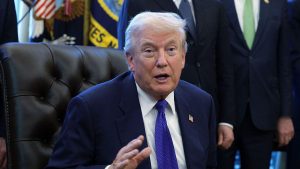
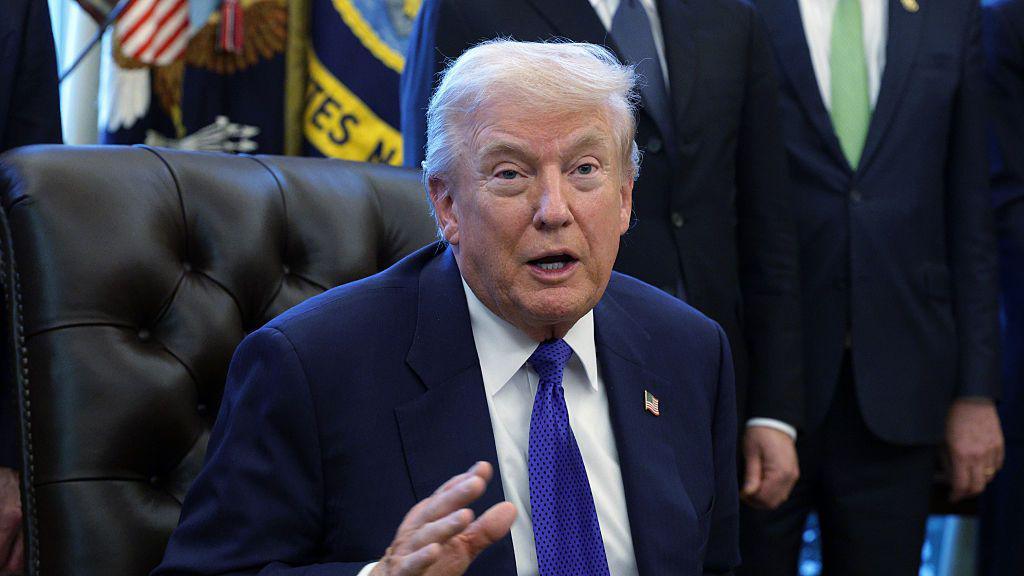
The footage in question was taken during a White House press conference in which the president signed an executive order related to addiction recovery efforts. Toward the end of the appearance, the meeting concluded somewhat abruptly, with reporters ushered out of the room faster than usual. That moment, paired with what some viewers interpreted as awkward reactions from people standing nearby, became the foundation for the rumor.
Almost immediately after the clip began circulating, users on social media platforms — particularly X — started offering their own interpretations. Some claimed they heard an unusual sound in the video, while others focused on what they described as “uncomfortable” expressions from officials positioned behind the president. These observations, entirely speculative, were quickly framed as evidence of a humiliating incident.
Within hours, the rumor took on a life of its own. Posts alleging that the president had “pooped himself” during the press conference spread rapidly, accumulating thousands of likes, reposts, and comments. Some users described the incident in vivid and crude terms, while others treated it as dark humor or political mockery.
Several viral posts insisted that aides rushed reporters out of the room to cover up the alleged accident. Others claimed that certain officials appeared to react physically to an unpleasant smell. None of these claims were supported by any verified evidence, audio confirmation, or eyewitness testimony.
Despite the lack of proof, repetition across platforms gave the rumor momentum. As often happens in the digital age, screenshots, edited clips, and exaggerated captions amplified the story, making it difficult for casual viewers to separate fact from fiction. What mattered less than accuracy was the virality of the claim.
The president at the center of the rumor, Donald Trump, has long been a polarizing figure whose every public movement is scrutinized intensely by both critics and supporters. His visibility, combined with the internet’s appetite for scandal and ridicule, created fertile ground for the rumor to spread unchecked.
However, official responses soon followed. White House communications director Steven Cheung publicly dismissed the claims, stating unequivocally that the rumors were false. According to Cheung, nothing unusual occurred during the press conference, and the speculation was simply another example of online misinformation spiraling out of control.
Independent fact-checking organizations also examined the footage closely. Snopes, a well-known verification outlet, confirmed that the video itself was authentic and had not been digitally altered or generated using artificial intelligence. Importantly, however, the organization found no evidence supporting the claim that the president experienced any kind of physical accident during the event.
The fact-check concluded that while the video shows a routine conclusion to a press appearance, there is no objective basis for interpreting the moment as anything other than standard protocol. The abrupt ending, according to analysts, could be attributed to scheduling constraints, security considerations, or simple procedural decisions — none of which are unusual at the White House.
Experts in media literacy point out that rumors like this thrive because they rely on ambiguity. When a clip lacks clear context, viewers may project their own assumptions onto it. Once a sensational explanation is introduced, especially one that aligns with preexisting biases or political animosity, it can spread faster than corrections.
This incident also underscores a broader challenge facing public discourse: the blurring line between satire, speculation, and misinformation. While some users may have intended their posts as jokes or exaggerations, others presented the claims as factual, contributing to confusion and reputational harm.
Political figures, regardless of party, are frequent targets of such narratives. Yet the speed at which this particular rumor gained traction illustrates how even baseless claims can dominate online conversations for days, overshadowing substantive policy discussions or legitimate news.
Media analysts note that viral rumors often benefit from shock value rather than credibility. The more outrageous the claim, the more likely it is to provoke engagement — whether through laughter, outrage, or disbelief. Algorithms then reward that engagement, pushing the content to wider audiences.
Despite the frenzy online, mainstream news organizations largely avoided repeating the claim itself, instead focusing on the phenomenon of misinformation and the subsequent debunking. This restraint reflects an increasing awareness among journalists of the need to avoid amplifying false narratives, even when they are trending.
For supporters of the president, the rumor was seen as yet another example of unfair mockery and politically motivated attacks. For critics, it became a moment of crude humor or symbolic ridicule. In both cases, the actual facts were often secondary to the emotional reactions the story provoked.
Ultimately, the episode serves as a reminder of how fragile truth can be in the age of viral media. A single misinterpreted moment, stripped of context and amplified by social platforms, can quickly become a widely believed — though entirely false — narrative.
As confirmed by both the White House and independent fact-checkers, there is no evidence that the president experienced any such incident during the press conference. The rumor, while widely shared, remains exactly that: a rumor.
In an era where public figures are constantly under a digital microscope, this incident reinforces the importance of skepticism, verification, and responsible sharing. Not every viral claim deserves attention, and not every trending topic reflects reality — even when the internet insists otherwise.

Emily Johnson is a critically acclaimed essayist and novelist known for her thought-provoking works centered on feminism, women’s rights, and modern relationships. Born and raised in Portland, Oregon, Emily grew up with a deep love of books, often spending her afternoons at her local library. She went on to study literature and gender studies at UCLA, where she became deeply involved in activism and began publishing essays in campus journals. Her debut essay collection, Voices Unbound, struck a chord with readers nationwide for its fearless exploration of gender dynamics, identity, and the challenges faced by women in contemporary society. Emily later transitioned into fiction, writing novels that balance compelling storytelling with social commentary. Her protagonists are often strong, multidimensional women navigating love, ambition, and the struggles of everyday life, making her a favorite among readers who crave authentic, relatable narratives. Critics praise her ability to merge personal intimacy with universal themes. Off the page, Emily is an advocate for women in publishing, leading workshops that encourage young female writers to embrace their voices. She lives in Seattle with her partner and two rescue cats, where she continues to write, teach, and inspire a new generation of storytellers.