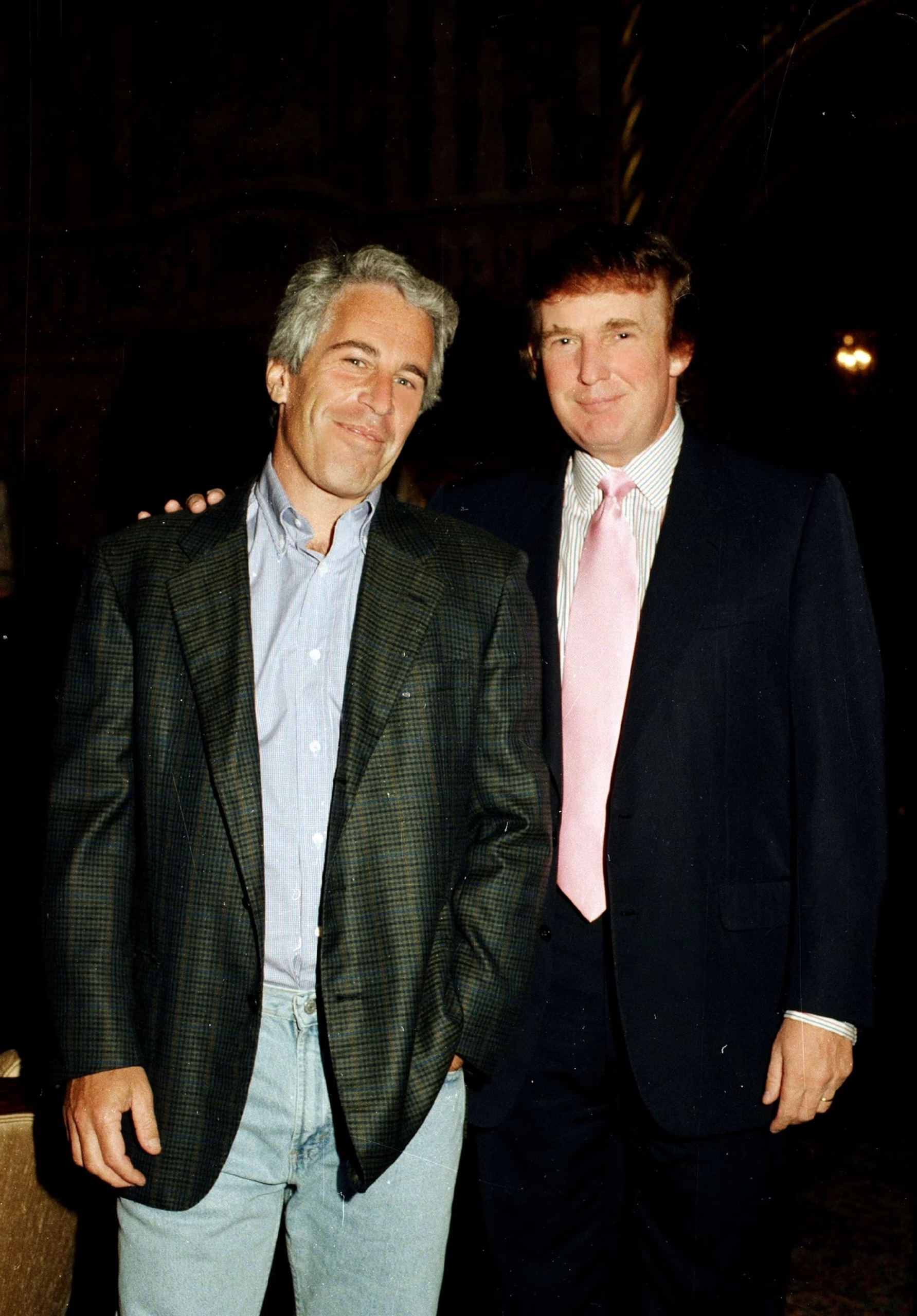
The final tranche of documents tied to disgraced financier Jeffrey Epstein has now been made public, with U.S. Attorney General Pam Bondi confirming the completion of the disclosure process under the Epstein Files Transparency Act.
Among the most heavily discussed elements of the release is how frequently Donald Trump appears throughout the millions of pages, emails, and records compiled over decades of investigations, litigation, and intelligence gathering.
The sheer volume of references has sparked viral comparisons, political debate, and widespread speculation—much of it detached from the legal reality that being named in the files does not, on its own, establish wrongdoing.
The Scale of the Release
According to the Department of Justice, roughly 3.5 million documents tied to Epstein’s network, contacts, and investigations have now been released in redacted form. These records include:
-
Emails
-
Flight manifests
-
Financial records
-
Contact books
-
Witness statements
-
Investigative notes
The dataset spans decades and includes references to hundreds of public figures, business leaders, and celebrities, often appearing in routine or incidental contexts.
How Often Trump Appears
The central question driving public attention is simple: How many times does Donald Trump appear in the Epstein files?
The answer depends on how “mentions” are defined.
Different media analyses have produced varying figures:
-
Roughly 5,100–5,300 direct name mentions
-
Around 38,000 broader references including properties, associates, and indirect mentions (such as Mar-a-Lago or family members)
Some tallies also include:
-
Photographs featuring Trump
-
References to locations associated with him
-
Mentions in third-party communications
Because the files are heavily redacted and not organized as a single searchable dataset, there is no universally agreed-upon count.
Viral Claims and Political Rhetoric
The high frequency of references has fueled viral claims—most notably comparisons suggesting Trump appears:
-
More times than Jesus Christ is mentioned in the Bible
-
More times than Harry Potter appears across all seven novels
These comparisons originated from remarks by Democratic lawmakers, including Rep. Jared Moskowitz and Rep. Jamie Raskin, who cited extremely high mention counts in public commentary.
However, these comparisons are rhetorical and not empirically verified. They rely on incomplete datasets, varying definitions of “mention,” and non-standardized counting methods.
What the Mentions Actually Mean
The Department of Justice has explicitly cautioned that frequency of mention does not equal culpability.
In a statement accompanying the release, the DOJ noted that some documents contain:
“Untrue and sensationalist claims… submitted to the FBI right before the 2020 election.”
The agency emphasized that:
-
The claims were unverified
-
They were not substantiated
-
If credible, they would have been pursued through formal legal channels
As of now, no criminal case has been filed against Donald Trump related to Epstein’s crimes, and no official finding of wrongdoing has been made.
Why Trump Appears So Frequently
There are several structural reasons Trump’s name appears often in the files:
1. Overlapping Social Circles
During the 1980s and 1990s, Epstein moved in elite New York and Palm Beach social circles that included high-profile business figures, politicians, and celebrities.
Trump, as a major real estate developer and public figure in those same circles, appears frequently in:
-
Event guest lists
-
Contact directories
-
Social references
2. Property References
Trump-owned properties—particularly Mar-a-Lago—appear in documents as locations referenced by third parties, increasing the number of indirect mentions.
3. Third-Party Communications
Many mentions are secondhand references in emails, notes, or witness statements—rather than direct interactions.
4. Investigative Over-Inclusion
Investigators often include wide-ranging contextual material in large cases, meaning many peripheral names are captured in records.
The Broader List of Names
Trump is not the only prominent figure referenced. The files include more than 300 high-profile individuals, spanning politics, entertainment, business, and global leadership.
These names appear in a wide variety of contexts, including:
-
Social invitations
-
Business contacts
-
Flight logs
-
Casual correspondence
The DOJ has stressed repeatedly that most of these references carry no implication of wrongdoing.
The Problem of Context
One of the primary criticisms of the release is lack of contextual labeling.
Critics from both political parties have argued that placing all names into a single list without categorization:
-
Blurs distinctions between witnesses, associates, and accused individuals
-
Risks reputational harm
-
Fuels misinformation and conspiracy theories
This issue has already triggered political backlash and public confusion, particularly when deceased individuals or unrelated figures appear alongside convicted offenders.
Legal Reality vs Public Perception
From a legal standpoint, the key distinction is clear:
-
Being named in documents is not evidence of a crime
-
Frequency of appearance does not imply involvement
-
Only substantiated allegations lead to charges or findings
However, in the public arena, raw data without context can easily be misinterpreted, particularly when amplified through social media and partisan commentary.
What Happens Next
With the full release now complete, the focus is shifting toward:
-
Independent analysis of the files
-
Media investigations
-
Congressional scrutiny
-
Potential civil litigation tied to newly surfaced information
Legal experts expect the documents to be parsed for years, as journalists, attorneys, and researchers examine their contents.
Bottom Line
The final release of the Epstein files has generated enormous public interest, particularly around how often Donald Trump’s name appears in the records.
While the frequency of references is undeniably high, there is currently no official finding of wrongdoing tied to those mentions.
The documents themselves are vast, complex, and often lacking in context—meaning that raw mention counts alone are not a reliable indicator of guilt or involvement.
As the material continues to be analyzed, the distinction between association, reference, and accusation will remain critical to understanding what the files actually reveal—and what they do not.

Emily Johnson is a critically acclaimed essayist and novelist known for her thought-provoking works centered on feminism, women’s rights, and modern relationships. Born and raised in Portland, Oregon, Emily grew up with a deep love of books, often spending her afternoons at her local library. She went on to study literature and gender studies at UCLA, where she became deeply involved in activism and began publishing essays in campus journals. Her debut essay collection, Voices Unbound, struck a chord with readers nationwide for its fearless exploration of gender dynamics, identity, and the challenges faced by women in contemporary society. Emily later transitioned into fiction, writing novels that balance compelling storytelling with social commentary. Her protagonists are often strong, multidimensional women navigating love, ambition, and the struggles of everyday life, making her a favorite among readers who crave authentic, relatable narratives. Critics praise her ability to merge personal intimacy with universal themes. Off the page, Emily is an advocate for women in publishing, leading workshops that encourage young female writers to embrace their voices. She lives in Seattle with her partner and two rescue cats, where she continues to write, teach, and inspire a new generation of storytellers.