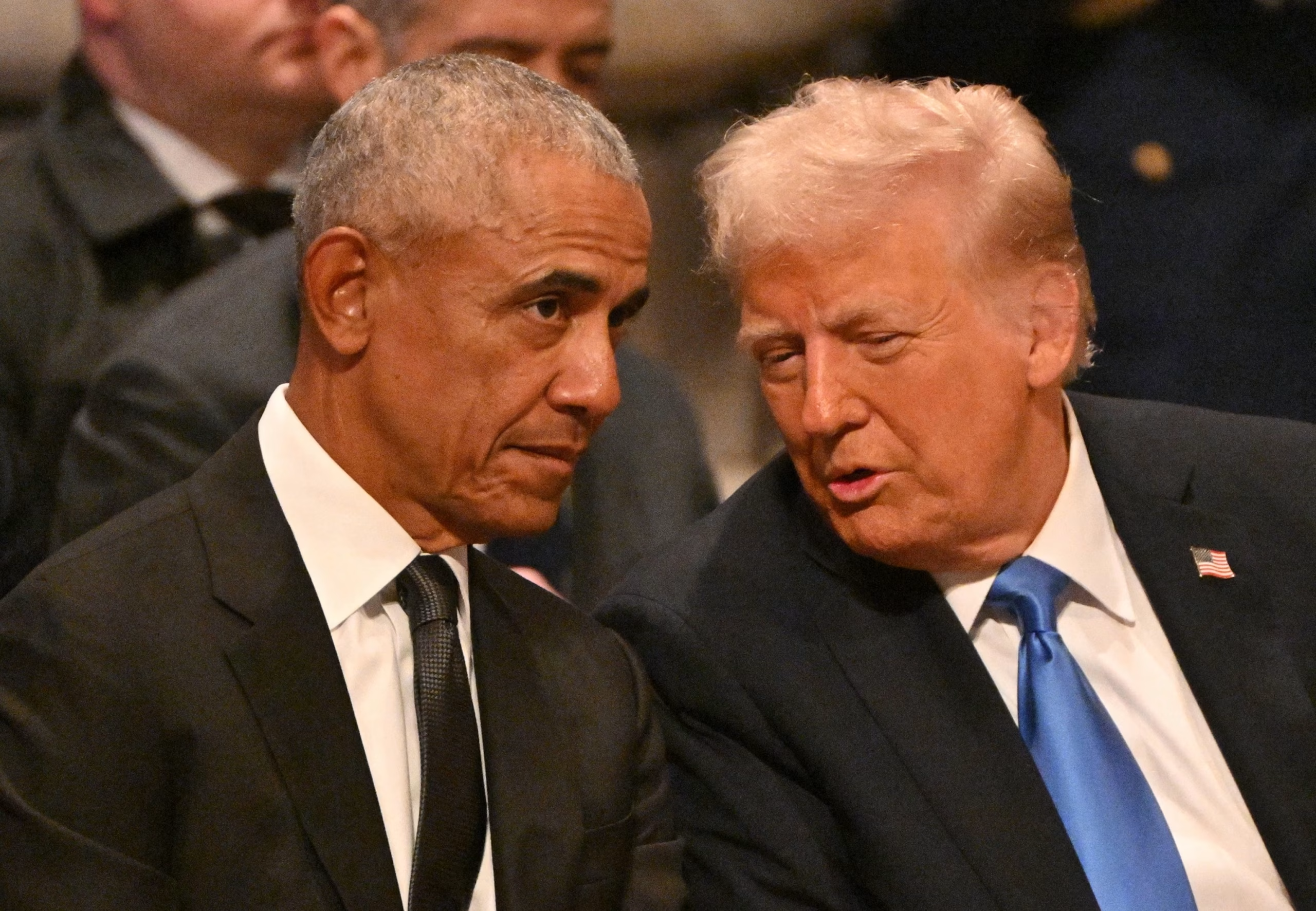
President Donald Trump set off a political firestorm this week after amplifying a startling online claim accusing former President Barack Obama of earning massive royalties from the Affordable Care Act. The allegation — which ballooned across social media after Trump reshared it on Truth Social — has now become the latest flashpoint in the long, bitter rivalry between the two men and the two political movements they represent.
Though the claim has been widely debunked, the controversy revealed something deeper: a growing mistrust among many Americans toward legacy media, the Democratic establishment, and the entire Obama-era healthcare system that continues to shape political battles more than a decade after its passage.
And in typical Trump fashion, one short post was enough to whip both critics and supporters into a frenzy.
A Post That Shook Up the Conversation
On Sunday, Trump shared a screenshot of a claim stating that Obama had received $2.5 million a year — adding up to $40 million since 2010 — in so-called “Obamacare royalties.”
The post, which made no attempt to cite a source, carried a headline about a company halting annual payments supposedly tied to the healthcare law. Trump responded with a single word:
“WOW!”
For many Trump supporters, the notion of Obama cashing in on a law that reshaped American healthcare — and drove up costs for millions — tapped into long-held frustrations. For critics, the post sparked immediate backlash, with some accusing Trump of spreading misinformation.
Either way, the story caught national attention almost instantly.
Where the Claim Really Came From
The allegation did not originate in Congress, the White House, or any legitimate investigative outlet. Instead, it began on a website called The Dunning-Kruger Times, part of a self-described “satire network” known as America’s Last Line of Defense.
The site labels everything it produces as parody and openly warns readers not to take any story as fact.
Its founder, Christopher Blair, even admitted to Reuters earlier this year that the “Obamacare royalties” narrative is a recurring joke his network has used repeatedly — relying on political tribalism and confirmation bias to push the content viral.
Still, the claim managed to spread widely enough that many Americans who saw Trump’s post had no idea it was sourced from a satirical website.
How the Media Reacted — and Why It Matters
CNN anchor Jake Tapper took to the air almost immediately after the Truth Social post, calling the claim “insane” and “completely false.” He emphasized that no federal law — including the Affordable Care Act — offers royalties, payments, or financial kickbacks to any president.
But for millions of Americans, particularly conservatives who feel burned by years of selectively reported scandals, such assurances from legacy media ring hollow. The debate wasn’t just about whether Obama made money. It was about something larger: trust.
For many voters, especially seniors who lived through the healthcare wars of the Obama era, the idea that political elites or bureaucrats might benefit from sweeping legislation is not far-fetched. And in a climate where government transparency is at a historic low, suspicion often fills the void.
Obama’s Wealth Surge Adds Fuel to the Fire
While the royalty claim is false, Obama’s post-presidency finances have been a source of ongoing scrutiny.
The former president entered the White House with relatively modest wealth; today his net worth is estimated in the tens of millions. After leaving office he secured:
• Multi-million-dollar book deals
• A lucrative Netflix production agreement
• Paid speeches
• Major real estate purchases, including the Martha’s Vineyard estate referenced by the White House
That trajectory — while legally earned — leaves political space for rumors to thrive.
A White House spokesperson, asked about Trump’s post, leaned into that frustration rather than pushing back directly.
“President Trump is the only president in modern history to actually lose money while in office,” the spokesperson said, arguing that Trump “put everyday Americans first” while Democrats used public service to enrich themselves.
The contrast between the two men, in style and substance, remains a defining political issue.
Trump’s Renewed War on Obamacare
The resurfaced claim appeared at a time when Trump has been waging a fresh campaign against the Affordable Care Act — a law he has battled since day one.
Earlier in November, Trump recommended redirecting “hundreds of billions” in federal spending away from insurance companies supporting the ACA framework and instead sending funds directly to Americans so they can purchase their own coverage.
But with federal subsidies set to expire for more than 24 million Americans at year’s end, political pressure has forced even Trump to acknowledge that a temporary extension may be unavoidable.
That tension — between long-standing conservative opposition to the law and the immediate reality facing millions of households — compounded the reaction to Trump’s Truth Social post.
Many conservative voters still see Obamacare as a symbol of mismanagement, waste, higher premiums, and broken promises. Any rumor, even a satirical one, suggesting Obama personally benefited from the program, hits an emotional nerve.
The Historical Battle Over the Autopen
Part of what made the rumor convincing to some is Trump’s ongoing argument that Biden signed thousands of documents using an autopen — a device that replicates signatures.
Trump has repeatedly argued that the previous administration abused the device to authorize major actions Biden did not personally oversee. While the legal community largely rejects this argument, Trump’s recent vow to “terminate” all autopen-approved documents heightened public suspicion surrounding presidential signatures.
When people are already questioning who actually signs what, even satire can start to feel like revelation.
A Story That Won’t Die Quickly
Even after fact-checkers debunked the claim, the story continues to bounce around online forums and social media pages. And political strategists on both sides know why:
• Trump’s base feels validated when he raises issues establishment media dismisses
• Obama remains a polarizing figure whose policies reshaped American life
• Obamacare continues to divide the country
• Trust in news outlets is at historic lows
• Some voters flatly refuse to believe “debunkings” from media they already distrust
This controversy is less about truth and more about perception — a reminder that Obama’s healthcare legacy, like the man himself, remains deeply contentious.
The Real Question Voters Are Asking
Behind all the noise, Americans are wrestling with something much bigger than a debunked claim:
Did Obamacare help regular families, or did it build an industry of winners and losers?
Conservatives overwhelmingly believe the latter.
And Trump’s post — whether satire, misunderstanding, or intentional provocation — reopened that debate at the worst possible moment for Democrats, just as the country approaches another high-stakes election year.
Obama is no longer in office, but his policies still shape the national debate. And Trump, as he has done for nearly a decade, continues to draw bright lines between the America he envisions and the one shaped by his predecessor.

James Jenkins is a celebrated Pulitzer Prize-winning author whose work has reshaped the way readers think about social justice and human rights in America. Raised in Atlanta, Georgia, James grew up in a community that instilled in him both resilience and a strong sense of responsibility toward others. After studying political science and creative writing at Howard University, he worked as a journalist covering civil rights issues before dedicating himself fully to fiction. His novels are known for their sharp, empathetic portraits of marginalized communities and for weaving personal stories with broader political realities. Jenkins’s breakout novel, Shadows of Freedom, won national acclaim for its unflinching look at systemic inequality, while his more recent works explore themes of identity, resilience, and the fight for dignity in the face of oppression. Beyond his novels, James is an active public speaker, lecturing at universities and participating in nonprofit initiatives that support literacy and community empowerment. He believes that storytelling is a way to preserve history and inspire change. When not writing, James enjoys jazz music, mentoring young writers, and traveling with his family to explore cultures and stories around the world.