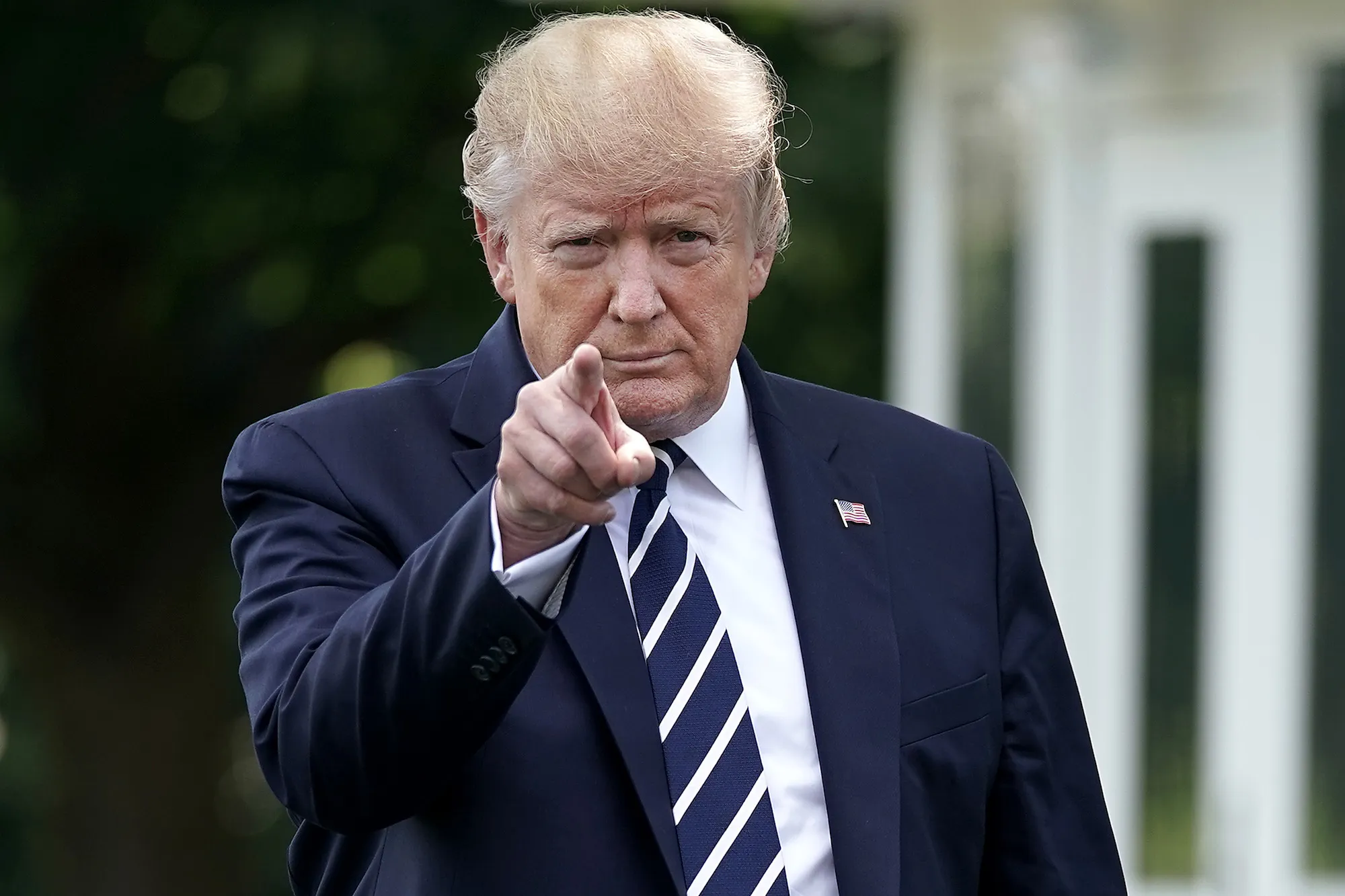
Minnesota Governor Tim Walz struck back at former President Donald Trump on Thursday, responding to what has become the latest in a string of incendiary attacks from the former commander-in-chief. The governor’s retort, a pointed four-word challenge—“Release the MRI results”—directly addressed both the content and context of Trump’s online tirade, highlighting ongoing questions about the former president’s health and the escalating tensions in political discourse ahead of the 2026 election cycle.
The exchange began on social media, where Trump unleashed a furious post on Truth Social, targeting Walz in the most personal terms. In a barrage of comments, Trump used an ableist slur, labeling the Minnesota governor “seriously retarded.” He compounded the attack by alleging that Walz had done “nothing, either through fear, incompetence, or both” to prevent what Trump inaccurately described as an “invasion” of Minnesota by “hundreds of thousands of refugees from Somalia.” The rhetoric drew immediate condemnation from political leaders, advocacy groups, and social media users across the spectrum, who criticized Trump for both the slur and the inflammatory nature of the claims.
Walz, a seasoned politician and former educator, has consistently prioritized measured communication and policy-focused discourse. Yet in this instance, he seized the opportunity to respond in a manner that highlighted broader questions surrounding Trump’s transparency and the ongoing scrutiny of his health. By referencing Trump’s own medical mystery—the enigmatic MRI scan conducted in October 2025—the governor reframed the conversation from ad hominem attacks to a pointed challenge that questioned the former president’s accountability and openness.
“Release the MRI results,” Walz tweeted, encapsulating a four-word demand that immediately resonated across social media. The succinct phrasing allowed the governor to shift public attention from Trump’s insult to a substantive matter: the uncertainty surrounding the former president’s physical condition, which has increasingly become a topic of national debate. For months, Trump has faced questions about his stamina, energy levels, and fitness for office, with many observers noting that transparency regarding health metrics is standard practice for presidential candidates and sitting officeholders.
The context for Walz’s challenge lies in the MRI exam that Trump underwent in October 2025. While the White House issued a brief statement claiming that the results were “as good as they’ve ever seen,” details of the evaluation, the analysis conducted, and the specific metrics assessed remain undisclosed. Medical experts have noted that transparency in such cases is critical for public confidence, especially in the midst of high-stakes political campaigns. Walz’s response capitalizes on this uncertainty, effectively using Trump’s own lack of disclosure as a foil to highlight the perceived double standard in the former president’s attacks on political opponents.
In issuing his challenge, Walz drew both praise and attention from a broad spectrum of political commentators. Analysts noted that the approach combined restraint, wit, and strategic leverage: by framing the dispute around a legitimate question of transparency, Walz avoided descending into similar ad hominem rhetoric while still delivering a clear rebuttal that forced Trump back into the narrative spotlight. Political operatives described the move as “smart and disciplined,” observing that it reframed the conversation from personal attacks to matters of public accountability.
The online response to Walz’s post was swift and widespread. Social media platforms saw immediate amplification of the four-word challenge, with users across partisan lines sharing the message and commenting on the broader implications. Many highlighted the contrast between the governor’s concise, pointed approach and Trump’s often sprawling, accusatory social media rants. Memes, discussion threads, and commentary pieces quickly circulated, analyzing the political and rhetorical impact of Walz’s succinct rebuttal.
Trump, who has frequently used Truth Social to communicate directly with his followers, has been particularly sensitive to public scrutiny regarding his physical health. Reports in recent weeks noted that questions about stamina, age-related vigor, and cognitive performance have become a recurring theme in media coverage, as well as a point of discussion among political opponents. The October MRI, conducted during a period of intense public attention, was intended to demonstrate the former president’s fitness. However, the absence of full disclosure has left room for speculation, which Walz leveraged with precision in his four-word response.
The Minnesota governor’s approach reflects a broader trend in modern political communication, where brevity, clarity, and shareability are increasingly valued. The “Release the MRI results” tweet exemplifies this strategy: it is concise, memorable, and immediately actionable, inviting both media coverage and public discourse. By framing the interaction around transparency and accountability, Walz effectively redirected attention from Trump’s insult to a substantive issue that carries political and public health significance.
Observers also noted the rhetorical elegance of Walz’s strategy. By issuing a challenge rather than an attack, the governor positioned himself as calm, measured, and focused on facts. This stands in contrast to Trump’s approach, which often blends personal insults, hyperbolic claims, and emotionally charged language. Analysts suggest that this dynamic could play a significant role in shaping voter perception, particularly among moderates and undecided constituencies who value composure and reasoned argumentation.
The incident also underscores the ongoing tensions between Trump and Democratic leaders, which have intensified in recent months. The former president’s rhetoric has often included exaggerated claims about immigration, public safety, and political opponents, drawing national attention and sparking debate. Walz’s response exemplifies a strategic countermeasure to such tactics: acknowledging the provocation while redirecting the conversation toward issues with broader significance.
Political commentators have suggested that Walz’s maneuver could serve as a template for other Democratic leaders facing similar attacks. By highlighting transparency and accountability, officials can respond to personal insults without mirroring the same aggressive tone, thereby maintaining credibility and reinforcing their public image as disciplined and responsible leaders. The combination of a pointed, four-word challenge with the underlying focus on medical transparency exemplifies this approach, blending clarity with strategic messaging.
In addition to its political resonance, the exchange also highlights the intersection of health, public trust, and governance. In modern politics, the physical and cognitive fitness of elected officials is a matter of public concern, particularly for individuals seeking or occupying high office. Walz’s invocation of the MRI question underscores this principle, reminding both media and the public that health disclosures are not merely private matters but issues of national significance.
Social media activity surrounding the incident further amplified the impact of Walz’s response. Hashtags referencing both the governor and Trump trended on platforms such as X and Truth Social, reflecting widespread engagement. Commentators dissected the rhetorical effectiveness of the challenge, noting that its brevity and directness made it highly shareable and memorable. In an era where social media often shapes political narratives as much as traditional press coverage, this amplification significantly increased the visibility of Walz’s message.
The political implications of this exchange are likely to extend beyond immediate media coverage. By highlighting a perceived lack of transparency from Trump, Walz positioned himself not only as a defender against personal attacks but also as an advocate for accountability and public trust. Analysts predict that this approach could influence voter perceptions in upcoming elections, framing the discussion in terms of competence, honesty, and leadership standards.
For his part, Trump has yet to respond directly to Walz’s challenge, leaving observers and commentators to speculate on potential follow-up strategies. Given the former president’s history of reactive social media communication, some analysts expect that a response—whether dismissive, combative, or evasive—could itself become a point of contention and public discourse. In the meantime, Walz’s concise demand stands as a clear and compelling statement that shifts the narrative from personal insult to issue-focused critique.
In the broader context of U.S. politics, this exchange exemplifies the increasingly intertwined nature of personal rhetoric, social media strategy, and public accountability. While Trump’s attack relied on a historically charged slur and hyperbolic claims about immigration, Walz’s response reframed the interaction, emphasizing transparency, public interest, and the importance of substantiated claims. This approach not only addresses the insult but also elevates the political discourse by redirecting attention to a matter of public significance.
The incident also serves as a reminder of the heightened scrutiny political figures face in the digital age. Every comment, attack, or rebuttal is instantly amplified, dissected, and debated across multiple platforms, often reaching audiences far beyond traditional news consumers. Walz’s four-word challenge is emblematic of a strategy that leverages this environment, using brevity and clarity to cut through the noise and convey a substantive point efficiently.
As the 2026 election cycle approaches, exchanges like this are likely to become more frequent, with social media serving as both a battleground and a megaphone for political messaging. Walz’s response demonstrates how carefully crafted communication can turn an offensive attack into an opportunity to raise meaningful questions and reinforce public expectations for accountability. By focusing on the MRI results, he shifted the conversation from personal animosity to transparency and public trust—issues that resonate with voters across the political spectrum.
In the end, the exchange between Walz and Trump encapsulates the dynamics of contemporary political conflict: personal attacks, rapid media dissemination, and strategic reframing. The Minnesota governor’s measured yet pointed response illustrates how public officials can confront offensive rhetoric without descending into similar invective, while simultaneously elevating the discussion to matters of relevance and consequence.
With social media engagement surging and national attention on both Trump’s rhetoric and his health, Walz’s four-word challenge—“Release the MRI results”—stands as a succinct, effective, and politically resonant rebuttal. Whether Trump will address the challenge directly remains to be seen, but for now, Walz has succeeded in reframing the conversation, transforming an offensive slur into a platform for public accountability.

Emily Johnson is a critically acclaimed essayist and novelist known for her thought-provoking works centered on feminism, women’s rights, and modern relationships. Born and raised in Portland, Oregon, Emily grew up with a deep love of books, often spending her afternoons at her local library. She went on to study literature and gender studies at UCLA, where she became deeply involved in activism and began publishing essays in campus journals. Her debut essay collection, Voices Unbound, struck a chord with readers nationwide for its fearless exploration of gender dynamics, identity, and the challenges faced by women in contemporary society. Emily later transitioned into fiction, writing novels that balance compelling storytelling with social commentary. Her protagonists are often strong, multidimensional women navigating love, ambition, and the struggles of everyday life, making her a favorite among readers who crave authentic, relatable narratives. Critics praise her ability to merge personal intimacy with universal themes. Off the page, Emily is an advocate for women in publishing, leading workshops that encourage young female writers to embrace their voices. She lives in Seattle with her partner and two rescue cats, where she continues to write, teach, and inspire a new generation of storytellers.