NOTE: VIDEO AT THE END OF THE ARTICLE.
President Donald Trump has ignited a new firestorm in the national immigration debate by directing federal officials to focus large-scale deportation operations on Democratic-controlled cities. The sweeping directive, made public on Sunday, has triggered widespread protests, stirred industry concerns, and deepened the political divide between the federal government and state and local leaders.
According to the Trump administration, this marks the launch of what the president calls “the largest Mass Deportation Program in History,” zeroing in on cities like Los Angeles, Chicago, and New York — urban centers he claims are harboring millions of undocumented immigrants. ICE agents have reportedly been ordered to ramp up daily arrests from roughly 650 to a staggering 3,000.
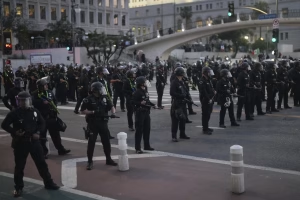
The backlash was immediate. Demonstrators took to the streets across the country, with Los Angeles and Portland seeing large crowds under the banner of the “No Kings” rally — a symbolic protest against Trump’s immigration crackdown and perceived authoritarian overreach. Though largely peaceful, some clashes with law enforcement occurred. In Los Angeles, police deployed tear gas and crowd-control rounds to disperse demonstrators near ICE facilities.
“We’re standing with our families and communities,” said Maria Lopez, a local immigrant rights organizer in LA. “These raids don’t just affect undocumented people — they destroy entire neighborhoods and livelihoods.”
Trump, however, defended the move, crediting the deployment of National Guard units with maintaining relative calm. “Without the Guard, LA would’ve been torn apart,” he said during a press stop ahead of his trip to the G7 summit in Alberta, Canada.
The directive also places pressure on industries heavily dependent on undocumented labor. In sectors like agriculture, hospitality, and food service, employers are voicing concerns over labor shortages. A senior administration official confirmed that enforcement actions at farms and hotels have been “temporarily paused” after industry leaders warned of serious economic fallout.
Trump acknowledged these concerns on Truth Social, writing, “I’ve heard from our farmers and hoteliers — they’re losing good people. But we must uphold the law. There will be adjustments, but the mission continues.”
At the heart of the pushback is California. The state has long stood in defiance of federal immigration enforcement efforts, and Governor Gavin Newsom reiterated that position on Monday. “Trump’s policies are heartless and economically shortsighted,” Newsom said. “California will not be complicit in tearing families apart.”
As deportations surge and protests grow, the national conversation turns once again to whether America can reconcile its immigration enforcement goals with humanitarian values and economic realities. The coming weeks are likely to see continued legal challenges, civil disobedience, and renewed calls for comprehensive immigration reform.
PLAY:

James Jenkins is a celebrated Pulitzer Prize-winning author whose work has reshaped the way readers think about social justice and human rights in America. Raised in Atlanta, Georgia, James grew up in a community that instilled in him both resilience and a strong sense of responsibility toward others. After studying political science and creative writing at Howard University, he worked as a journalist covering civil rights issues before dedicating himself fully to fiction. His novels are known for their sharp, empathetic portraits of marginalized communities and for weaving personal stories with broader political realities. Jenkins’s breakout novel, Shadows of Freedom, won national acclaim for its unflinching look at systemic inequality, while his more recent works explore themes of identity, resilience, and the fight for dignity in the face of oppression. Beyond his novels, James is an active public speaker, lecturing at universities and participating in nonprofit initiatives that support literacy and community empowerment. He believes that storytelling is a way to preserve history and inspire change. When not writing, James enjoys jazz music, mentoring young writers, and traveling with his family to explore cultures and stories around the world.