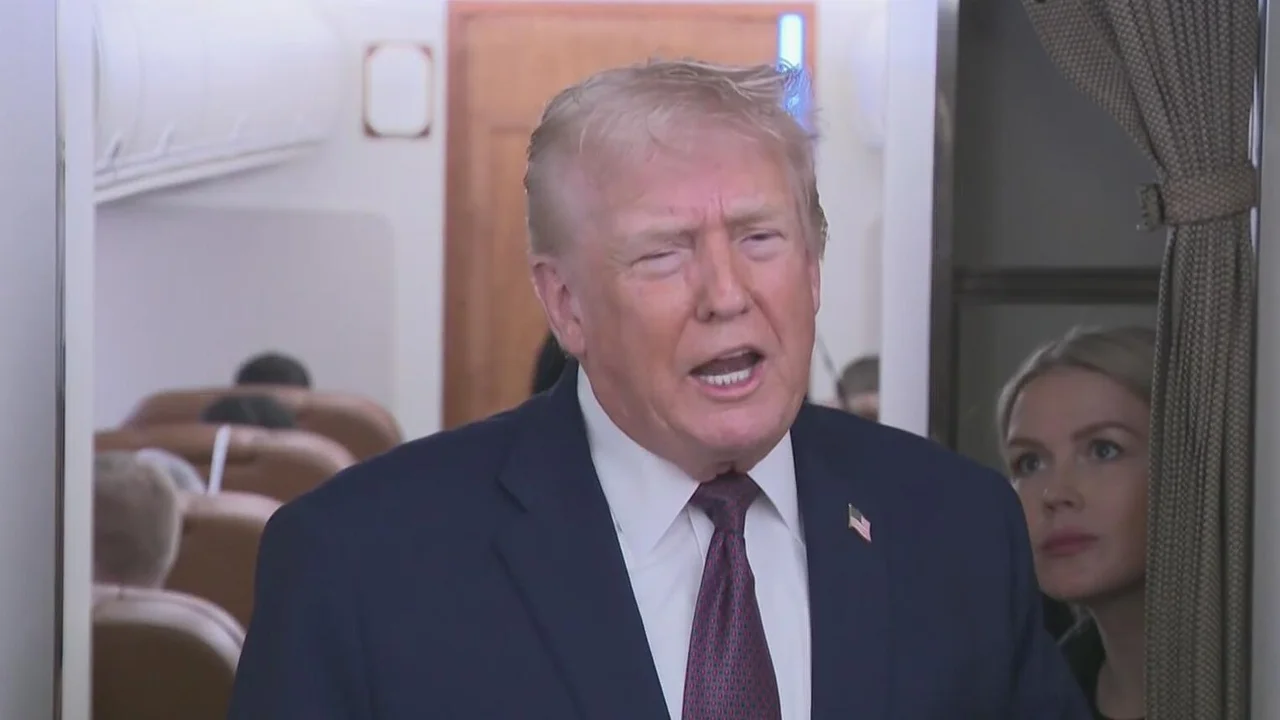
President Donald Trump arrived in Michigan this week with a familiar blend of bravado, grievance, and political theater, using a high-profile visit to tout his economic record while navigating the growing national controversy surrounding a fatal law enforcement encounter in Minneapolis. The president’s day unfolded across factory floors, speaking stages, and television cameras, offering a snapshot of an administration eager to project momentum even as it faces intensifying scrutiny over immigration enforcement and public trust.
In Detroit, Trump stood before business leaders and workers at the Detroit Economic Club, declaring what he called the “strongest and fastest economic turnaround in American history.” He spoke without a teleprompter, pausing often to mock critics, praise loyalists, and attack his predecessor. Inflation, he said, had been “defeated.” Growth, he claimed, was “booming everywhere.” America, in his telling, had reasserted its dominance at home and abroad.
The rhetoric echoed the themes that carried him back to the White House: national pride, economic nationalism, and a promise of restored order. Trump framed his presidency as a rescue mission, arguing that he inherited chaos and replaced it with strength. “We were on our knees,” he said, gesturing across the room. “Now we are respected again.”
Yet the numbers released earlier that morning told a more complicated story. The Consumer Price Index showed inflation holding at 2.7 percent at the end of 2025, with a 0.3 percent monthly increase. While far from the peaks of prior years, the data suggested persistent pressure on household budgets. Economists noted that growth had stabilized but not exploded. For many families, grocery bills and housing costs remained stubbornly high.
Trump brushed aside those nuances. He spoke instead of factories reopening, supply chains stabilizing, and America “winning again.” The audience responded with applause, but outside the ballroom, a different narrative was unfolding—one centered not on prices or productivity, but on power, accountability, and the human cost of enforcement.
Earlier in the day, Trump sat for an interview with CBS News, where he addressed the shooting of a mother of three by an Immigration and Customs Enforcement agent in Minneapolis on January 7. The case had already ignited protests and a fierce national debate about the scope and conduct of federal immigration operations.
“I would bet you that she, under normal circumstances, was a very solid, wonderful person,” Trump said, “but her actions were pretty tough.”
The comment, delivered in the president’s measured cadence, immediately reverberated. Supporters saw a leader acknowledging complexity—recognizing humanity while affirming the dangers officers face. Critics heard something colder: a subtle shift of blame onto a woman who no longer had a voice.
The woman at the center of the storm was Renee Good.
Her name had become a rallying cry in Minneapolis and beyond. Vigils were held. Signs were raised. Community leaders demanded transparency. According to preliminary accounts, the ICE agent involved believed the situation posed a threat. What exactly transpired in those final moments remains under investigation. Body-camera footage has not been fully released. Federal authorities say the inquiry will be thorough. Families and activists say patience has limits.
Trump’s phrasing—“pretty tough”—landed in that tense vacuum, where facts are still emerging and emotions already run high. In a country accustomed to presidential condolences after tragedy, the remark stood apart. It neither condemned nor absolved. It framed the incident as a tragic collision between individual behavior and institutional force.
For the administration, the case has become a stress test of its broader agenda. Trump has made immigration enforcement a cornerstone of his second term, promising mass deportations, expanded authority for federal agents, and a visible crackdown on what he describes as lawlessness. He has praised ICE repeatedly, calling its agents “heroes on the front lines.”
In Michigan, he returned to that theme. “We are restoring order,” he told the crowd. “We are protecting our borders, our communities, and our workers.” He spoke of communities “left behind” and “ignored,” pledging to prioritize citizens over “illegal systems.”
He also touched on foreign policy, boasting of U.S. intervention in Venezuela and portraying America as newly decisive. Environmental regulations, he said, had been “slashed.” Industry, he argued, was “free again.” The speech unfolded as a catalog of triumphs, each claim reinforcing the image of a leader unbound by convention.
But outside the speech hall, demonstrators held signs bearing Good’s name. Some demanded justice. Others demanded restraint. Local officials urged calm while calling for federal cooperation. The divide reflected a larger national fracture: between those who prioritize security above all else and those who fear that security is eroding the moral core of governance.
The president’s defenders argue that his words were realistic. Law enforcement encounters, they say, are inherently volatile. Officers must make split-second decisions. Acknowledging that reality, they contend, does not diminish the value of a life lost. It recognizes the peril of the job.
Critics counter that leadership requires more than realism. It requires empathy that is unambiguous. In moments of grief, they argue, even nuance can feel like deflection. By emphasizing “actions,” they say, the president shifted focus away from institutional responsibility and toward individual fault—before the facts were fully known.
The White House has sought to strike a careful tone. Spokespeople emphasize that the investigation is ongoing and that the president respects due process. They reiterate Trump’s belief that most people, including Good, are “wonderful under normal circumstances.” At the same time, they maintain unwavering support for federal agents.
This dual posture—sympathy paired with steel—defines much of Trump’s governing style. He rarely retreats from confrontation. Instead, he reframes it. Where others might soften language, he sharpens it, trusting that clarity, even when uncomfortable, resonates with his base.
In Michigan, that base was on full display. Workers cheered his arrival. Supporters waved flags. The president walked factory floors, shaking hands and posing for photos. He spoke of “American hands building American greatness.” The imagery was deliberate: industry, labor, nationhood.
Yet the undercurrent of the day remained unresolved. The Minneapolis shooting lingered in every press question, every protest chant, every social media post. It represented more than a single tragedy; it symbolized the stakes of a policy vision that treats enforcement as both shield and sword.
Historically, presidents have struggled to balance authority and compassion in such moments. Too much caution can appear weak. Too much force can appear cruel. Trump has never been inclined toward cautious language. His political identity is built on bluntness, on saying what others will not.
That bluntness, however, carries risk. Words from the Oval Office do not exist in isolation. They shape public memory. They set tone. They become reference points long after investigations conclude.
For Good’s family, the debate is not abstract. It is personal. A mother is gone. Children are left behind. Answers are incomplete. For them, the president’s words are not a policy statement; they are part of a story being written about a life and its end.
For Trump’s supporters, the moment reinforces a narrative of resolve. They see a president unwilling to undermine law enforcement under pressure. They see consistency with campaign promises. They see a leader who will not be swayed by protest.
Between those poles lies a nation accustomed to tragedy yet perpetually shocked by it. The cycle is familiar: an incident, a video, a statement, a backlash, an investigation. What changes are the details and the tone at the top.
As Trump boarded Air Force One after his Michigan visit, aides emphasized the economic message of the day. They highlighted factory tours and applause lines. They framed the trip as a success.
But the echoes of Minneapolis followed him.
In the months ahead, the investigation will yield findings. Footage may be released. Conclusions will be drawn. Some will accept them. Others will not. The administration will continue its push for aggressive enforcement. Activists will continue their push for reform.
What will endure, however, is the memory of how this moment was framed. “Under normal circumstances, a wonderful person,” the president said. “But her actions were pretty tough.”
Those words will be quoted, debated, and judged. They will appear in op-eds and court filings, in protest banners and campaign ads. They will become shorthand for a philosophy of governance that places order at the center, even when order collides with loss.
In a polarized era, both interpretations will persist. To some, the president spoke honestly about danger and consequence. To others, he failed to meet the moral weight of the moment.
As the nation waits for answers from Minneapolis, it is also waiting to see what kind of balance this presidency will strike—between authority and accountability, between strength and compassion, between the power of the state and the fragility of individual lives.
The outcome of that balance will define far more than a single case. It will shape how this era is remembered.

Emily Johnson is a critically acclaimed essayist and novelist known for her thought-provoking works centered on feminism, women’s rights, and modern relationships. Born and raised in Portland, Oregon, Emily grew up with a deep love of books, often spending her afternoons at her local library. She went on to study literature and gender studies at UCLA, where she became deeply involved in activism and began publishing essays in campus journals. Her debut essay collection, Voices Unbound, struck a chord with readers nationwide for its fearless exploration of gender dynamics, identity, and the challenges faced by women in contemporary society. Emily later transitioned into fiction, writing novels that balance compelling storytelling with social commentary. Her protagonists are often strong, multidimensional women navigating love, ambition, and the struggles of everyday life, making her a favorite among readers who crave authentic, relatable narratives. Critics praise her ability to merge personal intimacy with universal themes. Off the page, Emily is an advocate for women in publishing, leading workshops that encourage young female writers to embrace their voices. She lives in Seattle with her partner and two rescue cats, where she continues to write, teach, and inspire a new generation of storytellers.