President Donald Trump has pushed back against renewed speculation about his health after critics accused him of falling asleep during public meetings, offering an explanation that has drawn widespread attention and debate.
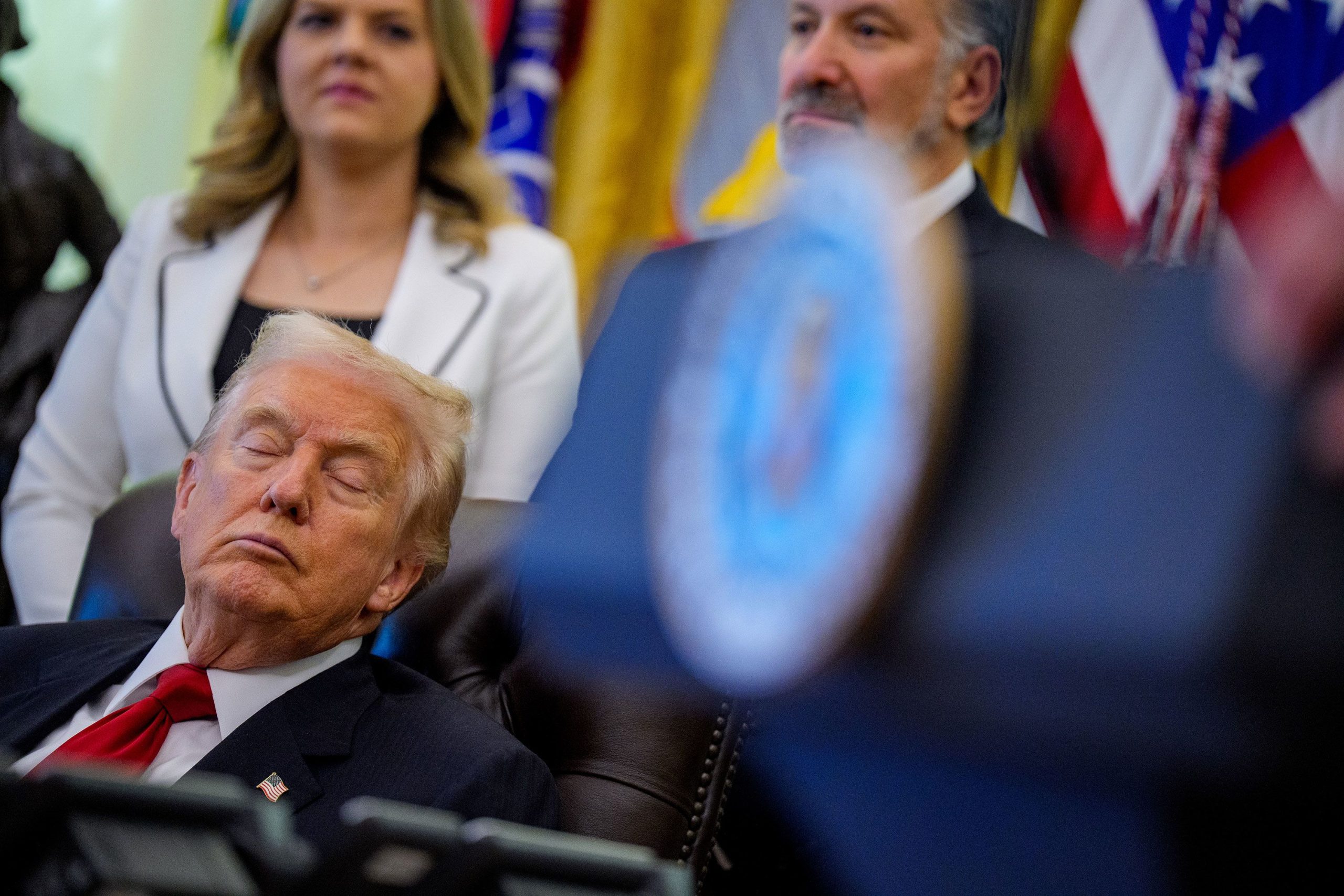
The claims emerged after cameras captured moments in which the president appeared to have his eyes closed during official events, prompting online commentary and renewed scrutiny of his physical condition. Trump, however, has insisted that the images are being misinterpreted and that he was not asleep.
In a recent interview, the president said he was simply resting his eyes — or, in some cases, blinking — and accused the media of seizing on brief moments to fuel misleading narratives about his health.
President Donald Trump attends a public meeting as questions about his health resurface
Health Under the Spotlight
Trump’s health has been a recurring topic of public discussion over the past year, driven by a series of highly visible moments and disclosures. In 2025, speculation intensified after a large bruise was spotted on the president’s hand during public appearances, leading to questions about his condition and prompting the White House to offer explanations.
Around the same time, Trump confirmed that he had been diagnosed with chronic venous insufficiency, a condition in which damaged leg veins struggle to return blood efficiently to the heart. The condition is relatively common among older adults and can cause swelling and discomfort, but doctors generally consider it manageable.
Despite those disclosures, Trump has repeatedly described himself as exceptionally healthy, often claiming he is the “healthiest president ever,” a phrase he has used frequently when addressing critics.
“Resting My Eyes,” Not Sleeping
In an interview with The Wall Street Journal, Trump addressed footage that appeared to show him nodding off during meetings. He dismissed the suggestion outright, saying the moments captured on camera were misleading.
“I’ll just close [my eyes]. It’s very relaxing to me,” Trump said. “Sometimes they’ll take a picture of me blinking, blinking, and they’ll catch me with the blink.”
Trump argued that brief eye closures are being framed unfairly and insisted that he does not fall asleep during meetings. He said the images are often taken out of context and circulated widely online without explanation.
The comments quickly gained traction, with critics calling the explanation unusual while supporters echoed the president’s view that the media exaggerates minor details.
Comparisons With Biden
The issue has taken on added political resonance because Trump has frequently mocked his predecessor, Joe Biden, as “Sleepy Joe,” a nickname he used repeatedly during past campaigns.
Some critics have seized on that contrast, arguing that Trump’s own appearances now invite similar scrutiny. Supporters, however, say the president’s packed schedule and frequent public engagements contradict claims that he lacks energy or focus.
During a cabinet meeting broadcast nationwide last month, Trump asserted that he was “sharper than I was 25 years ago.” Critics later circulated clips from the same meeting suggesting the president appeared to nod off during portions of the discussion.
The White House did not comment directly on those clips, but Trump’s interview remarks appeared aimed at shutting down the speculation.
Trump speaks during a cabinet meeting as footage circulates online
Bruising and Aspirin Use
Trump also addressed questions surrounding bruises that have appeared on his hands, which White House officials previously attributed to frequent handshaking and aspirin use.
In the Journal interview, Trump said he takes aspirin to thin his blood but acknowledged that he does so at a higher dose than doctors typically recommend.
“They say aspirin is good for thinning out the blood, and I don’t want thick blood pouring through my heart,” Trump said. “I want nice, thin blood pouring through my heart. Does that make sense?”
The president went on to say that he takes roughly four times the standard recommended dose, describing himself as “superstitious” about his health regimen.
Medical experts generally caution against excessive aspirin use without close supervision, but Trump indicated he was comfortable with his approach.
Age and Physical Changes
Trump also suggested that age-related changes have made him more prone to bruising, saying his skin has become thinner over time.
He recalled an incident from the 2024 Republican National Convention in which he said then–Attorney General Pam Bondi accidentally cut his hand when her ring caught his skin during a celebratory high-five.
The anecdote was offered as further explanation for visible marks that have drawn attention in photographs and video footage.
Trump gestures during a public event, where bruising on his hands has drawn attention
Online Speculation and Viral Claims
At one point, speculation surrounding Trump’s health escalated to such an extent that false rumors circulated online claiming the president had died after he was not seen publicly for several days. The claims were quickly debunked, but they underscored how intensely his health is monitored and discussed.
Trump has frequently pointed to such rumors as evidence of what he calls irresponsible online behavior and sensationalist coverage. He has argued that the speed and reach of social media amplify minor moments into major controversies.
Cognitive Testing and Reassurance
In recent months, Trump has repeatedly referenced the cognitive exam he took last year, saying he “aced” the test and viewing it as proof of his mental fitness.
He has framed the test as evidence of transparency, contrasting himself with other political figures and arguing that voters deserve reassurance about a leader’s cognitive health.
While medical experts note that cognitive exams can rule out serious impairment, they also caution that such tests are limited in scope and not designed to measure leadership ability or judgment.
A Debate Likely to Continue
As Trump approaches his 80th birthday, questions about age, stamina, and health are unlikely to fade. Supporters argue that his energy, schedule, and willingness to address the issue directly demonstrate resilience. Critics counter that repeated explanations and defenses suggest an issue that will continue to draw scrutiny.
For now, Trump appears determined to confront the speculation head-on, dismissing claims of falling asleep and offering his own explanations, however unconventional they may sound to some.
Whether his reassurances convince skeptics or fuel further debate, the discussion around the president’s health has become a persistent feature of the political landscape — one that shows no sign of disappearing anytime soon.