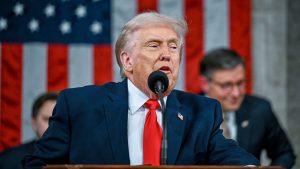
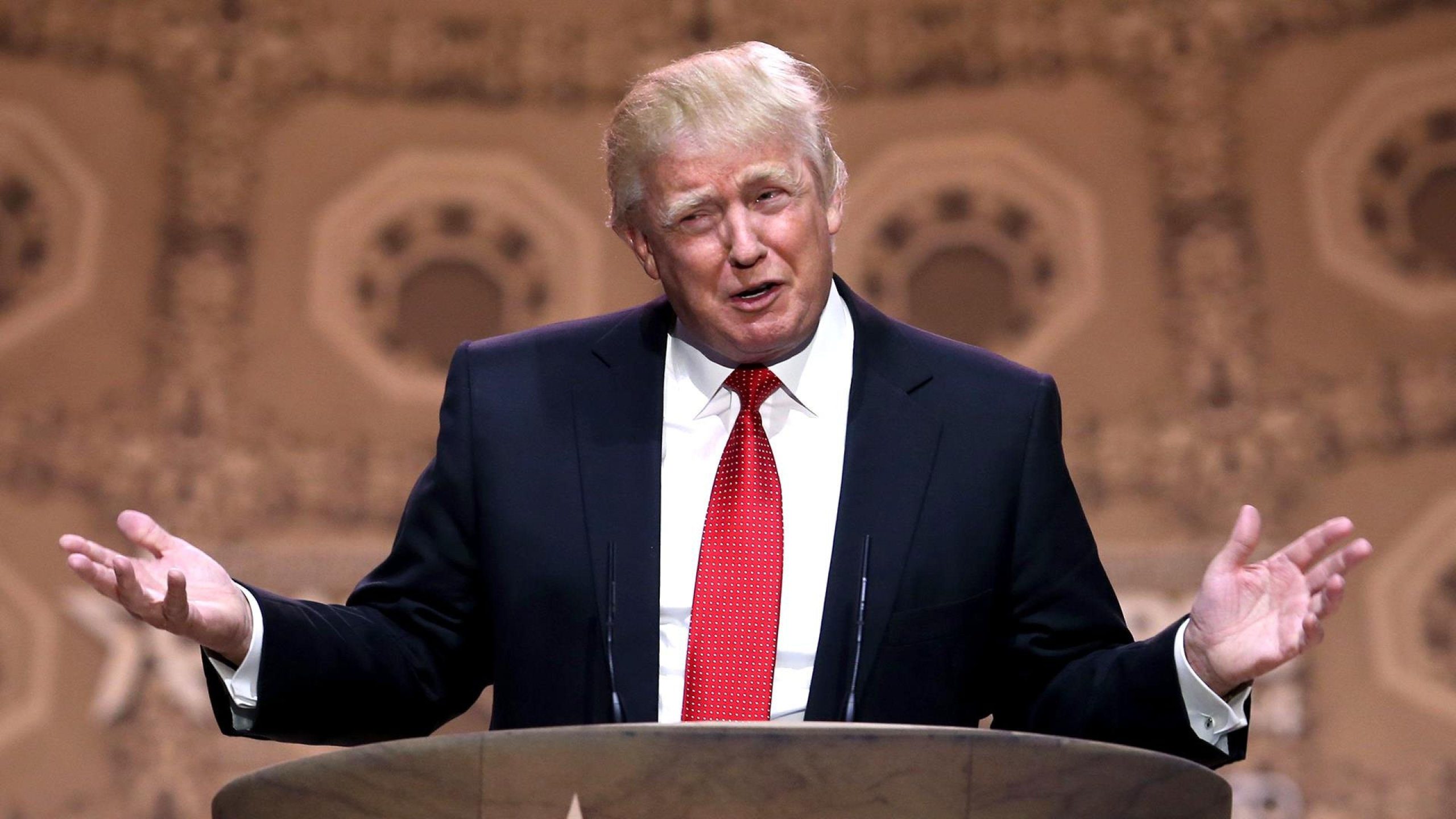
The clash between Donald Trump and Hakeem Jeffries over tariff authority has rapidly escalated into a broader institutional confrontation that now involves the Supreme Court, Congress, and financial markets. The episode illustrates not only a legal dispute over executive power but also a political contest over economic policy, constitutional limits, and messaging ahead of a volatile election cycle.
At the center of the dispute is the Supreme Court’s 6–3 decision to strike down the administration’s use of the International Emergency Economic Powers Act of 1977 as a legal basis for sweeping tariff measures. The Court’s ruling effectively constrained the executive branch’s ability to unilaterally impose broad-based tariffs under emergency authorities, reinforcing the constitutional role of Congress in regulating trade.
Jeffries, the top Democrat in the House, seized on the decision as both a legal and political victory. In a sharply worded statement, he characterized the ruling as “another crushing defeat for the wannabe King,” framing the Court’s intervention as a defense of constitutional balance against executive overreach. His rhetoric reflects a broader Democratic strategy to portray Trump’s economic nationalism as not only harmful to consumers but also institutionally dangerous.
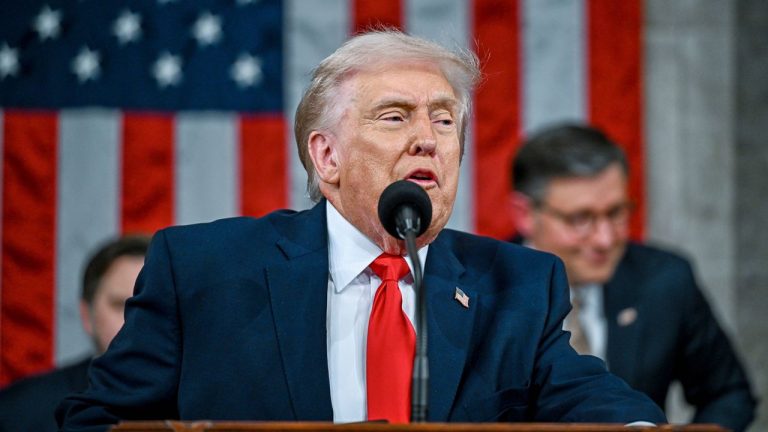
Trump, speaking from the White House, responded with characteristic bluntness. Dismissing Jeffries’ criticism, he attacked the House Minority Leader’s understanding of trade policy and rejected the premise that his tariff authority had been meaningfully curtailed. Trump insisted that he “always had the right to do tariffs,” asserting that existing statutory frameworks and congressional authorizations still provided sufficient legal grounding for his trade agenda.
This assertion reveals a key strategic pivot. Rather than pursuing a new tariff bill through Congress—an approach that would offer stronger legal footing but carry political risk—Trump signaled his intention to rely on alternative statutory mechanisms already on the books. Such a path allows the administration to preserve flexibility while avoiding a contentious legislative battle that could expose fractures within the Republican Party.
Those fractures were already visible in the House vote to rescind tariffs on Canada, where a small group of Republican lawmakers joined Democrats to form a majority against the administration’s policy. Although Trump downplayed the significance of the defections, the vote highlighted the limits of party discipline when trade measures begin to affect domestic industries, consumer prices, and electoral prospects in swing districts.
The political implications are significant. With midterm elections approaching, House Republicans face the challenge of defending a narrow majority while navigating voter concerns about inflation and economic stability. Tariffs, which function as import taxes, can raise costs for businesses and consumers, potentially undermining broader economic messaging centered on growth and job creation. Democrats, for their part, are likely to continue linking tariff policy to price pressures and supply chain disruptions, framing the issue as one of economic competence as well as constitutional governance.
On Wall Street, the Court’s decision triggered a positive market response, reflecting investor relief at the prospect of reduced trade uncertainty. Markets have historically reacted negatively to sudden tariff escalations, which can disrupt global supply chains and provoke retaliatory measures from trading partners. By constraining the executive branch’s unilateral tariff authority, the Court’s ruling may introduce greater predictability into trade policy, at least in the short term.
However, the legal landscape remains complex. The administration retains access to other trade statutes that allow for targeted tariffs under specific conditions, such as national security or unfair trade practices. The question now is whether those narrower authorities can be leveraged to replicate the scope and impact of the invalidated tariff program. Legal challenges are likely to continue, particularly if new measures are perceived as attempts to circumvent the spirit of the Court’s ruling.
From a constitutional perspective, the case underscores an enduring tension between executive flexibility and legislative control. Historically, Congress has delegated certain trade powers to the president to enable rapid responses to economic threats. Over time, however, successive administrations have tested the outer limits of those delegations, prompting periodic judicial interventions. The current dispute may prompt Congress to revisit and clarify the statutory framework governing tariffs, especially if lawmakers seek to reassert institutional authority.
Politically, the rhetorical escalation between Trump and Jeffries signals a broader narrative battle. Trump’s framing emphasizes national sovereignty, economic protection, and party unity, while Jeffries’ messaging centers on rule of law, institutional balance, and consumer impact. Each side is speaking not only to legal realities but also to its electoral base, using the tariff issue as a proxy for larger ideological differences.
Trump’s insistence that he could pass a tariff bill through Congress, while simultaneously asserting that he does not need to, reflects a dual-track strategy. On one hand, it projects confidence in his legislative leverage; on the other, it avoids the practical risks of forcing a vote that could expose internal divisions. This approach allows the administration to maintain momentum on trade policy without committing to a potentially costly legislative fight.
For Jeffries and House Democrats, the Supreme Court’s decision provides a powerful talking point. By framing the ruling as a rebuke of executive overreach, they can position themselves as defenders of constitutional norms while also appealing to economic concerns among voters. The challenge for Democrats will be to translate that legal victory into a coherent economic message that resonates beyond partisan lines.
Looking ahead, the trajectory of U.S. trade policy will depend on how aggressively the administration pursues alternative legal pathways and how willing Congress is to intervene. If lawmakers choose to reassert their authority, the result could be a more structured and predictable tariff regime. If not, the cycle of executive action and judicial review is likely to continue, with each new measure tested in the courts.
In the immediate term, the confrontation between Trump and Jeffries encapsulates a broader moment of institutional friction. It is a dispute not only over tariffs but over the balance of power, the interpretation of statutory authority, and the political framing of economic policy. As the midterm elections approach, the stakes of that dispute will only intensify, shaping both legislative dynamics and the national political narrative.

Emily Johnson is a critically acclaimed essayist and novelist known for her thought-provoking works centered on feminism, women’s rights, and modern relationships. Born and raised in Portland, Oregon, Emily grew up with a deep love of books, often spending her afternoons at her local library. She went on to study literature and gender studies at UCLA, where she became deeply involved in activism and began publishing essays in campus journals. Her debut essay collection, Voices Unbound, struck a chord with readers nationwide for its fearless exploration of gender dynamics, identity, and the challenges faced by women in contemporary society. Emily later transitioned into fiction, writing novels that balance compelling storytelling with social commentary. Her protagonists are often strong, multidimensional women navigating love, ambition, and the struggles of everyday life, making her a favorite among readers who crave authentic, relatable narratives. Critics praise her ability to merge personal intimacy with universal themes. Off the page, Emily is an advocate for women in publishing, leading workshops that encourage young female writers to embrace their voices. She lives in Seattle with her partner and two rescue cats, where she continues to write, teach, and inspire a new generation of storytellers.