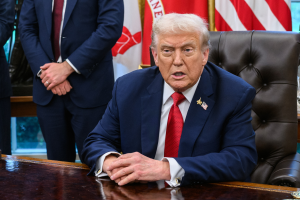
A new allegation involving Donald Trump, a covert recording, and a claim described as “history-shattering” has ignited a wave of speculation across political, media, and legal circles. What began as a serialized memoir about a fallen relationship has now widened into something far more combustible: the suggestion that a secret audio device captured Trump discussing the 2024 assassination attempt in terms drastically different from his public statements — and that those concealed remarks, if true, could dramatically alter the public’s understanding of one of the most shocking political events in recent memory.
The explosive claim comes from journalist Ryan Lizza, who in recent weeks has been publishing an eight-part, intensely personal Substack series about his tumultuous relationship with former New York Magazine reporter Olivia Nuzzi. But in the latest installment, the tone shifts sharply from personal narrative to something closer to political intrigue. Lizza alleges that during the summer of 2024, Nuzzi orchestrated a covert surveillance operation inside Trump’s private residence at Mar-a-Lago — a scheme that allegedly placed a recording device mere feet from the former president during private conversations.
The device, he claims, belonged to a sketch artist sent into Trump’s inner circle under the pretext of creating a portrait. And according to Lizza, that same artist overheard Trump make a comment about the July 2024 shooting in Butler, Pennsylvania — a comment so striking, he writes, that its full disclosure “would shatter our understanding of recent history.”
For now, the substance of the comment remains withheld, teased only as a cliffhanger at the end of his latest chapter. But already the allegation has triggered debate about legality, journalistic ethics, political weaponization, and the reliability of a source airing deeply personal grievances in serialized form.
A Covert Operation Inside Mar-a-Lago
According to Lizza’s account, the alleged recording stems from a covert operation he claims was conceived not by political operatives, but by a journalist who understood Trump’s habits, preferences, and vulnerabilities.
Lizza portrays Nuzzi, 32, as someone who moved within political and media circles with unusual dexterity — a reporter whose access to Trump was both professional and personal. He alleges she persuaded her editors to commission a portrait of Trump, a request that, on its face, seemed harmless: the kind of insider-access journalism New York Magazine routinely published.
But behind the scenes, Lizza claims, the request served a more strategic purpose. The artist chosen for the task, Isabelle Brourman, had previously sketched Trump during his Manhattan criminal trial, where her quiet, non-intrusive presence reportedly made an impression on him. Nuzzi, Lizza argues, knew Trump viewed Brourman favorably and realized she could be granted close-range access without raising suspicion.
In Lizza’s telling, this set the stage for the alleged recording. He writes that Brourman entered Mar-a-Lago with a concealed recording device hidden in her bag — a device he says was active as Trump held conversations involving campaign planning, personal reflections, and, critically, private commentary about the assassination attempt that had nearly taken his life just months earlier.
Lizza offers no proof that audio exists. He does not claim to have heard it himself. What he provides is a narrative: an operation built on trust, proximity, and deception; an artist quietly sketching as Trump spoke freely; and an overheard remark that, according to him, carries monumental implications.
The Assassination Attempt and the Public Narrative
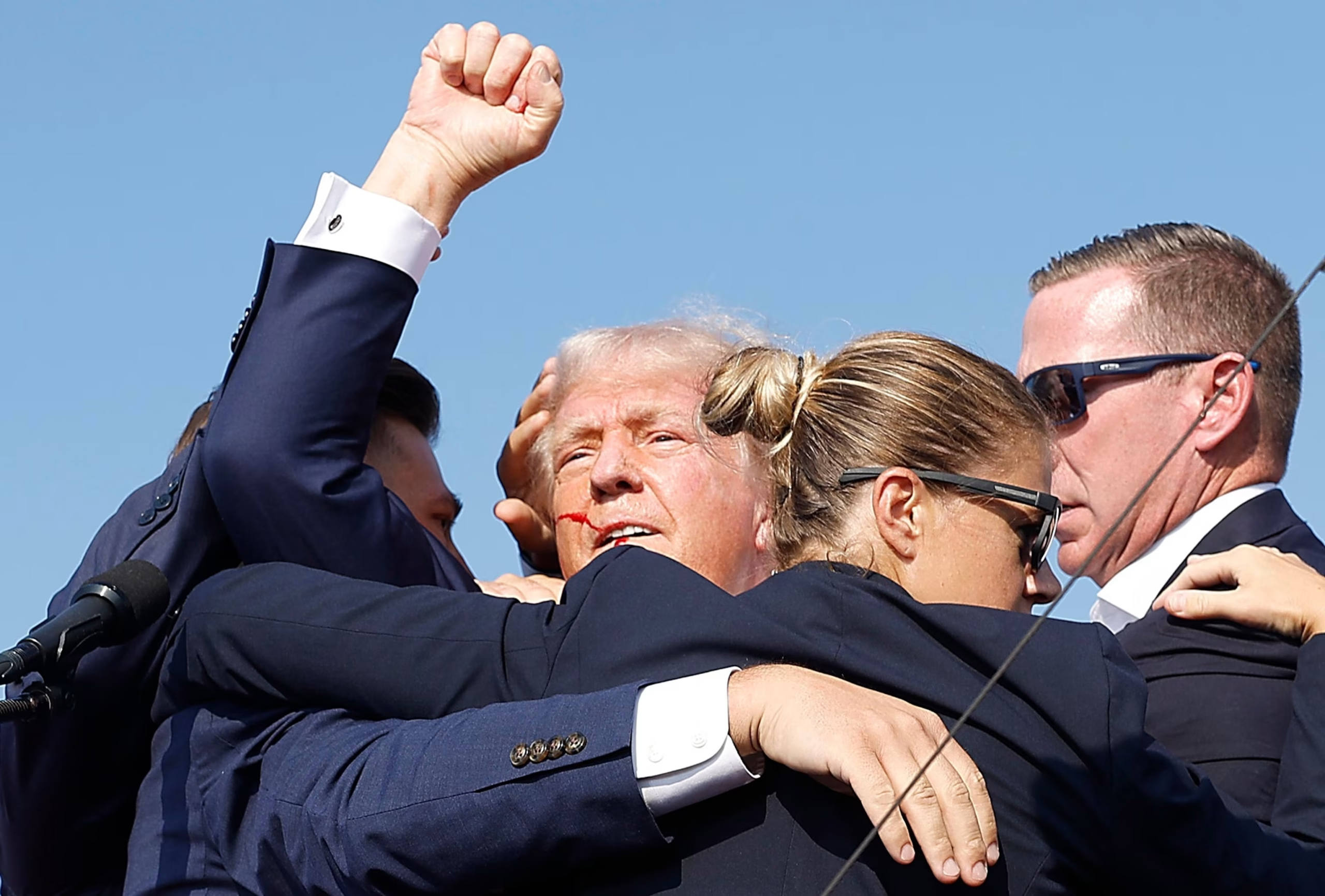
The July 2024 attempt on Trump’s life remains one of the most scrutinized political events of the decade. During a campaign rally in Butler, Pennsylvania, 20-year-old Thomas Matthew Crooks fired shots toward the stage, grazing Trump’s ear and killing Corey Comperatore, a local firefighter who attended the event with his family. The incident instantly reshaped the tone of the election, hardened political divisions, and triggered an intensive federal investigation.
Authorities later concluded that Crooks acted alone. They described him as a troubled young man with a documented history of violent political rhetoric and online radicalization. Investigators found no evidence of foreign involvement, coordinated planning, or accomplices.
That official narrative has become widely accepted — though, unsurprisingly, not universally. Fringe theories have long circulated online. Now, Lizza’s claim introduces a new, unsettling possibility: that Trump himself may have privately voiced doubts, suspicions, or revelations contradicting the government’s findings.
The idea that such a comment exists — and was allegedly captured on tape — instantly elevates the allegation from personal drama to national intrigue.
The Personal Fallout Behind the Revelations
To understand the full context of Lizza’s claim, it is necessary to examine the volatile personal history behind it. His Substack series is not a neutral reporting project. It is, by his own admission, a deeply emotional attempt to process the end of his engagement to Nuzzi, whom he accuses of deception, infidelity, and unethical behavior.
In earlier chapters, Lizza alleges that Nuzzi engaged in an affair with Robert F. Kennedy Jr. during his independent presidential run — allegations Kennedy denies and which Nuzzi describes as an emotional entanglement rather than a physical affair. Lizza claims the relationship influenced her reporting and contributed to Kennedy’s eventual decision to endorse Trump following his withdrawal from the race.
He also alleges that Nuzzi engaged in “catch-and-kill” tactics: obtaining damaging information about political figures but withholding it for strategic purposes. He frames these actions as part of a broader pattern in which journalistic lines blurred with political goals.
These claims are unverified and come from a source whose motivations are entangled with heartbreak, betrayal, and professional rivalry. Yet Lizza argues that the ethics issue transcends personal disputes — that what he witnessed was not merely a relationship unraveling, but a journalist wielding influence with political intent.
His latest installment leans heavily into that argument, presenting the alleged secret recording not as gossip, but as evidence of a deeper ethical crisis.
The Legal Questions Now Looming
If a secret recording of Trump exists, the legal implications would be immediate and potentially severe. Florida is a two-party consent state, meaning covertly recording someone without their knowledge is a felony. This would apply even more forcefully inside a private residence like Mar-a-Lago, where personal expectation of privacy is at its highest.
Such a recording could also trigger federal concerns, given Trump’s status as a former president and current officeholder.
But Lizza stops short of confirming whether the recording device captured usable audio. His wording is intentionally ambiguous: he writes that Brourman was “armed with a recording device” and that she “overheard” Trump’s comment. He does not explicitly state that a recording exists, only that an attempt was made.
This ambiguity has generated an intense split among readers — with some interpreting it as a dramatic setup for the next installment, and others seeing it as an insinuation without evidence.
The Media World Reacts with Caution — and Alarm
Newsrooms and political observers have reacted cautiously but with clear concern.
If the claim is true — and especially if a recording emerges — it would represent one of the most significant journalistic ethics scandals in decades. It would also raise questions about the integrity of reporting on Trump during a period when national divisions were at their peak.
Others note that Lizza’s personal involvement with Nuzzi makes him a conflicted narrator. His depiction of her as a political operative, a manipulator, and now the architect of a covert recording device could be interpreted as deeply biased.
Still, the central detail — that Trump allegedly made a private comment contradicting the public narrative of the assassination attempt — has drawn intense attention. Even critics of Lizza acknowledge that the allegation, if fabricated, is a dangerous one to publish. And if true, its implications are monumental.
The Cliffhanger: What Did Trump Allegedly Say?
Lizza concludes his most recent chapter with a tantalizing tease: that during the portrait session at Mar-a-Lago, Trump made a private remark about the assassination attempt that would fundamentally reshape public understanding of the event.
He does not describe the content.
He does not hint at whether it aligns with conspiracy theories, undisclosed intelligence, personal suspicions, or something else entirely.
He simply writes that readers “may” learn the full details in part four of his series — though he makes no explicit promise.
That silence, more than anything, has fueled the frenzy around the story. Thousands of readers are now waiting for the continuation not because of the relationship drama, but because of the possibility that a secret remark may rewrite the narrative surrounding one of the most consequential moments in modern American politics.
Until Lizza publishes the next installment — and until he provides evidence, not implication — the allegation will remain suspended in uncertainty.
But for now, one thing is clear: the question of what Trump allegedly said in that private room at Mar-a-Lago has become the most anticipated revelation in the entire saga.

Emily Johnson is a critically acclaimed essayist and novelist known for her thought-provoking works centered on feminism, women’s rights, and modern relationships. Born and raised in Portland, Oregon, Emily grew up with a deep love of books, often spending her afternoons at her local library. She went on to study literature and gender studies at UCLA, where she became deeply involved in activism and began publishing essays in campus journals. Her debut essay collection, Voices Unbound, struck a chord with readers nationwide for its fearless exploration of gender dynamics, identity, and the challenges faced by women in contemporary society. Emily later transitioned into fiction, writing novels that balance compelling storytelling with social commentary. Her protagonists are often strong, multidimensional women navigating love, ambition, and the struggles of everyday life, making her a favorite among readers who crave authentic, relatable narratives. Critics praise her ability to merge personal intimacy with universal themes. Off the page, Emily is an advocate for women in publishing, leading workshops that encourage young female writers to embrace their voices. She lives in Seattle with her partner and two rescue cats, where she continues to write, teach, and inspire a new generation of storytellers.