


Trump Suggests America Could Enter a Post-Income-Tax Era
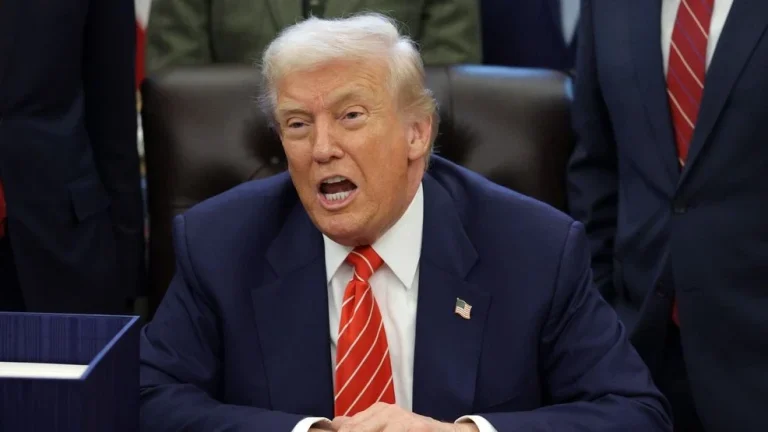
President Donald Trump ignited a political firestorm this week after floating the possibility that Americans may one day stop paying federal income taxes altogether. His remarks came after a Cabinet meeting in Washington, where the president claimed the United States is collecting so much money from tariffs that the government could eventually drop the income tax completely.
The comment landed like a thunderbolt across economic, political, and media circles. While Trump has hinted at transformational tax changes before, this marked his clearest and most direct suggestion that the federal income tax — the backbone of government revenue for more than a century — might be wiped off the books.
And in typical Trump style, he framed the idea not as a far-off dream, but as something Americans might see sooner than anyone expected.
“At some point in the not too distant future you won’t even have income tax to pay,” he told reporters.
The statement immediately set off a national debate. Supporters cheered the possibility of ending what they see as a burdensome, outdated tax system. Critics warned that the math cannot support such a move. Economists scrambled to calculate the consequences. And Congress — the body that would ultimately decide whether such a proposal could become reality — appeared stunned.
Still, Trump’s remarks made one thing certain: the fight over the future of America’s tax system has officially begun.
A Transformational Idea Rooted in a Simple Argument
Trump has long argued that the United States taxes its own citizens too heavily while giving foreign countries an economic free ride. In his view, tariffs should do more of the heavy lifting — and Americans should keep more of their paychecks.
This idea has been a recurring theme at rallies, speeches, and policy rollouts. But until now, it mostly revolved around cutting taxes, not replacing them entirely.
His message after the Cabinet meeting went much further.
Trump said tariff revenue is now “so great… so enormous” that income tax could eventually be eliminated or turned into a symbolic formality.
“Whether you get rid of it or just keep it around for fun or have it really low, much lower than it is now,” Trump said, “you won’t be paying income tax.”
Coming from a sitting president, the suggestion carries immense political weight. It signals that Trump sees the tariff system not just as a negotiating tool, but as a potential primary source of government funding.
And it sets the stage for one of the most explosive policy battles in decades.
Where This Idea Comes From
Trump’s economic philosophy has centered around the idea of taxing foreign manufacturers to give American workers a better deal. His argument is simple:
Stop taxing citizens. Start taxing foreign companies.
Earlier this year, he framed it this way:
“We shouldn’t tax our citizens to enrich foreign nations.
We should tariff foreign nations to enrich our citizens.”
The proposed shift would mark a dramatic break from the modern U.S. tax structure. Instead of relying on income taxes from American workers, Trump wants to bring in revenue by taxing imported goods at higher rates.
According to Trump, this system puts America first, boosts domestic manufacturing, and creates a more self-sufficient economy.
But the idea raises a critical question:
Can tariffs actually generate enough revenue to replace income taxes?
The Math Says “No” — At Least for Now
Economists and tax experts wasted no time challenging Trump’s claim. Several non-partisan analysts noted that income taxes bring in far more money than tariffs.
To put the difference in perspective:
-
Income taxes: over $2.6 trillion per year
-
Tariffs: around $195 billion per year
That means tariffs currently make up only about 3% of federal revenue.
Brandon DeBot of New York University’s Tax Law Center summed up the issue plainly:
“It’s not possible. It’s not feasible mathematically or economically.”
Even if tariffs were raised dramatically, experts say the strategy would backfire. Higher tariffs generally mean fewer imports — which would choke off the very revenue Trump wants to rely on.
In addition, steep tariffs often trigger retaliation from trade partners, hurting American exporters and raising consumer prices at home.
Economists across the political spectrum agree: tariffs cannot replace income tax unless the entire U.S. economy transforms in ways that are unpredictable and risky.
What Would Have to Happen for This Idea to Become Reality
Trump’s proposal — even as a concept — would require a monumental shift in both law and economics.
Here’s what would need to occur:
1. Congress would have to abolish the federal income tax.
This alone would be historic. The income tax has anchored U.S. revenue since 1913. Eliminating it would require sweeping legislation and political unity that does not currently exist.
2. Tariff revenue would have to explode to unprecedented levels.
The U.S. would need either:
-
extremely high tariffs,
-
a massive increase in imports, or
-
a combination of both.
Each option comes with major political and economic risks.
3. Federal spending would need dramatic restructuring.
Unless revenue skyrockets, the government would need to cut spending on a scale never seen in the modern era.
4. The global economy would have to absorb major U.S. tariff changes without triggering trade wars.
No modern country has ever attempted this.
Why Trump Still Sees It as Possible
Despite the enormous challenges, Trump views the idea as visionary, not impossible.
His argument rests on two core beliefs:
First: Tariff revenue will continue to grow rapidly.
Trump claims tariff income is already “enormous” and increasing.
Second: America’s economic strength gives it leverage.
He believes foreign nations will continue selling goods to the U.S. even with steep tariffs—keeping revenue strong while protecting American workers.
To his supporters, Trump’s confidence is not just rhetoric. It’s a sign that he wants to fundamentally rewrite the rules of how America funds its government.
To critics, the plan is grandiose and unrealistic.
Either way, the proposal has forced the entire country to confront a question that once seemed unthinkable:
What would America look like without income tax?
Could This Become a 2028 Campaign Pledge?
Many analysts believe Trump’s remarks were not accidental. Instead, they may be an early test run for a blockbuster 2028 campaign promise.
Eliminating income tax is politically explosive.
But it is also extremely popular — at least in theory.
Such a pledge would deliver:
-
a massive populist message,
-
a simple policy position,
-
and a political earthquake unlike anything in modern U.S. history.
Democrats would call it impossible.
Republicans would split over the economics.
Voters would pay attention.
And for Trump, attention is oxygen.
The Bottom Line
Trump’s suggestion does not mean income tax is going away tomorrow — or ever. The idea would need congressional approval, enormous revenue changes, and sweeping structural reforms.
But the comment represents something bigger:
A willingness to challenge America’s core financial structure and force a national debate on how the government should operate.
Whether the plan is realistic or not, Trump has succeeded in doing what he does best:
Shifting the conversation and setting the political agenda.

Emily Johnson is a critically acclaimed essayist and novelist known for her thought-provoking works centered on feminism, women’s rights, and modern relationships. Born and raised in Portland, Oregon, Emily grew up with a deep love of books, often spending her afternoons at her local library. She went on to study literature and gender studies at UCLA, where she became deeply involved in activism and began publishing essays in campus journals. Her debut essay collection, Voices Unbound, struck a chord with readers nationwide for its fearless exploration of gender dynamics, identity, and the challenges faced by women in contemporary society. Emily later transitioned into fiction, writing novels that balance compelling storytelling with social commentary. Her protagonists are often strong, multidimensional women navigating love, ambition, and the struggles of everyday life, making her a favorite among readers who crave authentic, relatable narratives. Critics praise her ability to merge personal intimacy with universal themes. Off the page, Emily is an advocate for women in publishing, leading workshops that encourage young female writers to embrace their voices. She lives in Seattle with her partner and two rescue cats, where she continues to write, teach, and inspire a new generation of storytellers.