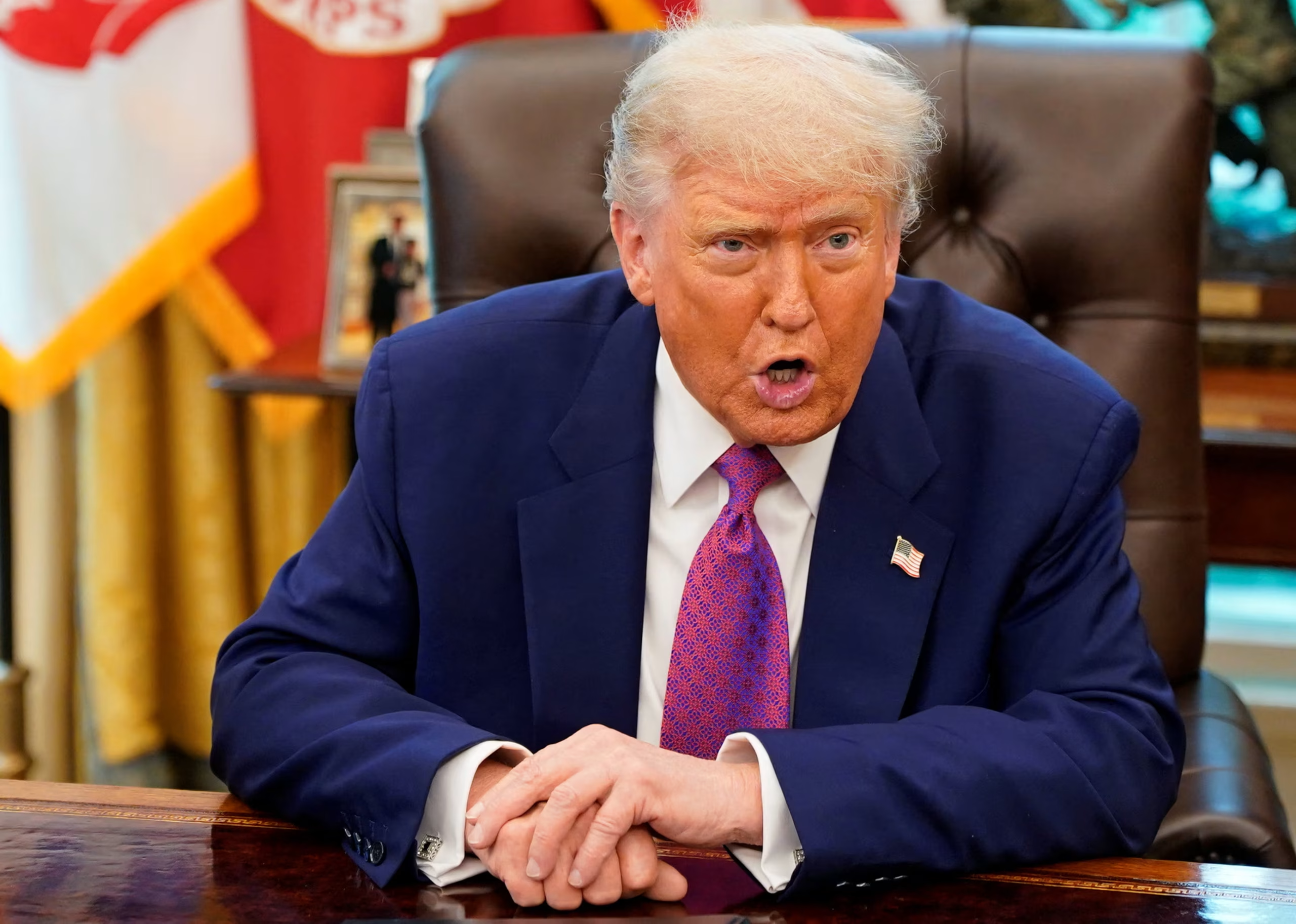
President Donald Trump has signed a sweeping new executive order that could dramatically reshape how the federal government polices the food industry — and the White House is making it clear that rising grocery prices are now officially being treated as a national security issue.
The order establishes powerful new task forces inside both the Department of Justice and the Federal Trade Commission, giving federal investigators expanded authority to probe allegations of price fixing, collusion, and anti-competitive behavior throughout the U.S. food supply chain.
The move marks one of the most aggressive federal crackdowns on the food industry in decades and signals a dramatic escalation in Trump’s war on inflation just months ahead of the 2026 midterm elections.
Administration officials say the goal is simple: find out who is driving up food prices — and hold them accountable.
Why Trump says food prices are now a national security issue
The directive, titled “Addressing Security Risks From Price Fixing and Anti-Competitive Behavior in the Food Supply Chain,” frames food affordability as far more than just an economic problem.
According to the order, vulnerabilities in the food system — ranging from meat processing and fertilizer to seeds, agricultural equipment, and food distribution — now pose direct risks to America’s economic stability and national security.
The White House argues that when large corporations manipulate prices or restrict competition, the consequences ripple far beyond grocery stores. Higher food costs weaken families, strain small businesses, increase reliance on public assistance programs, and leave the nation more vulnerable to supply disruptions.
The executive order also warns that foreign-owned corporations operating in critical areas of the food system may be contributing to price manipulation, potentially exposing the U.S. to external pressure over its own food supply.
New DOJ and FTC task forces created immediately
Under Trump’s directive, the attorney general and the chair of the FTC are now required to form dedicated, permanent task forces focused exclusively on food supply chain misconduct.
These units are authorized to:
• Investigate price fixing and collusion
• Target monopolistic behavior
• Examine foreign ownership in key food sectors
• Launch enforcement actions
• Recommend new federal regulations
• Refer criminal cases for prosecution
If criminal collusion is discovered, the DOJ is directed to pursue indictments and grand jury investigations.
The task forces will also be required to submit joint reports to congressional leadership within 180 days and again at 365 days, keeping lawmakers informed on the progress of investigations.
Foreign ownership now under the microscope
One of the most significant components of Trump’s new order is its focus on foreign control of American food companies.
Federal investigators are now instructed to determine whether foreign-owned firms are deliberately inflating prices, restricting production, or manipulating supply chains in ways that harm American consumers.
The administration argues that foreign control over meatpacking plants, fertilizer production, seed technology, and food transportation puts the U.S. at serious strategic risk during times of conflict, trade disputes, or international instability.
Trump officials have repeatedly argued that America cannot remain dependent on overseas corporations for the survival of its own food system.
The beef industry is already under federal scrutiny
Trump’s latest move builds directly on investigations that began earlier this year.
In November 2025, the president formally requested a DOJ investigation into major meatpacking corporations amid mounting allegations of price manipulation in the beef industry.
At the time, Trump accused major foreign-owned meat processors of artificially inflating prices while forcing American ranchers to absorb the blame.
“We will always protect our American Ranchers,” Trump wrote. “They are being blamed for what is being done by majority foreign-owned meat packers who artificially inflate prices and jeopardize the security of our Nation’s food supply.”
That investigation has now effectively been supercharged with the creation of the new task forces.
Reports of past settlements already in the tens of millions
The executive order points to a history of civil settlements involving alleged price fixing in multiple areas of the food system.
Over the past decade, federal regulators have secured tens of millions of dollars in settlements linked to anti-competitive behavior involving:
• Chicken processing
• Pork production
• Fertilizer manufacturing
• Agricultural inputs
• Distribution networks
The administration believes these past cases represent only a fraction of the true scope of price manipulation affecting American consumers today.
Trump prepares nationwide tour focused on affordability
The move comes as Trump prepares to begin a major nationwide tour focused almost entirely on economic messaging and household affordability.
The president is expected to travel across multiple battleground states promoting what the White House describes as “clear progress” on inflation, gas prices, wages, and economic confidence.
His first stop is scheduled for a casino in northeastern Pennsylvania, where Trump plans to highlight:
• Lower gas prices
• Energy investment deals
• Artificial intelligence development
• Japanese investment in U.S. Steel
• Manufacturing expansion
The administration believes the food pricing crackdown will be a major pillar of Trump’s economic argument heading into 2026.
Consumer confidence begins to rebound
New economic data released on Friday delivered encouraging news for the administration.
Consumer sentiment rose for the first time in five months, with Americans reporting increasing confidence about their personal finances and expectations for inflation.
White House officials credit falling fuel prices, slowing inflation, and stronger labor market stability for the shift — though food prices remain one of the most stubborn pressure points for households nationwide.
Democrats pivot to “Make America Affordable Again” message
Democrats are expected to make affordability the centerpiece of their midterm campaign strategy.
Party leaders have begun branding their message as “Make America Affordable Again” (MAAA) — a direct attempt to counter Trump’s economic narrative.
They have focused heavily on:
• Housing affordability
• Grocery prices
• Healthcare costs
• Student loan debt
• White House renovations
Democrats have highlighted projects like Trump’s planned ballroom renovation at the White House as evidence, they say, of misplaced priorities while families struggle financially.
Trump counters with rebates and long-term mortgages
Trump, however, is pushing back with proposals designed to directly appeal to middle- and working-class voters.
These include:
• Tariff rebate payments
• Expansion of domestic manufacturing
• Energy price controls
• Fifty-year mortgage options for first-time buyers
• Major tax reforms linked to domestic production
White House officials argue that cutting inflation permanently requires structural change — not temporary subsidies.
What happens next
The DOJ and FTC task forces are now officially activated and will begin issuing subpoenas, data requests, and market audits in the coming weeks.
Industries most likely to face immediate scrutiny include:
• Beef, chicken, and pork processing
• Fertilizer manufacturing
• Seed and genetic crop technology
• Food transportation and logistics
• Wholesale grocery suppliers
Legal experts say corporations facing investigation could be exposed to massive civil penalties, criminal charges, forced divestment, or even breakup orders if monopolistic control is proven.
The political stakes could be enormous
The food price crackdown is shaping up to be one of the most politically explosive enforcement actions of Trump’s second term.
If federal investigators uncover widespread collusion or manipulation, it would validate years of public anger over grocery inflation — and could dramatically reshape the food industry.
If the investigations stall, however, Democrats are prepared to argue that Trump overpromised and underdelivered on one of the most painful economic issues facing everyday Americans.
Either way, the battle over who controls America’s food prices has officially become a central fight heading into the next election cycle.

Emily Johnson is a critically acclaimed essayist and novelist known for her thought-provoking works centered on feminism, women’s rights, and modern relationships. Born and raised in Portland, Oregon, Emily grew up with a deep love of books, often spending her afternoons at her local library. She went on to study literature and gender studies at UCLA, where she became deeply involved in activism and began publishing essays in campus journals. Her debut essay collection, Voices Unbound, struck a chord with readers nationwide for its fearless exploration of gender dynamics, identity, and the challenges faced by women in contemporary society. Emily later transitioned into fiction, writing novels that balance compelling storytelling with social commentary. Her protagonists are often strong, multidimensional women navigating love, ambition, and the struggles of everyday life, making her a favorite among readers who crave authentic, relatable narratives. Critics praise her ability to merge personal intimacy with universal themes. Off the page, Emily is an advocate for women in publishing, leading workshops that encourage young female writers to embrace their voices. She lives in Seattle with her partner and two rescue cats, where she continues to write, teach, and inspire a new generation of storytellers.