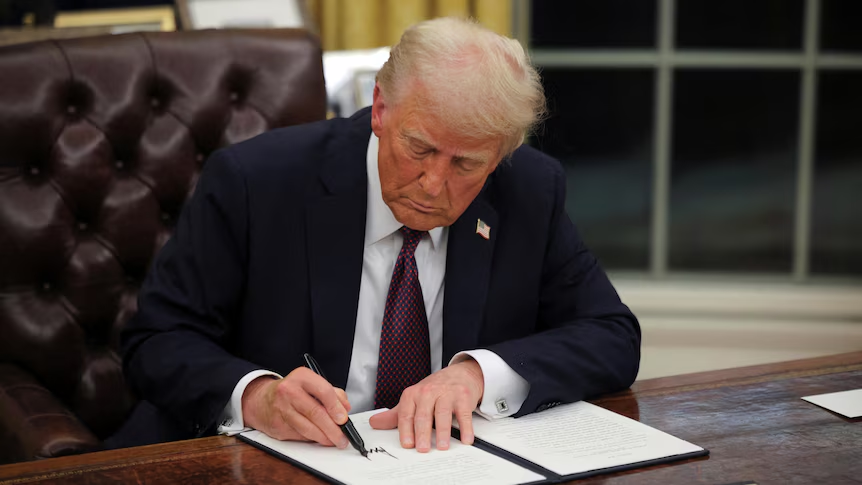
Within hours of NASA’s latest permanent administrator being sworn in, President Donald Trump issued a sweeping executive order aimed at securing American superiority in space, emphasizing national security, commercial growth, and human exploration as core priorities.
“Superiority in space is a measure of national vision and willpower, and the technologies Americans develop to achieve it contribute substantially to the nation’s strength, security, and prosperity,” Trump stated in the order. “The United States must therefore pursue a space policy that will extend the reach of human discovery, secure the nation’s vital economic and security interests, unleash commercial development, and lay the foundation for a new space age.”
The executive order outlines four overarching priorities for the United States’ space program: expanding human presence and American leadership in space exploration, defending national and economic security interests in and from space, cultivating a vibrant commercial space economy, and laying the groundwork for “the next century of space achievements” through advanced technological development.
Specific Goals and Deadlines
Several high-priority objectives are detailed in the order, accompanied by tight deadlines. By 2028, the United States aims to return astronauts to the moon, demonstrate prototype next-generation missile defense technologies, and attract at least $50 billion in investment into domestic space markets.
Looking further ahead, by 2030, the United States seeks to establish foundational elements for a permanent lunar outpost. This includes deploying a nuclear-powered lunar surface reactor and creating a commercial pathway to replace the International Space Station, which is approaching the end of its operational life. These goals are framed as critical to maintaining U.S. leadership in space and ensuring strategic, economic, and technological advantages over other nations.
Additionally, the order emphasizes the need for operational standards in space. The administration calls for establishing frameworks for orbital traffic management, mitigation of space debris, and lunar navigation systems, all aimed at laying the foundation necessary to eventually send humans to Mars and ensure long-term U.S. dominance in space exploration.
Agency Responsibilities and Deadlines
The executive order directs several senior officials to deliver detailed implementation plans in rapid succession. NASA Administrator Jared Isaacman has 90 days to submit a comprehensive plan to expand human reach and American presence in space, while also addressing supply chain, technology, or industrial capacity gaps relevant to the achievement of these objectives.
Isaacman is further tasked to work with Commerce Secretary Howard Lutnick to identify major space acquisition programs that are behind schedule, over budget, or misaligned with the administration’s priorities, and to provide remediation plans within the same 90-day window. Within 120 days, Isaacman and Secretary of State Marco Rubio must review international civil space cooperation arrangements involving NASA, determining whether existing agreements support the policy priorities outlined in the order and terminating or initiating arrangements as necessary.
The executive order leaves open questions regarding the United States’ current collaborations with international partners, including the European Space Agency (ESA), the Japan Aerospace Exploration Agency (JAXA), and the Canadian Space Agency (CSA). The order also creates uncertainty about the future of the Artemis Accords, which form the framework for peaceful international cooperation on lunar exploration.
Space Security Measures
National security is a central component of the executive order. War Secretary Pete Hegseth, working with National Intelligence Director Tulsi Gabbard and the assistant to the president for national security affairs, must provide a report within 90 days identifying technology, supply chain, and industrial gaps relevant to enhancing U.S. air and missile defenses. Additionally, the trio has 180 days to develop a space security strategy addressing current and potential threats from low Earth orbit through cislunar space, including the possible deployment of nuclear weapons in orbit.
The order further instructs officials to create an adaptive and responsive national space security architecture and strengthen partnerships and alliances to maintain collective space security, signaling a clear emphasis on preempting strategic threats from adversaries in space.
Commercial Space Development
Beyond national security, the executive order prioritizes commercial investment and innovation. By 2028, the administration aims to attract at least $50 billion in private sector investment to the U.S. space market, fostering a competitive domestic commercial space sector capable of supporting exploration, infrastructure development, and broader economic growth.
The order also emphasizes sustainability, calling for investments in Earth-based infrastructure such as launch and landing facilities, as well as improvements in commercial business models and operational efficiency. This approach seeks to balance technological ambition with financial prudence, ensuring the United States can lead both scientifically and commercially in the emerging space economy.
Coordination Across Government
The executive order envisions a highly coordinated federal effort. The assistant to the president for science and technology will oversee collaboration among department and agency leaders, ensuring that objectives are met in a timely manner. Within 60 days, guidance for establishing the National Initiative for American Space Nuclear Power must be issued, signaling a focus on nuclear propulsion technologies to support long-term lunar and deep-space missions.
The order represents a departure from previous administration approaches that often prioritized incremental goals over rapid, high-visibility milestones. Trump’s directive reflects a desire to accelerate American efforts in space and assert U.S. dominance as a technological and strategic leader.
Artemis and Beyond
The timing of the executive order coincides with NASA’s preparations for the Artemis II mission, which will carry the first humans around the moon since 1972. The mission’s launch window opens in early February 2026, with the goal of liftoff no later than April 30. This historic flight is expected to demonstrate the capability for sustained human operations beyond low Earth orbit and provide a foundation for long-term lunar exploration in line with the president’s stated objectives.
The Artemis program has been central to U.S. lunar ambitions, with Artemis I already completing an uncrewed lunar orbit demonstration. The upcoming mission, Artemis II, will validate human-rated spacecraft systems and operational procedures essential for a permanent lunar presence. Trump’s executive order positions the Artemis program as a cornerstone for broader ambitions, including commercial expansion and strategic dominance in space.
Implications for International Partnerships
The executive order also raises questions regarding international cooperation. The United States has long relied on collaborative efforts with partners such as ESA, JAXA, CSA, and private sector contractors. While the order signals an assertive stance on U.S. leadership, it remains unclear whether it will strain existing partnerships or necessitate renegotiation of ongoing agreements.
Experts note that balancing national priorities with cooperative frameworks is critical. “Space exploration is inherently international,” said Dr. Andrea Morales, a senior policy analyst in aerospace strategy. “The U.S. can pursue superiority, but it must maintain partnerships that enhance technical capabilities and share the risks and costs of deep-space missions.”
Strategic Rationale
Trump’s order frames space as a domain of strategic competition, emphasizing both security and economic objectives. By asserting U.S. leadership in commercial, scientific, and defense domains, the administration aims to ensure that the country remains competitive in a rapidly evolving space landscape.
Analysts suggest that space superiority is increasingly seen as essential to national defense, economic growth, and technological prestige. With other nations investing heavily in orbital and lunar capabilities, the United States is seeking to secure a competitive edge through accelerated development, policy leadership, and infrastructure investment.
Public and Industry Reaction
Initial reactions from the space community have been mixed. Commercial contractors welcome the emphasis on investment and clear targets, while some scientists caution that rapid deadlines could strain resources and compromise safety. Industry leaders note that coordination among agencies and adherence to rigorous testing protocols will be essential to achieving ambitious goals.
“There is excitement about the clarity of direction,” said Mark Reynolds, CEO of a major commercial launch provider. “But the timelines are aggressive. Meeting them will require unprecedented collaboration between NASA, the Department of Defense, private industry, and international partners.”
Policy experts also highlight potential legal and regulatory challenges, particularly around space nuclear power and orbital traffic management. Establishing a national framework that is both safe and internationally compliant will be critical to the administration’s long-term objectives.
Looking Ahead
Trump’s executive order represents a decisive push to ensure American leadership in space. The directive spans commercial investment, scientific exploration, and national security, with a focus on tangible milestones and strict timelines. By setting clear goals for lunar exploration, orbital defense, and Mars readiness, the administration is signaling that space is a top-tier national priority.
As NASA prepares for the Artemis II mission and private companies gear up to expand commercial activities, the coming years are likely to witness a significant acceleration in U.S. space initiatives. The executive order also establishes a framework for monitoring progress, addressing deficiencies, and ensuring alignment with national objectives, reflecting an integrated approach to space leadership.
The directive’s success will ultimately depend on the ability of federal agencies, commercial partners, and international collaborators to work in unison, overcoming technological, logistical, and regulatory challenges. The world will be watching closely as the United States moves to assert its dominance in space, setting ambitious targets for lunar and deep-space missions while maintaining national security and fostering commercial growth.
In summary, Trump’s executive order lays out a comprehensive vision for American space leadership, blending security, economic, and exploratory priorities. With aggressive deadlines, high-profile projects like the Artemis II mission, and a focus on both domestic and international engagement, the administration seeks to redefine the country’s space agenda and secure its position as a preeminent power in the final frontier.

Emily Johnson is a critically acclaimed essayist and novelist known for her thought-provoking works centered on feminism, women’s rights, and modern relationships. Born and raised in Portland, Oregon, Emily grew up with a deep love of books, often spending her afternoons at her local library. She went on to study literature and gender studies at UCLA, where she became deeply involved in activism and began publishing essays in campus journals. Her debut essay collection, Voices Unbound, struck a chord with readers nationwide for its fearless exploration of gender dynamics, identity, and the challenges faced by women in contemporary society. Emily later transitioned into fiction, writing novels that balance compelling storytelling with social commentary. Her protagonists are often strong, multidimensional women navigating love, ambition, and the struggles of everyday life, making her a favorite among readers who crave authentic, relatable narratives. Critics praise her ability to merge personal intimacy with universal themes. Off the page, Emily is an advocate for women in publishing, leading workshops that encourage young female writers to embrace their voices. She lives in Seattle with her partner and two rescue cats, where she continues to write, teach, and inspire a new generation of storytellers.