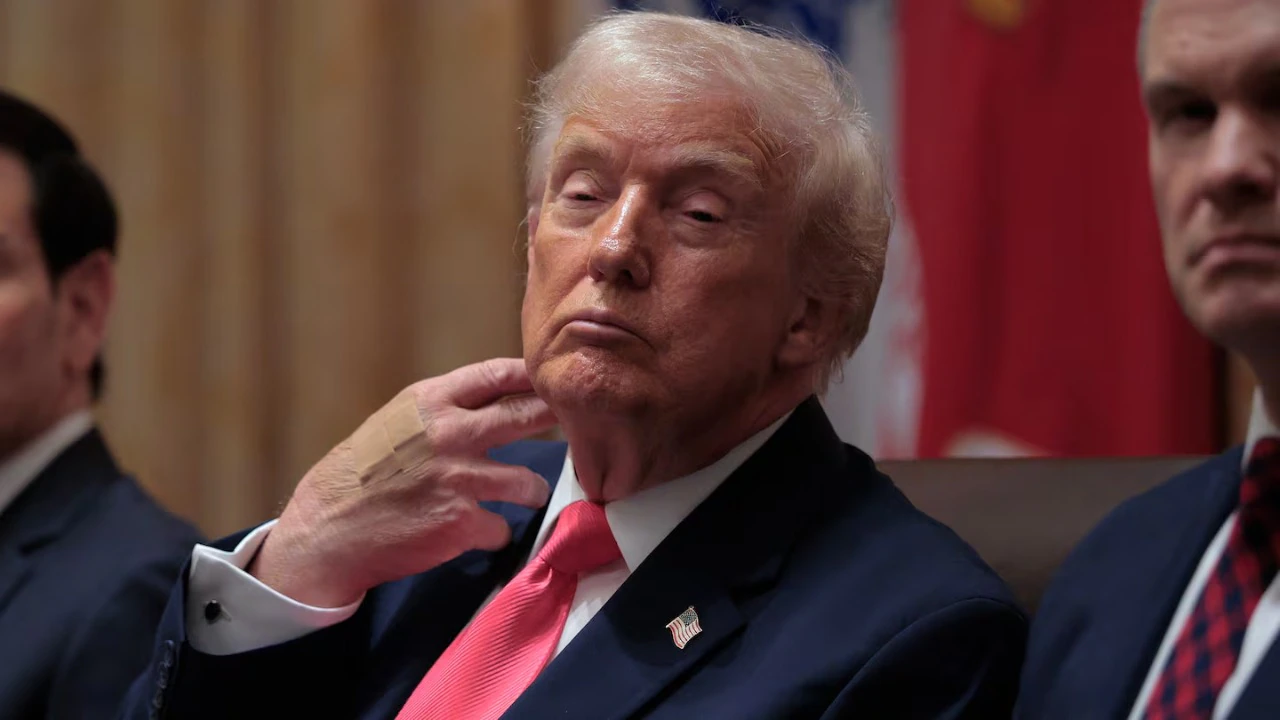
In a provocative and widely shared social media post on Sunday, U.S. President Donald Trump presented himself as the “Acting President of Venezuela,” a bold declaration that has drawn international attention and raised questions about the legality and intent of the message.
The image—shared on Trump’s Truth Social platform—was formatted like a screenshot of a Wikipedia-style profile. It listed Trump’s official portrait alongside his titles as both the 45th and 47th President of the United States, and it added a new line describing him as “Acting President of Venezuela, Incumbent January 2026.” The post also identified U.S. Vice President J.D. Vance as Trump’s deputy in that role.
The unusual claim comes amid a period of heightened U.S. involvement in Venezuela, one of the world’s most oil-rich nations, following a dramatic military operation earlier this month that resulted in the capture of Venezuelan leader Nicolás Maduro and his wife, Cilia Flores. They were transported to the United States to face federal charges, including alleged narcoterrorism and weapons violations.
A Social Media Declaration With Real-World Implications
The Truth Social post has no basis in Venezuelan law or international recognition; no official documentation or global entity has acknowledged Trump as Venezuela’s acting president. Venezuela’s own constitutional processes saw Vice President and oil minister Delcy Rodríguez sworn in as interim president in Caracas after Maduro’s detention, according to Venezuelan legal authorities.
Despite this, Trump’s post reflects a narrative he and members of his administration have pursued in recent days—that Washington will shepherd Venezuela through a transitional period following what the U.S. describes as a necessary intervention to combat drug trafficking and political corruption.
In past statements, Trump has insisted that the United States would “run” Venezuela during this period, and that American and Venezuelan interests must align to stabilize the country and leverage its vast oil reserves. He has also discussed cooperation with Venezuela’s interim leadership and has signaled interest in meeting with Rodríguez in upcoming diplomatic engagements.
Global Reactions and Legal Questions
The post has already sparked debate among legal scholars, foreign policy analysts, and international relations experts. Many have pointed out that the U.S. Constitution and widely accepted international law do not permit a sitting U.S. president to assume executive authority over a foreign government, let alone declare such authority on social media. Critics argue that the declaration could undermine diplomatic norms and potentially violate both U.S. and international laws governing sovereignty and noninterference.
“It’s one thing to offer support for a transitional process, but it’s another to claim an official title over another sovereign nation,” said a professor of international law at a leading university. “This raises both constitutional questions at home and serious diplomatic concerns abroad.”
Skeptics note that the post appears to be symbolic or rhetorical rather than a formal policy declaration. However, given the context of recent U.S. actions in Venezuela, many officials and analysts are taking the message seriously because of its potential geopolitical ramifications.
Several foreign governments have already responded with caution or condemnation, stressing the importance of respecting Venezuelan sovereignty and urging diplomatic solutions rather than unilateral assertions of authority.

The U.S. Military Operation in Venezuela
The backdrop to Trump’s social media declaration is a large-scale U.S. military operation conducted in Caracas on Jan. 3, during which Venezuelan leaders were captured by U.S. forces. Trump and his administration justified the operation as part of an effort to dismantle narco-trafficking networks and bring criminal leaders to justice.
The operation, which involved precision strikes and a coordinated seizure of key individuals, prompted condemnation from many international actors who criticized what they viewed as an infringement on Venezuelan sovereignty. Maduro has denied wrongdoing and has repeatedly insisted that his capture was illegal.
In the immediate aftermath, thousands of Venezuelans protested his removal, and a domestic political debate erupted over who should legitimately lead the country. Rodríguez’s installation as interim president was recognized by some, though not all, domestic and foreign entities, leaving Venezuela’s political landscape deeply contested.
U.S. Goals and Oil Strategy
Trump has also positioned the United States as a key player in rebuilding Venezuela’s battered energy sector. In recent days, he has pointed to agreements reportedly made with Venezuela’s interim authorities to transfer millions of barrels of oil to the United States and to involve major oil companies in investment and redevelopment projects.
On Truth Social, Trump reiterated that oil proceeds would be managed in a way he believes would benefit both Venezuelans and U.S. taxpayers. Whether these arrangements are finalized or legally enforceable remains unclear, but they underline the strategic importance of Venezuela’s oil reserves in U.S. foreign policy considerations.
Domestic Political Implications
The assertion of acting presidential authority over Venezuela has stirred debate within the United States as well. Supporters of the move say it reflects bold leadership at a time when regional security and drug enforcement are priorities. They argue that the dramatic social media post underscores Trump’s commitment to decisive action.
Critics argue that it undermines democratic norms and could embroil the United States in a protracted overseas conflict without clear congressional authorization. Some constitutional scholars have suggested that such moves could trigger legal challenges or ignite debate over the powers of the executive branch in foreign affairs.
International Norms and Sovereignty
International relations experts warn that unilateral claims of leadership over another sovereign state could erode long-standing norms that govern diplomatic relations. Even allies of the United States have expressed concern that the move—especially when framed in a satirical or provocative online document—could complicate cooperation on other global issues.
At the United Nations, diplomats said they were closely monitoring developments, emphasizing that any changes in Venezuelan leadership should be handled through recognized diplomatic channels and with respect for international law.
What Comes Next
As Trump continues to publish provocative declarations on social media, world leaders are likely to watch closely for further signals about U.S. intentions in Venezuela. Whether the acting president claim will have any legal or diplomatic force remains to be seen, but it has already fueled discussions about sovereignty, intervention, and the bounds of executive power in foreign policy.
In the meantime, Venezuelan interim authorities under Rodríguez continue to assert their own claim to leadership, while Maduro’s legal team fights his detention in U.S. courts and political figures at home denounce the foreign intervention.
The situation in Venezuela remains fluid, and Trump’s social media declaration—however symbolic—adds a new dimension to an already complex international crisis.

Emily Johnson is a critically acclaimed essayist and novelist known for her thought-provoking works centered on feminism, women’s rights, and modern relationships. Born and raised in Portland, Oregon, Emily grew up with a deep love of books, often spending her afternoons at her local library. She went on to study literature and gender studies at UCLA, where she became deeply involved in activism and began publishing essays in campus journals. Her debut essay collection, Voices Unbound, struck a chord with readers nationwide for its fearless exploration of gender dynamics, identity, and the challenges faced by women in contemporary society. Emily later transitioned into fiction, writing novels that balance compelling storytelling with social commentary. Her protagonists are often strong, multidimensional women navigating love, ambition, and the struggles of everyday life, making her a favorite among readers who crave authentic, relatable narratives. Critics praise her ability to merge personal intimacy with universal themes. Off the page, Emily is an advocate for women in publishing, leading workshops that encourage young female writers to embrace their voices. She lives in Seattle with her partner and two rescue cats, where she continues to write, teach, and inspire a new generation of storytellers.