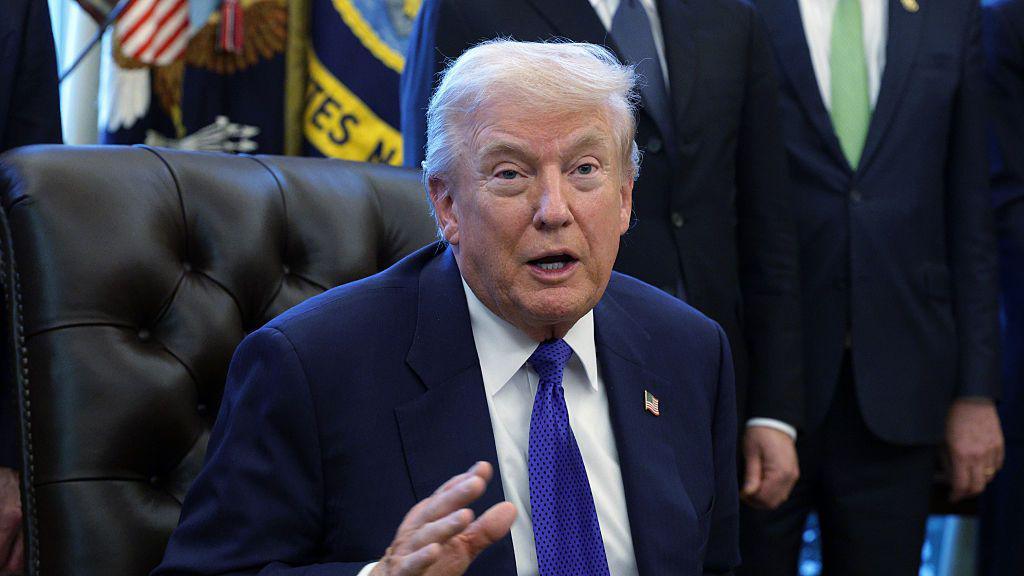
President Donald Trump on Wednesday seized on a newly released employment report that he described as “far greater than expected,” arguing that the latest data confirm the strength of the U.S. economy and justify significantly lower borrowing costs for the federal government.
In a post on Truth Social shortly after the figures were made public, Trump declared the report a major economic victory.
“Just in: GREAT JOBS NUMBERS, FAR GREATER THAN EXPECTED!” he wrote.
The president went on to connect the strong labor market performance to the cost of government debt, contending that the United States, as what he characterized as the strongest nation in the world, should be paying the lowest interest rates.
“The United States of America should be paying MUCH LESS on its Borrowings (BONDS!),” Trump wrote. “We are again the strongest Country in the World, and should therefore be paying the LOWEST INTEREST RATE, by far.”
He further claimed that lower rates would translate into dramatic savings for taxpayers, suggesting that interest cost reductions could total at least one trillion dollars per year, paving the way for a balanced federal budget. “The Golden Age of America is upon us!!!” he added.
The comments came as financial markets reacted positively to the fresh economic data. Major stock indexes climbed in early trading, reflecting investor optimism that the economy remains resilient despite ongoing concerns about inflation and monetary policy.
Shortly after markets opened Wednesday morning, the S&P 500 and the Nasdaq Composite both rose to their highest levels in a week. The gains were fueled by the employment figures, which pointed to continued labor market stability and stronger-than-anticipated job creation. Investors interpreted the data as evidence that economic momentum remains intact.
The Dow Jones Industrial Average advanced more than 200 points in early trading, while the S&P 500 and Nasdaq each posted gains of roughly half a percent. Market breadth was also notable: dozens of stocks reached new 52-week highs, underscoring the broad-based nature of the rally.
Behind the market reaction was a key detail in the report: job growth had accelerated in January, while the unemployment rate edged lower. Together, these developments signaled that employers continue to hire at a healthy pace and that the labor market remains tight.
Only midway through the report did the full significance of the headline figure become clear. Employers added far more positions than economists had forecast, with total nonfarm payrolls rising by a robust margin. At the same time, the unemployment rate declined to 4.3 percent, reinforcing the perception of a stable and durable jobs market.
For policymakers at the Federal Reserve, the data present a complex picture. On one hand, steady job gains and low unemployment are signs of economic strength. On the other, a resilient labor market can complicate efforts to bring inflation fully under control if wage growth remains elevated.
Traders quickly adjusted their expectations for the central bank’s next moves. According to data compiled by LSEG, investors pared back bets on near-term interest rate cuts. The probability of a first 25-basis-point reduction shifted from June to July, reflecting a view that the Federal Reserve may feel less urgency to ease policy if the economy continues to perform strongly.
Just one day earlier, expectations for rate cuts had increased following weaker-than-anticipated retail sales data for December. That report had suggested a potential cooling in consumer spending. However, the stronger employment numbers appeared to counterbalance those concerns, suggesting that underlying economic fundamentals remain solid.
Market strategists noted that equity investors welcomed the jobs report because it reinforced confidence in corporate earnings and overall economic growth.
“Equities are viewing this favorably because the underlying employment picture looks like it’s stronger than what’s expected and most importantly maybe somewhat stronger than has been recently assessed and characterized by the FOMC,” said Jordan Rizzuto, chief investment officer at GammaRoad Capital Partners.
Rizzuto added that if the figures hold up after potential revisions in coming months, they could imply that the economy is operating closer to what economists describe as a “neutral rate” — a level of interest rates that neither stimulates nor restrains growth — than markets had previously assumed.
Such an outcome would have significant implications for monetary policy. If the Federal Reserve determines that economic activity remains robust and inflation risks persist, it could maintain current rates for longer than investors had anticipated. Conversely, if inflation continues to moderate while job growth remains healthy, policymakers might feel more comfortable gradually lowering borrowing costs later in the year.
An additional piece of the puzzle is due later this week, when the government releases its latest inflation report. That data could either reinforce or complicate the narrative emerging from the employment figures. A cooler-than-expected inflation reading might revive expectations for earlier rate cuts, while hotter numbers could push them further into the future.
For President Trump, however, the emphasis was less on the nuances of monetary policy and more on the broader message of economic vitality. By highlighting the strength of the labor market, he sought to underscore what he views as the success of his administration’s economic agenda.
Trump has frequently argued that a strong economy should translate into lower borrowing costs for the federal government. His contention is that global investors should view U.S. debt as exceptionally safe in light of the country’s economic performance, thereby demanding lower yields on Treasury bonds.
Interest payments on the national debt have grown significantly in recent years, becoming a major component of federal spending. Lower interest rates could, in theory, reduce those costs and ease pressure on the budget. However, interest rates are influenced by a wide array of factors, including inflation expectations, global demand for safe assets, and Federal Reserve policy.
Financial markets, meanwhile, continue to navigate a delicate balance. Investors appear encouraged by evidence that the economy can sustain job growth without tipping into recession. Yet they remain mindful that too much strength could delay rate cuts and keep borrowing costs elevated for businesses and consumers.
By mid-morning, all three major indexes were solidly in positive territory. The Dow Jones Industrial Average climbed to 50,415.98, while the S&P 500 reached 6,979.08. The Nasdaq Composite advanced to 23,229.43. The S&P recorded dozens of new 52-week highs, while the Nasdaq saw nearly one hundred stocks achieve new annual peaks.
Such performance reflects a market attempting to reconcile competing forces: strong economic data that support earnings growth, and the possibility that interest rates may stay higher for longer.
As policymakers, investors, and political leaders digest the latest numbers, one thing is clear: the labor market remains a central pillar of the U.S. economy. Whether that strength translates into lower interest rates, as President Trump has urged, will depend on how the Federal Reserve interprets both employment trends and inflation pressures in the months ahead.
For now, the president is framing the report as validation of American economic resilience — and as evidence that the nation stands, in his words, stronger than ever.

Emily Johnson is a critically acclaimed essayist and novelist known for her thought-provoking works centered on feminism, women’s rights, and modern relationships. Born and raised in Portland, Oregon, Emily grew up with a deep love of books, often spending her afternoons at her local library. She went on to study literature and gender studies at UCLA, where she became deeply involved in activism and began publishing essays in campus journals. Her debut essay collection, Voices Unbound, struck a chord with readers nationwide for its fearless exploration of gender dynamics, identity, and the challenges faced by women in contemporary society. Emily later transitioned into fiction, writing novels that balance compelling storytelling with social commentary. Her protagonists are often strong, multidimensional women navigating love, ambition, and the struggles of everyday life, making her a favorite among readers who crave authentic, relatable narratives. Critics praise her ability to merge personal intimacy with universal themes. Off the page, Emily is an advocate for women in publishing, leading workshops that encourage young female writers to embrace their voices. She lives in Seattle with her partner and two rescue cats, where she continues to write, teach, and inspire a new generation of storytellers.