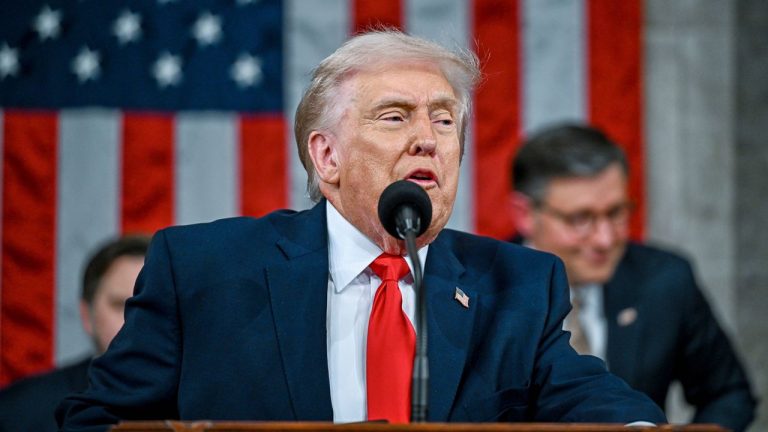
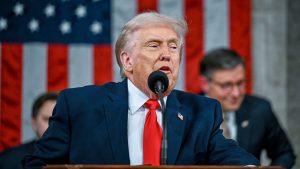
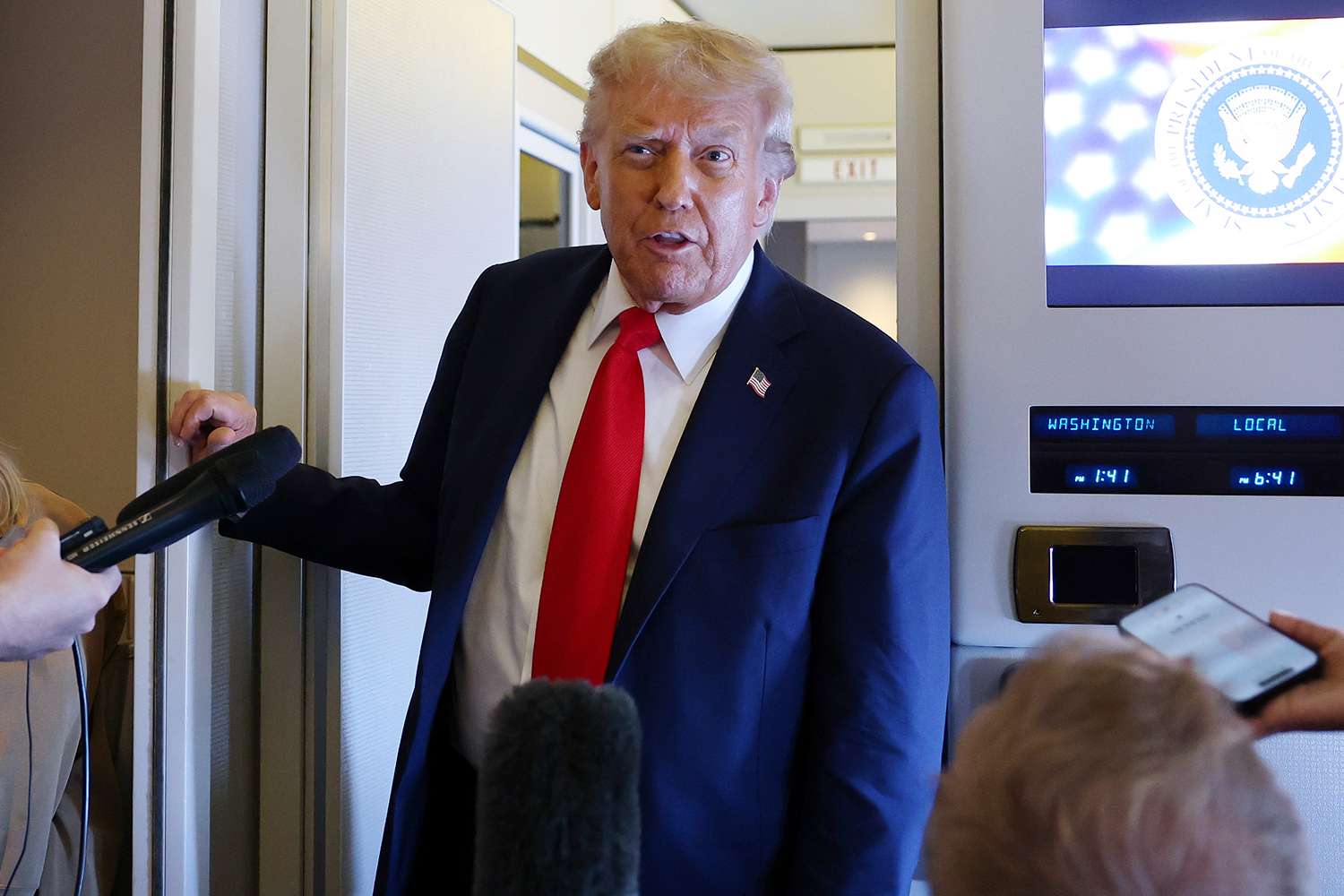
Tension and unease briefly rippled through Air Force One on December 9 as the presidential aircraft encountered a sudden burst of turbulence mid-flight, prompting President Donald Trump to cut short a conversation with reporters and deliver a remark that left many stunned. The moment occurred as the president traveled to Mount Pocono, Pennsylvania, where he was scheduled to address the nation’s mounting affordability crisis—a topic he has been increasingly vocal about in recent weeks.
Reporters aboard the aircraft described the atmosphere as relatively calm at first. Trump, who frequently strolls through the press cabin during flights, had been chatting casually with journalists as the blue-and-white Boeing jet cruised thousands of feet above the ground. The mood was businesslike, with reporters peppering the president with questions ranging from tax reform to labor policy, and Trump—at least in the early minutes—was answering with his usual blend of confidence and off-the-cuff improvisation.
In audio shared widely online, the president could be heard discussing his interest in eliminating taxes on overtime, Social Security payments, and tipped income—an idea that has generated intense debate among lawmakers. When asked whether he would consider ending taxation on gambling winnings as well, Trump pushed back with a characteristic quip before the tone of the exchange abruptly shifted.
Without warning, the aircraft lurched. Loose items rattled. Conversations stopped mid-sentence as reporters and staff instinctively reached for the nearest armrest or overhead rail. Air Force One, while engineered to withstand extreme conditions, is not immune to pockets of severe air disturbance. Those on board immediately felt the unmistakable jolt of heavy turbulence.
Trump paused mid-comment, bracing himself as the cabin jostled again. A rumble could be heard beneath the floorboards. Several reporters exchanged startled looks. Though turbulence is common, the timing was unnerving—hitting just as the president walked the aisle rather than being securely seated.
“I think it’s better to go up and take our seats,” Trump said after a beat, his voice half pragmatic, half amused. “It’s a pretty rough flight.”
He then added a line that quickly went viral—and not for reasons the White House communications team might have hoped.
“Bye everybody,” he said with a wry, almost theatrical tone. “I hope to see you again!”
The remark—only six words long—sent social media spiraling into speculation, jokes, memes, and, in some corners, genuine concern. Some interpreted it as gallows humor; others thought it was an unscripted moment of vulnerability from a president who rarely allows such glimpses. A few insisted he was simply teasing the press corps, many of whom started laughing immediately after he said it.
But the context couldn’t be ignored. Air Force One was still shuddering. Trump was standing in the aisle. And the combination of turbulence and a parting line that sounded eerily like a farewell made the moment resonate far beyond the cabin.
This incident came at the end of a week already thick with tension between Trump and the press. Just days earlier, ABC News correspondent Rachel Scott had confronted the president about the administration’s refusal to release full footage of a controversial military strike on an unmarked vessel off the coast of Venezuela. According to the White House, the ship was involved in narcotics trafficking. Critics demanded proof.
“You said you would have no problem with releasing the video,” Scott pressed.
“I didn’t say that,” Trump snapped back. “You said that. This is ABC fake news.”
However, a transcript from December 3 shows he did, in fact, say the administration would “certainly release” whatever footage it possessed. That discrepancy fueled days of debate, leading to increasing friction between the president and multiple reporters.
On the flight, turbulence may have interrupted the conversation, but the subject itself remained unresolved. Before being forced back to his seat, Trump defended the controversial “kinetic strikes,” claiming they had reduced narcotics arriving by sea by an implausible 94 percent—a statistic analysts quickly labeled as unverified.
“Every boat we sink,” Trump declared, “we save 25,000 American lives.”
When Scott attempted to press him again on the missing video, the president’s tone hardened.
“You are the most obnoxious reporter in the whole place,” he shot back. “Actually—a terrible reporter.”
This exchange mirrored other tense moments in recent months, including Trump calling one reporter “piggy” and another “ugly” during previous press availabilities. To critics, these incidents are evidence of escalating hostility toward the media. To supporters, they are proof that Trump refuses to tolerate what he perceives as biased or misleading coverage.
The turbulence episode nevertheless stood out—not for confrontation, but for the unexpectedly human moment it produced. Despite the laughter that followed his remark, even some veterans aboard acknowledged that it was unsettling to hear a sitting president casually say, “I hope to see you again” while the aircraft jolted and shuddered.
Air Force One is among the safest aircraft in the world, equipped with advanced avionics, reinforced airframe construction, and systems designed to withstand threats ranging from weather to hostile attacks. Yet turbulence is a humbling reminder that even the most powerful leaders remain subject to the forces of nature.
As the aircraft stabilized and passengers returned to their seats, reporters noted that Trump resumed his usual routine—reviewing notes, speaking with aides, and preparing for his Pennsylvania speech. But the moment lingered online, circulating across platforms and fueling headlines framing it as anything from dark humor to an unguarded emotional slip.
Whether the president intended it to be meaningful or merely comedic, the line became one of the most discussed moments of the week. And given Trump’s turbulent relationship with the media—both literal and metaphorical—the symbolism was hard to miss.
For now, the remark stands as yet another vivid snapshot in a presidency marked by unpredictability, confrontation, and the constant glare of public scrutiny. But for those on board, it was also a simple truth: sometimes, in the sky or on the ground, even the most powerful person in the world can be reduced to making a joke to break the tension when the world seems to shake.

Emily Johnson is a critically acclaimed essayist and novelist known for her thought-provoking works centered on feminism, women’s rights, and modern relationships. Born and raised in Portland, Oregon, Emily grew up with a deep love of books, often spending her afternoons at her local library. She went on to study literature and gender studies at UCLA, where she became deeply involved in activism and began publishing essays in campus journals. Her debut essay collection, Voices Unbound, struck a chord with readers nationwide for its fearless exploration of gender dynamics, identity, and the challenges faced by women in contemporary society. Emily later transitioned into fiction, writing novels that balance compelling storytelling with social commentary. Her protagonists are often strong, multidimensional women navigating love, ambition, and the struggles of everyday life, making her a favorite among readers who crave authentic, relatable narratives. Critics praise her ability to merge personal intimacy with universal themes. Off the page, Emily is an advocate for women in publishing, leading workshops that encourage young female writers to embrace their voices. She lives in Seattle with her partner and two rescue cats, where she continues to write, teach, and inspire a new generation of storytellers.