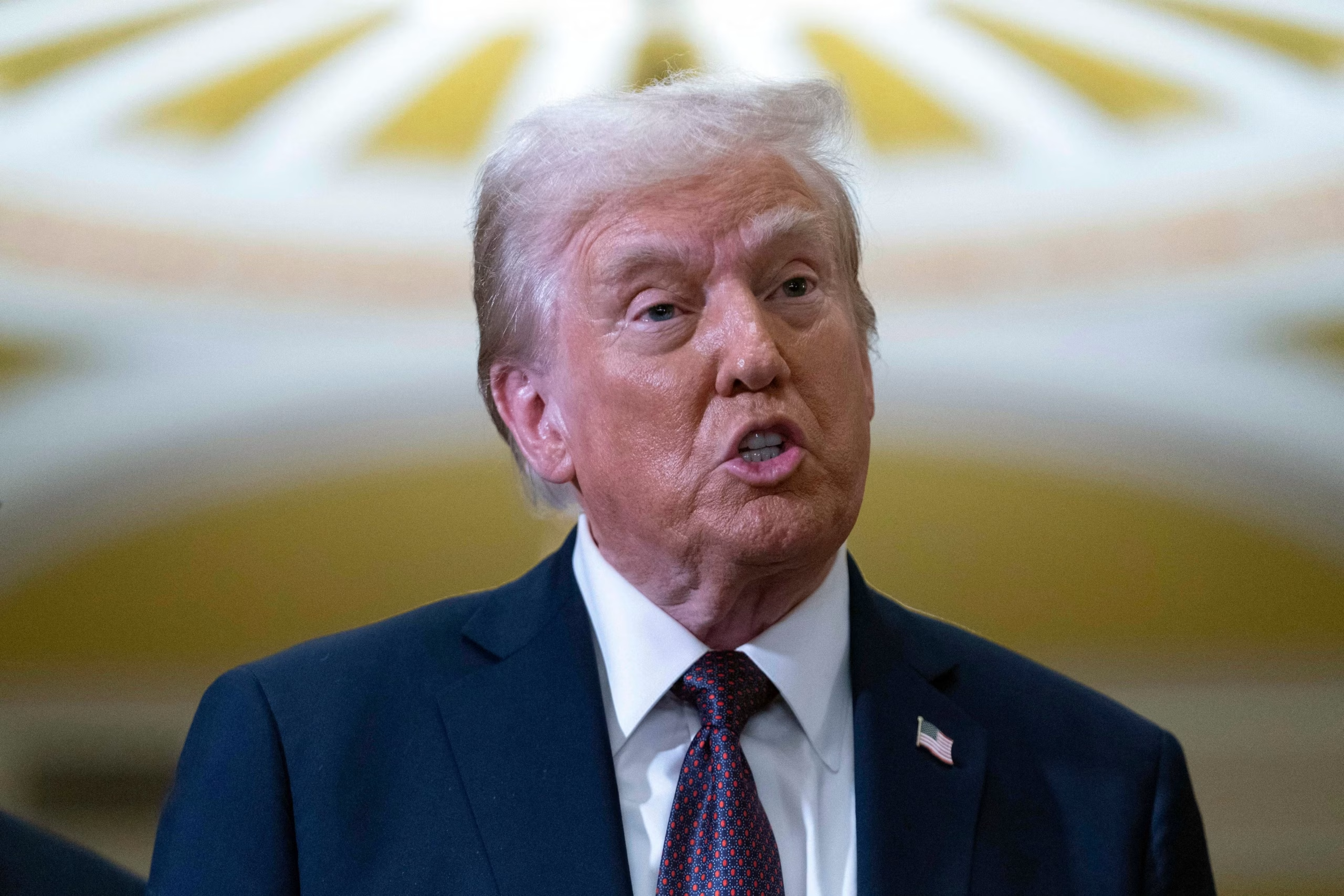
President Donald Trump reiterated the United States’ steadfast commitment to the NATO alliance on Wednesday, asserting that his administration has strengthened the military partnership and that the U.S. will “always be there” for the alliance. Speaking in a brief statement, Trump highlighted the importance of the transatlantic alliance in maintaining global security and countering the growing influence of rival powers such as Russia and China.
The president’s remarks follow a period of heightened attention to U.S. strategic positioning in the Arctic, where Trump and his national security team have been actively discussing the potential acquisition of Greenland. Greenland, an autonomous territory of Denmark, holds significant geopolitical and mineral resources, and its location in the Arctic offers strategic advantages for military and surveillance operations in the region. While Trump has suggested that all options are “on the table” for securing U.S. interests there, White House officials insist that diplomacy remains the first course of action.
White House spokeswoman Karoline Leavitt emphasized that discussions about Greenland are part of a broader effort to ensure the U.S. can counter Russian and Chinese aggression in the Arctic. “The president has been very clear that he views it as in the best interest of the United States to maintain strategic advantage in this region,” Leavitt said. “That is why his team is actively exploring what a potential acquisition would look like.”
Trump’s message to NATO comes amid continued scrutiny from allies about U.S. policy consistency. Critics have sometimes questioned whether Trump’s transactional approach to international agreements could undermine alliance cohesion. However, the president stressed that his actions have strengthened NATO, citing increased defense contributions from member states during his administration. “We will always be there for NATO, even if they won’t be there for us,” Trump said in a post on Truth Social, signaling his expectation that allies meet their defense obligations while reaffirming America’s commitment to collective security.
The timing of Trump’s statement aligns with broader U.S. strategic concerns over the Arctic, where Russia and China have increased military and economic activity. Experts say that Greenland’s location makes it a vital node for early-warning systems, missile defense, and maritime operations in the North Atlantic and Arctic Oceans. Securing influence in Greenland could provide the U.S. with both defensive and economic advantages, including access to untapped mineral reserves.
Defense analysts note that the dual focus on NATO and Arctic strategy reflects a long-standing priority for Trump: ensuring the U.S. maintains a dominant position on the global stage while expecting allies to share more responsibility for their own defense. “Trump’s approach is to combine strategic presence with leverage,” said Daniel Foster, a senior fellow at the Center for Security Policy. “By emphasizing both NATO commitments and Arctic positioning, he is signaling that America remains a global leader but expects partners to step up as well.”
Trump’s reaffirmation of NATO also comes amid rising tensions in Europe, where Russia’s military activities remain a source of concern. By reiterating that the U.S. stands firmly behind the alliance, Trump aims to reassure member states while reinforcing his administration’s posture on deterrence. Combined with discussions on Greenland, his message underscores a broader effort to maintain U.S. influence in both the North Atlantic and Arctic theaters, areas critical to future security dynamics.
While some NATO officials have expressed caution over the Greenland talks, the president insists that his administration’s actions are intended to strengthen—not undermine—the alliance. “The United States has made NATO stronger than ever before,” Trump said. “We will always be there for our allies, and our commitment remains unwavering.”
With ongoing deliberations over Greenland and continued attention to global security challenges, the White House anticipates that Trump’s statement will provide clarity to NATO members about the U.S.’s enduring role in international defense and Arctic strategy.

James Jenkins is a celebrated Pulitzer Prize-winning author whose work has reshaped the way readers think about social justice and human rights in America. Raised in Atlanta, Georgia, James grew up in a community that instilled in him both resilience and a strong sense of responsibility toward others. After studying political science and creative writing at Howard University, he worked as a journalist covering civil rights issues before dedicating himself fully to fiction. His novels are known for their sharp, empathetic portraits of marginalized communities and for weaving personal stories with broader political realities. Jenkins’s breakout novel, Shadows of Freedom, won national acclaim for its unflinching look at systemic inequality, while his more recent works explore themes of identity, resilience, and the fight for dignity in the face of oppression. Beyond his novels, James is an active public speaker, lecturing at universities and participating in nonprofit initiatives that support literacy and community empowerment. He believes that storytelling is a way to preserve history and inspire change. When not writing, James enjoys jazz music, mentoring young writers, and traveling with his family to explore cultures and stories around the world.