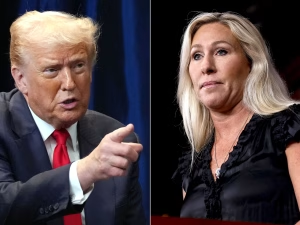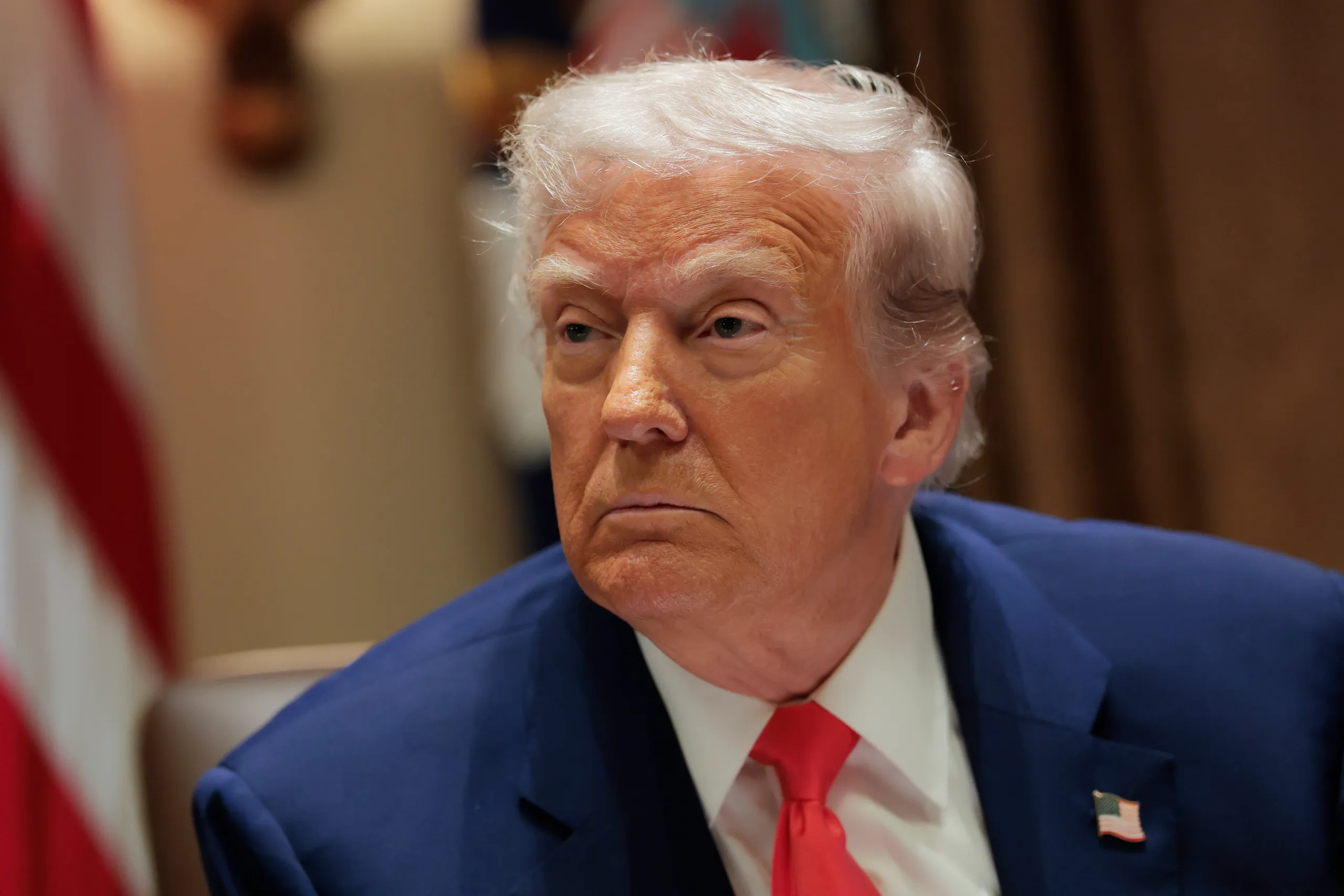
Donald Trump has threatened legal action against comedian Trevor Noah following a sharp joke delivered during Noah’s appearance as host of the Grammy Awards, escalating yet another public feud between the president and a prominent figure from the entertainment world.
The confrontation began during the ceremony when Noah, while presenting one of the evening’s most prestigious awards, took aim at Trump with a joke that blended political commentary, celebrity culture, and lingering controversy surrounding convicted sex offender Jeffrey Epstein. The remark, delivered to a live audience and millions of viewers at home, appeared to strike a nerve with Trump, who responded within hours with an aggressive and personal rebuttal.
As Noah prepared to announce the award for Song of the Year, he quipped that the honor was something “every artist wants almost as much as Trump wants Greenland.” He then extended the joke further, adding that the desire made sense “because Epstein’s island is gone, he needs a new one to hang out with Bill Clinton.” The line drew audible reactions in the room and immediately circulated across social media.
The reference combined several long-running political and cultural flashpoints: Trump’s past public interest in acquiring Greenland, his former social association with Epstein, and Epstein’s documented connections to powerful figures across politics and finance. While the joke did not accuse Trump of criminal conduct, it relied on association and insinuation—an approach that has repeatedly enraged the president in similar situations.
Trump, who has consistently denied any involvement in Epstein’s crimes and has publicly distanced himself from the disgraced financier, reacted furiously. Posting on Truth Social, the president unleashed a barrage of insults aimed at both Noah and the awards ceremony itself, characterizing the Grammys as “virtually unwatchable” and deriding the comedian’s credibility, talent, and relevance.
In his statement, Trump claimed Noah’s remarks were “false and defamatory,” insisting he had never visited Epstein’s private island or been accused of doing so. He emphasized that, while he could not speak on behalf of former President Bill Clinton, he categorically rejected any suggestion that he had spent time at Epstein’s properties. Trump framed the joke not as satire but as a factual misrepresentation designed to damage his reputation.
The president went further, threatening legal action and suggesting that Noah would soon face consequences for what Trump described as reckless commentary. He claimed he would “have fun” pursuing the matter through lawyers, a phrase that underscored both the personal nature of his anger and his willingness to weaponize litigation against critics.
Trump’s response followed a familiar pattern. Over the years, he has repeatedly clashed with comedians, late-night hosts, and entertainers who mock him, often responding with threats of lawsuits, demands for apologies, or attacks on their ratings and professional standing. Figures such as Jimmy Kimmel, Stephen Colbert, and various news organizations have previously been targeted with similar rhetoric.
In this case, Trump compared Noah unfavorably to other television hosts he has criticized in the past, dismissing him as a “talentless” performer and questioning why he was chosen to host a major cultural event. He also revived past grievances against broadcast networks, portraying the entertainment industry as hostile, elitist, and politically motivated.
Trevor Noah has not publicly responded to Trump’s threat. Known for his measured and often analytical comedic style, Noah has historically avoided escalating direct personal conflicts with political figures, preferring to let his work speak for itself. During his tenure as host of The Daily Show, he regularly skewered politicians from across the ideological spectrum, often using humor to highlight contradictions and controversies rather than issuing direct accusations.
The joke itself rested on widely reported facts: Trump and Epstein were acquainted in the 1990s and early 2000s, and photographs and statements from that period confirm that they socialized in elite circles. However, Trump has repeatedly stated that he severed ties with Epstein long before Epstein’s legal troubles became public and has denied visiting Epstein’s island or having knowledge of his criminal activities.
Bill Clinton, who was also referenced in Noah’s joke, has likewise denied any awareness of Epstein’s crimes, despite records showing that he traveled on Epstein’s private aircraft on multiple occasions. Ghislaine Maxwell, Epstein’s longtime associate who was later convicted for her role in his trafficking operation, has claimed that Clinton was her friend rather than Epstein’s and has denied his involvement in criminal conduct. None of these denials have fully quieted public speculation, making Epstein a recurring reference point in political satire.
Legal experts have long noted that defamation lawsuits brought by public figures against comedians face extremely high hurdles. Under U.S. law, satire and opinion are broadly protected by the First Amendment, particularly when directed at public officials. To prevail, Trump would need to show not only that the statement was false, but that it was made with actual malice—meaning knowledge of falsity or reckless disregard for the truth.
Historically, such cases rarely succeed, and Trump himself has filed or threatened numerous lawsuits that either stalled or were dismissed. Nonetheless, the threat itself often serves as a political message to supporters, reinforcing his image as a fighter against what he portrays as a hostile media and cultural elite.
The incident also highlights the increasingly blurred lines between entertainment, politics, and legal conflict. Award shows have become platforms for political commentary, while political figures increasingly respond to jokes as though they were formal accusations. What might once have been dismissed as late-night humor now frequently escalates into headline-grabbing confrontations.
For Trump’s supporters, the president’s response reinforces his narrative that he is unfairly targeted by celebrities who enjoy immunity from accountability. For critics, the reaction exemplifies his thin skin and tendency to overreact to satire. Either way, the exchange ensured that Noah’s joke—and Trump’s response—would dominate discussion long after the Grammys concluded.
Whether Trump follows through on his threat remains unclear. What is clear is that a single line of comedy succeeded in provoking a full-scale presidential rebuttal, once again demonstrating how deeply entertainment and politics are intertwined—and how quickly humor can turn into conflict in the current climate.

Emily Johnson is a critically acclaimed essayist and novelist known for her thought-provoking works centered on feminism, women’s rights, and modern relationships. Born and raised in Portland, Oregon, Emily grew up with a deep love of books, often spending her afternoons at her local library. She went on to study literature and gender studies at UCLA, where she became deeply involved in activism and began publishing essays in campus journals. Her debut essay collection, Voices Unbound, struck a chord with readers nationwide for its fearless exploration of gender dynamics, identity, and the challenges faced by women in contemporary society. Emily later transitioned into fiction, writing novels that balance compelling storytelling with social commentary. Her protagonists are often strong, multidimensional women navigating love, ambition, and the struggles of everyday life, making her a favorite among readers who crave authentic, relatable narratives. Critics praise her ability to merge personal intimacy with universal themes. Off the page, Emily is an advocate for women in publishing, leading workshops that encourage young female writers to embrace their voices. She lives in Seattle with her partner and two rescue cats, where she continues to write, teach, and inspire a new generation of storytellers.