NOTE: VIDEO INSIDE THE ARTICLE.
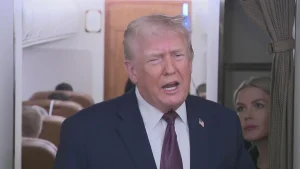
Donald Trump lashed out at a heckler during a visit to a Ford manufacturing plant in Michigan this week, cursing and raising his middle finger after being accused of protecting pedophiles—an explosive moment captured on video that has already ricocheted across social media and cable news.
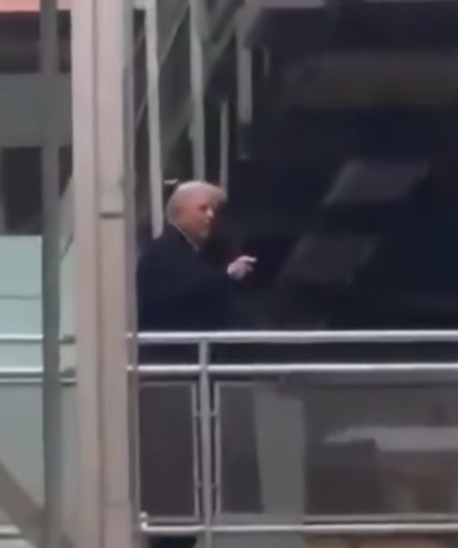
The incident unfolded as the president walked across a raised gangway inside the factory, greeting workers and officials during what was meant to be a showcase of American manufacturing strength. From below, an unidentified individual shouted a slur, calling Trump a “pedophile protector,” a reference to the ongoing political storm surrounding the unreleased Jeffrey Epstein files.
Video from the scene shows Trump pausing mid-stride, pointing toward the heckler, and mouthing “f*** you.” He then raises his middle finger before continuing on, his expression tight with visible anger. The outburst marked one of the most openly confrontational moments of Trump’s second term, blurring the already thin line between his private instincts and public conduct.
White House communications director Steven Cheung defended the president’s reaction in stark terms. “A lunatic was wildly screaming expletives in a complete fit of rage, and the president gave an appropriate and unambiguous response,” Cheung said, framing the exchange as justified pushback against harassment.
Ford, for its part, distanced itself from the disruption. A company spokesperson emphasized that “respect is one of our core values” and noted that inappropriate behavior inside its facilities is handled through established internal processes. The automaker declined to identify the individual involved or clarify whether disciplinary action would follow.
The confrontation comes at a moment of heightened political tension for Trump, who remains under sustained pressure to release the full archive of documents tied to convicted sex offender Jeffrey Epstein. The Department of Justice recently released only a fraction of the material—roughly one percent—despite a congressional deadline, igniting backlash from both parties and particularly from within Trump’s own base.
The president further inflamed that backlash late last year when he dismissed bipartisan calls for transparency as a “Democrat hoax,” triggering a rare Republican revolt. Lawmakers who had campaigned on exposing Epstein’s network accused the administration of shielding powerful figures, creating a fissure between Trump and some of his most loyal supporters.
Trump has long acknowledged that he knew Epstein in the 1990s and early 2000s, when both were fixtures in New York and Palm Beach social circles. He has said he severed ties after concluding Epstein was a “creep” and claims to have barred him from Mar-a-Lago. Trump has never been accused of wrongdoing in connection with Epstein.
Still, the unresolved questions surrounding the case have become politically radioactive. They now entangle not only Trump but also former President Bill Clinton and former Secretary of State Hillary Clinton, who this week defied congressional subpoenas seeking testimony about their past interactions with Epstein.
In a defiant letter to House Oversight Committee Chairman James Comer, the Clintons declared the subpoenas legally invalid and accused Republicans of weaponizing congressional power. Comer responded by announcing plans to initiate contempt-of-Congress proceedings, setting up what could become one of the most unprecedented legal confrontations in modern American politics.
That broader backdrop gives the Michigan exchange a weight that extends beyond a single flash of temper. For Trump’s supporters, the moment reinforces his image as a fighter who refuses to be cowed by insults. For critics, it exemplifies a pattern of impulsive behavior unbecoming of the presidency, particularly at a time when public trust in institutions is already strained.
The setting made the contrast even starker. The Ford plant visit was designed to project stability, economic momentum, and patriotic unity. Trump spoke about reshoring manufacturing, praised American workers, and touted policies aimed at revitalizing domestic industry. Yet the unscripted encounter eclipsed those themes, transforming a carefully managed appearance into another viral controversy.
Political analysts note that Trump has always thrived on confrontation, often using conflict as fuel rather than liability. In rallies and interviews, he has built a brand around refusing to “play by the rules,” casting himself as a tribune of ordinary Americans against elites and hostile media. The Michigan moment fits that pattern—but it also risks alienating moderates who expect a higher standard of decorum from the Oval Office.
Inside the administration, aides privately acknowledge the challenge of containing a president who prides himself on spontaneity. Supporters argue that Trump’s rawness is precisely what voters elected. Detractors counter that the presidency demands restraint, especially amid volatile international and domestic crises.
The heckler’s accusation—“pedophile protector”—was calculated to strike at the most sensitive nerve in contemporary American politics. Epstein’s crimes, and the perception that powerful figures escaped accountability, have become symbolic of a rigged system. Any hint of obstruction or secrecy now carries explosive resonance.
Trump’s response, though brief, crystallized that tension. It was not a speech, not a policy announcement, not even a shouted retort. It was a gesture—visceral, unmistakable, and deeply polarizing.
In that sense, the raised finger in a Michigan factory was more than a fleeting act of anger. It became a snapshot of a presidency under siege from all sides, where unresolved scandals, partisan warfare, and personal instinct collide in real time.
The clip’s impact lies in its timing. By the moment it appears, readers have absorbed the political stakes, the Epstein backdrop, and the brewing constitutional clash with the Clintons. The video then lands not as spectacle alone, but as culmination—an emotional punctuation mark to a story about power, pressure, and a president who refuses to mask either.
In an era where every gesture is immortalized, Trump’s defiant glare and raised hand will endure far longer than any prepared talking point from the day. Whether it is remembered as authenticity or recklessness may ultimately depend on how the deeper crises surrounding his presidency are resolved.

Emily Johnson is a critically acclaimed essayist and novelist known for her thought-provoking works centered on feminism, women’s rights, and modern relationships. Born and raised in Portland, Oregon, Emily grew up with a deep love of books, often spending her afternoons at her local library. She went on to study literature and gender studies at UCLA, where she became deeply involved in activism and began publishing essays in campus journals. Her debut essay collection, Voices Unbound, struck a chord with readers nationwide for its fearless exploration of gender dynamics, identity, and the challenges faced by women in contemporary society. Emily later transitioned into fiction, writing novels that balance compelling storytelling with social commentary. Her protagonists are often strong, multidimensional women navigating love, ambition, and the struggles of everyday life, making her a favorite among readers who crave authentic, relatable narratives. Critics praise her ability to merge personal intimacy with universal themes. Off the page, Emily is an advocate for women in publishing, leading workshops that encourage young female writers to embrace their voices. She lives in Seattle with her partner and two rescue cats, where she continues to write, teach, and inspire a new generation of storytellers.