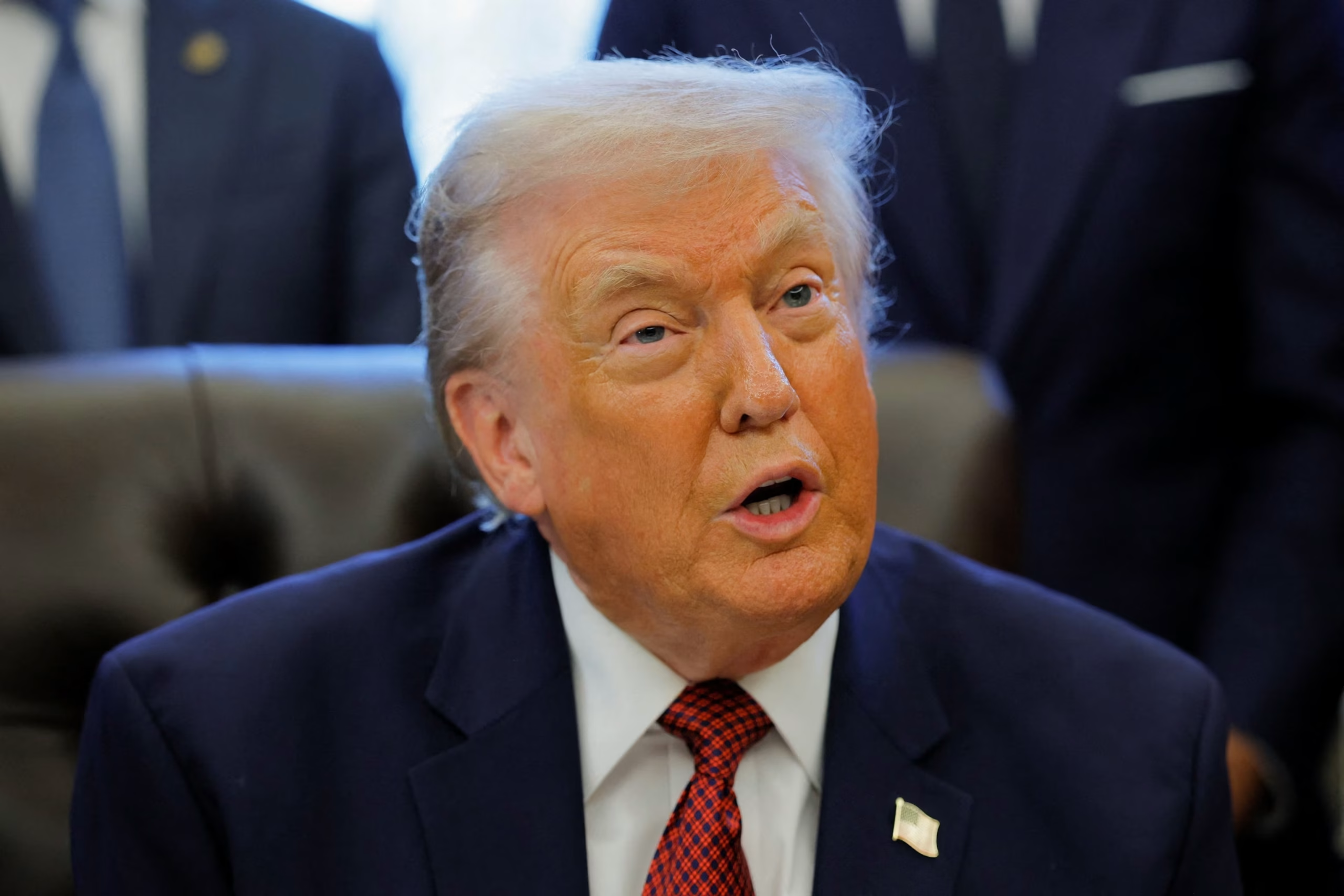
President Donald Trump is accustomed to operating under relentless public scrutiny. In an era when the president appears on camera almost daily, every word—spoken intentionally or unintentionally—carries consequences. Yet even by the standards of the modern media environment, the latest incident has ignited an unusually intense wave of analysis, speculation, and political reaction. A hot mic, left active as reporters exited a White House roundtable, captured Trump muttering a two-word comment that has since set political circles ablaze: “blue slip.”
The moment occurred Monday during a high-level discussion focused on a newly announced $12 million federal aid package designed to support farmers dealing with sustained economic turbulence related to trade and tariffs. Surrounded by Treasury Secretary Scott Bessent, Agriculture Secretary Brooke Rollins, and several industry figures, Trump spent the publicly portioned segment highlighting the administration’s ongoing commitment to rural communities and agricultural producers. But the most scrutinized remarks of the day were not part of that formal presentation. They were uttered as journalists were being guided out, when the president’s private commentary unexpectedly remained audible.
The hot-mic recording caught Trump expressing frustration with the limits he believes Congress has imposed on the executive branch’s ability to appoint qualified personnel. “You know, I can’t appoint anybody,” he said in a tone that observers described as exasperated. “I can’t appoint anybody. Everybody I’ve appointed, their time has expired. Then they’re in default, then we’re losing.”
Those words would have sparked discussion on their own, but it was the two-word phrase that followed—“blue slip”—that triggered a far broader political reaction. Trump has criticized the Senate’s long-standing blue-slip tradition before, but hearing it voiced in an unguarded moment gave the issue new intensity and revived longstanding tensions between the White House and Senate procedural norms.
The blue-slip practice, a century-old Senate custom, allows home-state senators to approve or oppose judicial and U.S. attorney nominees representing their states. While the process is not a formal rule and its application depends on committee leadership, it can effectively stall or block appointments when senators return a negative slip or withhold it entirely. Trump has repeatedly argued that the mechanism grants too much power to individual lawmakers and undermines the federal government’s ability to fill critical legal and judicial posts.
“You’ve got a blue slip thing that’s horrible,” he has said publicly on multiple occasions. The hot-mic moment reaffirmed that frustration in raw, unscripted form: “It’s a horrible thing. It makes it impossible to appoint a judge or a U.S. attorney. And it’s a shame. And the Republicans should be ashamed of themselves that they allow this to go on.”
The timing of the incident added further fuel to the fire. Just hours earlier, Alina Habba—Trump’s former attorney—confirmed that she would step down as U.S. Attorney for New Jersey following a federal appeals court ruling determining she had been serving unlawfully. The announcement intensified scrutiny on the administration’s entire appointment pipeline. Critics argue that the administration’s appointment disruptions stem from legal missteps; supporters counter that Senate obstruction tactics, including the blue-slip tradition, are primarily responsible. Trump’s hot-mic lament has therefore become a flashpoint in a larger structural conflict over nominations, separation of powers, and congressional prerogatives.
Political commentators were quick to seize on the moment. Clips circulated widely across digital platforms, with the two-word phrase becoming a trending topic within hours. Analysts on both sides of the aisle weighed in, some accusing Trump of undermining institutional norms, others applauding him for exposing what they call an outdated procedural bottleneck. A number of constitutional scholars noted that the blue-slip tradition, while respected, has evolved significantly over time and is not legally binding. The chairman of the Senate Judiciary Committee ultimately decides how strictly to enforce it, meaning the influence of the tradition expands or contracts depending on who holds the gavel.
This nuance does little to settle the political tensions. Trump’s comments, candid and unfiltered, reflect a deeper frustration that has shaped multiple administrations—not just his own. For decades, presidents of both parties have struggled with the slow-moving machinery of Senate confirmations, particularly for judicial roles and federal prosecutors. Supporters of the blue-slip practice argue it ensures local input and prevents politically motivated appointments from overriding regional concerns. Opponents contend that the mechanism is outdated, inconsistently applied, and easily weaponized for partisan leverage.
But while the procedural debate is significant, it is Trump’s candor—delivered unintentionally—that has drawn the most attention. Hot-mic moments have a unique power in modern politics. They offer the electorate a glimpse into the internal reality of leadership, unfiltered by prepared remarks or strategic messaging. This latest episode follows a long line of such moments across administrations, each shaping public perception in different ways. In Trump’s case, supporters view his hot-mic frustration as evidence of authenticity and determination to confront entrenched political obstacles. Critics see it as further proof of his combative posture toward institutional constraints.
The president’s additional remarks on the recording only deepened that sense of unease among observers. “I guess I just have to keep appointing people for three months and then just appoint another one, another one,” he said. “It’s a very sad situation. We’re losing tremendous—we’re losing a lot of great people.” These comments underscore the administration’s belief that procedural obstacles, rather than a shortage of qualified candidates, are hindering effective governance.
The conversation also revived a longstanding debate over the balance between executive efficiency and congressional oversight. In theory, the appointment process ensures that individuals holding powerful federal roles are vetted, evaluated, and approved through a system designed to prevent unilateral executive authority. In practice, the process can become gridlocked, leaving vacancies unfilled for months or even years. Trump’s comments have reignited concerns about administrative strain, especially in the judiciary and U.S. attorney offices.
Political strategists predict the issue will grow even more prominent as the administration continues to push for reforms. Some believe Trump’s team will leverage the incident to rally support for altering Senate traditions. Others believe congressional leaders, wary of precedent, will double down on preserving institutional norms.
For now, the fallout continues to spread across media and political channels. The White House has not issued a formal comment regarding the hot-mic remarks, though officials have emphasized that the administration remains committed to filling vacancies and ensuring stable leadership across all federal departments. Meanwhile, legal scholars, political analysts, advocacy groups, and lawmakers all await the next development, knowing that in the current political climate, even a two-word phrase can reshape the national conversation.
What remains clear is that the episode has exposed a deep and ongoing conflict within Washington’s governing structures—one involving constitutional authority, procedural tradition, and the ever-evolving role of the presidency. Whether the administration’s frustration leads to substantive procedural reform or simply adds another chapter to a long-running political standoff remains to be seen. But for now, the nation continues to parse every syllable from a microphone that was never supposed to be on.

Emily Johnson is a critically acclaimed essayist and novelist known for her thought-provoking works centered on feminism, women’s rights, and modern relationships. Born and raised in Portland, Oregon, Emily grew up with a deep love of books, often spending her afternoons at her local library. She went on to study literature and gender studies at UCLA, where she became deeply involved in activism and began publishing essays in campus journals. Her debut essay collection, Voices Unbound, struck a chord with readers nationwide for its fearless exploration of gender dynamics, identity, and the challenges faced by women in contemporary society. Emily later transitioned into fiction, writing novels that balance compelling storytelling with social commentary. Her protagonists are often strong, multidimensional women navigating love, ambition, and the struggles of everyday life, making her a favorite among readers who crave authentic, relatable narratives. Critics praise her ability to merge personal intimacy with universal themes. Off the page, Emily is an advocate for women in publishing, leading workshops that encourage young female writers to embrace their voices. She lives in Seattle with her partner and two rescue cats, where she continues to write, teach, and inspire a new generation of storytellers.