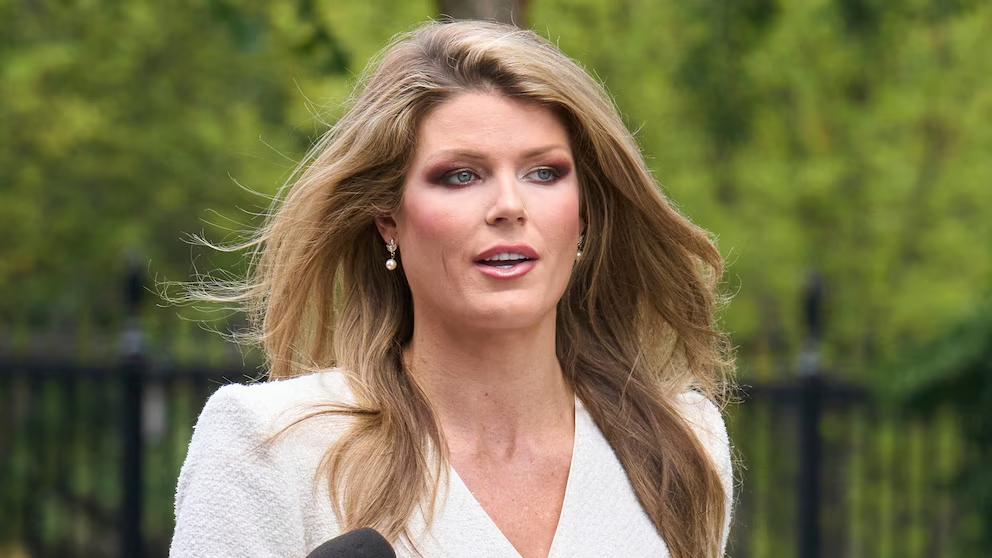
Federal judges in Virginia have taken formal steps to replace a U.S. attorney appointed by former President Donald Trump, escalating a months-long legal and political standoff over who has the authority to lead one of the nation’s most consequential federal prosecutor’s offices.
The move follows the expiration of Lindsey Halligan’s 120-day term as interim U.S. attorney for the Eastern District of Virginia, after the U.S. Senate declined to confirm her nomination. With no confirmed successor in place, the court has invoked its statutory authority to begin the process of appointing a new interim prosecutor.
Halligan’s departure marks the latest flashpoint in a broader confrontation between the Trump administration, the Department of Justice, Senate Democrats, and the federal judiciary — a dispute that could have ripple effects for U.S. attorney appointments nationwide.
A vacancy with national implications
Under federal law, when a U.S. attorney position becomes vacant and the Senate has not confirmed a presidential nominee, district judges may appoint an interim replacement. On Jan. 20, the court overseeing the Eastern District of Virginia confirmed that Halligan’s appointment had formally ended and that the position was now vacant.
The court announced it is seeking applications from qualified attorneys interested in serving as interim U.S. attorney, with a deadline set for Feb. 10. Until an appointment is made, the office remains without a Senate-confirmed or court-appointed leader.
While such transitions are not uncommon, the circumstances surrounding Halligan’s exit are anything but routine. Her tenure — and the legal battles over her authority — have drawn intense scrutiny from both sides of the political aisle.
Administration pushes back
Attorney General Pam Bondi strongly criticized the failure to confirm Halligan, praising her record and accusing Senate Democrats of abusing procedural rules to block the administration’s nominee.
“During her 120-day tenure as Interim United States Attorney for the Eastern District of Virginia, Lindsey Halligan served with the utmost distinction and an unwavering commitment to the rule of law,” Bondi said in a statement. She highlighted Halligan’s focus on prosecuting violent criminals, including murderers, child abusers, and individuals unlawfully present in the country.
Bondi placed particular blame on Virginia’s Democratic senators, Mark Warner and Tim Kaine, citing the Senate’s “blue slip” tradition — a long-standing practice that allows home-state senators to effectively veto judicial and prosecutorial nominees. According to Bondi, that process was “weaponized” to prevent Halligan’s confirmation.
“The circumstances that led to this outcome are deeply misguided,” Bondi wrote. “We are living in a time when a democratically elected president’s ability to staff key law enforcement positions faces serious obstacles.”
While Bondi criticized the court’s role in filling the vacancy, she stopped short of saying the administration would challenge the judges’ authority directly. Instead, she said the Justice Department would continue to seek appellate review of rulings that, in her view, undermine public safety.
Legal challenges shadow Halligan’s tenure
Halligan’s authority as U.S. attorney had already been called into question well before her term expired. Multiple judges in the Eastern District ruled that her appointment did not comply with governing statutes, casting doubt on her ability to bring criminal cases on behalf of the United States.
Those rulings proved consequential. In November 2025, two high-profile indictments brought under Halligan’s leadership were dismissed without prejudice. The court concluded that because Halligan lacked lawful authority at the time, the prosecutions could not proceed.
The Justice Department has appealed those dismissals to the U.S. Court of Appeals for the Fourth Circuit, arguing that Halligan’s appointment was valid and that the rulings improperly constrained executive authority.
Even as those appeals were pending, tensions escalated further. Earlier this month, a federal judge ordered Halligan to stop identifying herself as U.S. attorney in court filings, stating she had “no legal basis” to hold the title following prior rulings. The judge warned that continuing to use the title would amount to a false statement made in defiance of court orders.
The Justice Department disagreed sharply, arguing that Halligan’s status remained a contested legal question and that internal DOJ guidance supported her continued use of the title. That argument, however, did not prevail at the district court level.
How the standoff began
The dispute traces back to early 2025, when Halligan’s predecessor, Erik Siebert, resigned from the post after declining to pursue certain politically sensitive indictments. His resignation opened the door for Halligan’s interim appointment later that year.
Once installed, Halligan quickly moved forward with prosecutions that attracted national attention, including cases involving prominent political figures. Those cases intensified scrutiny of her appointment and accelerated legal challenges to her authority.
Supporters of the administration argued that Halligan was carrying out her duties aggressively and without fear or favor. Critics countered that her appointment bypassed statutory requirements designed to limit executive overreach.
Judges assert statutory authority
With Halligan’s term now expired and no Senate confirmation forthcoming, the court has asserted its right under federal law to appoint an interim replacement. Legal experts note that this authority has existed for decades and has been exercised by courts of varying ideological makeup.
“The statute is clear,” said one former federal prosecutor, speaking generally. “If there’s no confirmed U.S. attorney, the judges can step in. What’s unusual here is the political intensity surrounding a process that’s normally administrative.”
The court’s call for applicants signals that judges intend to move swiftly to stabilize leadership at the office, even as appeals over Halligan’s authority continue.
A spokesperson for the Justice Department acknowledged that while judges may appoint an interim U.S. attorney, the president retains the power to remove that appointee if he deems it necessary — setting the stage for a potential new confrontation.
Broader stakes beyond Virginia
The outcome of the dispute could extend far beyond the Eastern District of Virginia. The Trump administration has taken steps to install preferred candidates in several other major districts, including Nevada, California, New York, and New Jersey.
Legal observers say the Virginia case could become a test of how far courts can go in pushing back against executive appointments — and how aggressively the Justice Department is willing to respond.
“If appellate courts side with the district judges, it could significantly constrain future administrations,” said a constitutional law analyst. “If the DOJ prevails, it would strengthen presidential control over prosecutorial appointments.”
What comes next
For now, the Eastern District of Virginia awaits applications from prospective interim U.S. attorneys, while the Justice Department presses its appeals and weighs its options. Halligan, meanwhile, is leaving the post she held for just four months — a tenure marked by controversy, courtroom battles, and national attention.
As the legal fight continues, one thing is clear: the struggle over who controls federal prosecution has become a defining issue in the broader clash between the executive branch and the judiciary, with consequences that may shape law enforcement leadership for years to come.