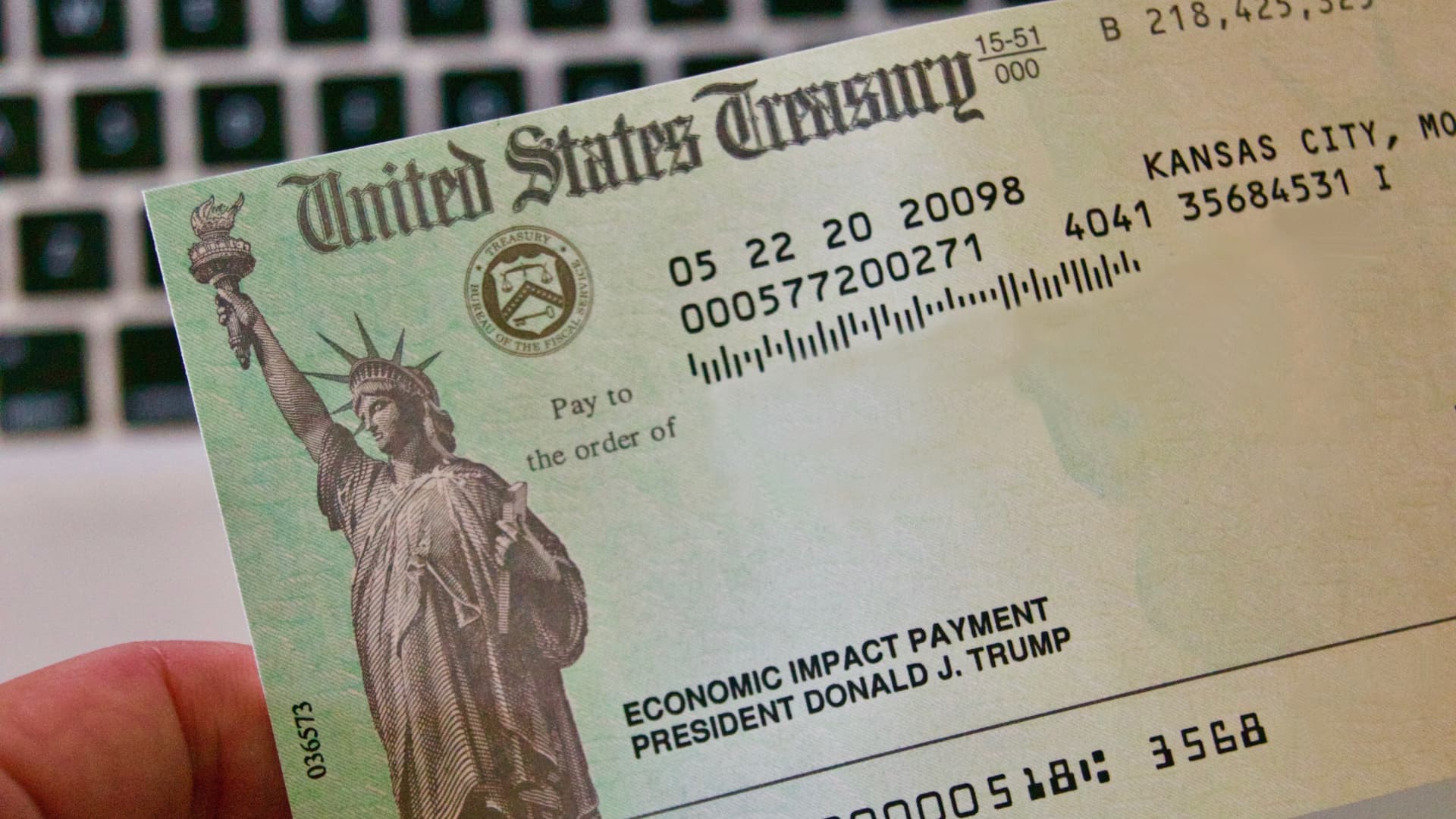
President Donald Trump has offered a new timeline for his long-teased plan to send one-time $2,000 “tariff dividend” checks to Americans, saying the payments could arrive “toward the end of the year” in 2026.
In a recent interview, Trump was asked when voters might actually see the money he has repeatedly promised would come from the massive revenue generated by his tariff policies. His answer marked a shift from earlier statements in which he suggested the checks could arrive by mid-2026.
“The tariff money is so substantial that’s coming in that I’ll be able to do $2,000 sometime,” Trump said. “I would say toward the end of the year.”
The president has framed the idea as a way to return a portion of tariff revenue directly to American households, portraying it as a dividend from his aggressive trade policies. He has argued that tariffs are bringing in enormous sums and that Americans deserve to share in that windfall.
However, the proposal remains highly uncertain, both legally and politically.
Trump has claimed he does not need congressional approval to issue the payments, a position that many legal and budget experts dispute. Under the Constitution, Congress controls federal spending, and any direct payments to the public typically require explicit legislative authorization. Several administration officials have privately acknowledged that the plan would almost certainly require Congress to act.
That hurdle may be difficult to clear.
Many Republican lawmakers have openly rejected the idea. Some have called it a “bad idea,” while others have gone further, labeling it “insane.” Fiscal conservatives argue that any tariff revenue should be used to reduce the national debt rather than fund new cash payments. With deficits continuing to climb, they say, sending out checks would undermine efforts to restore fiscal discipline.
The skepticism within Trump’s own party has made the prospect of congressional approval remote.
Complicating matters further is the legal status of the tariffs themselves. The Supreme Court is expected to issue a ruling soon on the administration’s authority to impose sweeping tariffs under national emergency powers. During a recent hearing, several justices appeared unconvinced by the argument that the president has near-unlimited power to declare emergencies and impose trade penalties without congressional involvement.
If the Court strikes down the tariffs, the consequences could be significant. The government could be required to refund billions of dollars to importers, draining the very pool of money Trump says will fund the rebate checks. In that scenario, the idea of sending $2,000 payments to households would become effectively impossible.
Despite these obstacles, Trump continues to promote the concept as a signature benefit of his trade agenda.
The administration has suggested that the checks would be targeted rather than universal. Trump has said they would go to “working families” and “moderate” or “middle-income” households. Treasury Secretary Scott Bessent has indicated that income limits would apply, though no specific thresholds have been announced.
Even if the legal and political barriers were overcome, budget experts warn that the numbers may not support Trump’s claims. The president has repeatedly said that “trillions of dollars” are flowing into the United States from tariffs. Independent analysts counter that while tariff revenue has increased, it falls far short of the scale needed to fund $2,000 payments for tens of millions of households.
Sending a single $2,000 check to 100 million households, for example, would cost $200 billion. To sustain such a program even once would require a level of net revenue far beyond current projections, especially after accounting for economic distortions caused by tariffs, including higher consumer prices and reduced trade volumes.
This is not the first time Trump has floated the idea of turning policy gains into direct cash payments. Earlier in the year, he expressed enthusiasm for distributing part of the savings generated by the Department of Government Efficiency, the cost-cutting initiative associated with Elon Musk, as a “dividend” for Americans. That proposal stalled, and the initiative eventually faded from prominence.
The “tariff dividend” concept follows a similar pattern: bold, politically appealing, and rhetorically powerful, but thin on operational detail.
Supporters argue that the idea is consistent with Trump’s populist brand. By promising direct payments, he casts tariffs not merely as punitive tools against foreign competitors but as a revenue engine that benefits ordinary Americans. The framing allows him to argue that his trade wars are not only protective but profitable.
Critics counter that tariffs function as a hidden tax on consumers. Importers typically pass higher costs down the supply chain, meaning Americans pay more for goods ranging from electronics to clothing and household items. From that perspective, rebate checks would amount to returning only a fraction of what consumers already paid through higher prices.
There is also concern that promising checks tied to tariff revenue could distort future trade policy. Economists warn that it may create political pressure to maintain or expand tariffs regardless of their broader economic impact, simply to preserve a funding stream for popular payouts.
For now, Trump’s revised timeline places the potential checks near the end of 2026, assuming the tariffs survive legal scrutiny and Congress authorizes the payments. Neither condition is guaranteed.
Until those hurdles are cleared, the $2,000 tariff rebate remains more a campaign-style promise than an actionable policy. Whether it becomes a reality will depend not on presidential rhetoric, but on court rulings, congressional approval, and fiscal math that so far does not favor the plan.

Emily Johnson is a critically acclaimed essayist and novelist known for her thought-provoking works centered on feminism, women’s rights, and modern relationships. Born and raised in Portland, Oregon, Emily grew up with a deep love of books, often spending her afternoons at her local library. She went on to study literature and gender studies at UCLA, where she became deeply involved in activism and began publishing essays in campus journals. Her debut essay collection, Voices Unbound, struck a chord with readers nationwide for its fearless exploration of gender dynamics, identity, and the challenges faced by women in contemporary society. Emily later transitioned into fiction, writing novels that balance compelling storytelling with social commentary. Her protagonists are often strong, multidimensional women navigating love, ambition, and the struggles of everyday life, making her a favorite among readers who crave authentic, relatable narratives. Critics praise her ability to merge personal intimacy with universal themes. Off the page, Emily is an advocate for women in publishing, leading workshops that encourage young female writers to embrace their voices. She lives in Seattle with her partner and two rescue cats, where she continues to write, teach, and inspire a new generation of storytellers.