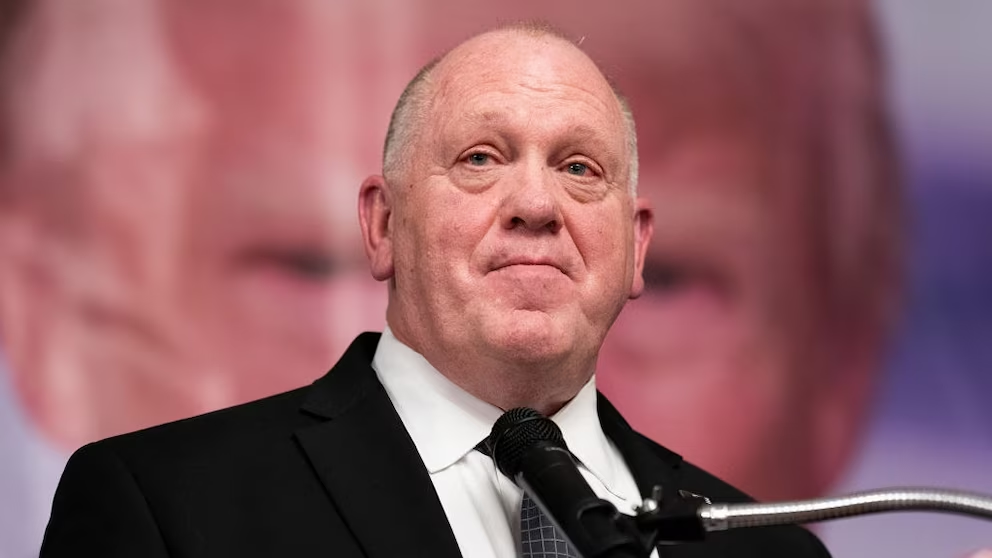
The Trump administration has announced a significant reduction in federal immigration enforcement personnel in Minnesota, citing what officials describe as a dramatic improvement in cooperation between federal authorities and local law enforcement agencies. According to White House border czar Tom Homan, 700 immigration agents will be immediately reassigned from the state, marking a major shift in the federal government’s operational posture in the region.
Speaking at a press conference in Minneapolis, Homan said the drawdown was made possible by what he called “unprecedented cooperation” from local counties, particularly in their willingness to honor Immigration and Customs Enforcement (ICE) detainers. These detainers request that local jails notify federal authorities before releasing an illegal immigrant inmate, allowing ICE to assume custody for removal proceedings.
“This is smarter enforcement, not less,” Homan said, emphasizing that the reduction in personnel does not reflect a retreat from immigration enforcement, but rather a more targeted and efficient strategy. He stressed that when local jurisdictions cooperate with federal authorities, fewer agents are needed on the ground to achieve enforcement goals.
The announcement comes amid heightened public and political scrutiny of federal immigration operations in Minneapolis following the fatal shootings of Renee Good and Alex Pretti during recent enforcement activity. Those incidents have fueled protests, criticism from Democratic lawmakers, and renewed debate over the conduct and oversight of federal immigration agents operating in American cities.
Homan made clear that the personnel reduction does not apply to officers tasked with protecting federal agents or ensuring operational security. He said the administration remains committed to safeguarding law enforcement personnel amid what he described as increasing hostility toward immigration officers.
According to Homan, the broader objective is to gradually end the surge of federal agents deployed to Minneapolis under what has been referred to as “Operation Metro Surge.” However, he warned that continued cooperation from local officials is essential for the drawdown to remain in place. He also tied future reductions to a decline in attacks, threats, and what he called “hateful rhetoric” directed at ICE and U.S. Border Patrol agents.
During his remarks, Homan highlighted the results of recent federal enforcement actions in the city. He said federal law enforcement officers have arrested 14 individuals with homicide convictions, 87 people with sex-related offenses, 28 known gang members, and 139 individuals convicted of assault. These figures, he argued, demonstrate that federal operations have focused on removing serious offenders rather than conducting indiscriminate enforcement.
The border czar also issued a direct appeal to the public, urging individuals and activist groups to stop interfering with law enforcement activities. While acknowledging the constitutional right to protest, Homan drew a firm line between peaceful demonstrations and actions that obstruct or endanger officers.
“Everyone has a constitutional right to peacefully protest. President Trump and I completely support that,” he said. “At the same time, professional law enforcement officers should and need to be able to perform their sworn duties without being harassed, impeded, or assaulted.”
The drawdown announcement coincides with a major policy change regarding transparency and accountability for federal immigration agents. Homeland Security Secretary Kristi Noem confirmed that agents operating in Minneapolis will now be required to wear body cameras. In a public statement, Noem said the deployment would take effect immediately and would expand nationwide as funding becomes available.
“Effective immediately we are deploying body cameras to every officer in the field in Minneapolis,” Noem said. “As funding is available, the body camera program will be expanded nationwide. We will rapidly acquire and deploy body cameras to DHS law enforcement across the country.”
Previously, federal immigration agents were not required to wear body cameras, a policy that has long been criticized by Democrats and civil liberties groups. The recent shootings intensified those criticisms, with opponents arguing that body cameras are essential for transparency, accountability, and public trust. Federal officials, however, have defended the agents involved in the incidents, stating that their actions were justified under existing use-of-force policies.
The issue has also sparked division within Congress. Some Republicans have called for investigations into the shootings, while Senate Democrats are pushing for broader restrictions on federal immigration enforcement as part of negotiations over a full-year Department of Homeland Security appropriations bill.
Senate Minority Leader Chuck Schumer outlined several Democratic demands during remarks late last month. One proposal calls for an end to what he described as “roving patrols” of ICE agents in American cities, as well as tighter restrictions on warrants and mandatory coordination with state and local law enforcement agencies before operations are conducted.
Another demand focuses on accountability standards for immigration agents. Schumer argued that federal officers should be held to the same use-of-force policies as state and local police and face consequences when those standards are violated.
A third demand includes requirements that immigration agents operate without face coverings, wear body cameras at all times, and carry visible, state-issued identification while on duty. Supporters of these measures say they are necessary to prevent abuses and ensure that residents can identify law enforcement officers during enforcement actions.
Meanwhile, Minnesota state and city officials have sought to limit or halt federal immigration operations altogether. A request by the state to force immigration agents to leave Minneapolis was recently denied by a federal judge, dealing a setback to local efforts to curtail the operation.
In her ruling, U.S. District Judge Katherine Menendez said the court was required to evaluate the state’s claims within the specific legal framework presented. She concluded that the plaintiffs failed to meet the necessary legal burden to justify intervention, and denied the motion to remove federal agents from the city.
The administration has framed the ruling as a validation of its authority to conduct immigration enforcement operations, while emphasizing that cooperation—not confrontation—is the preferred path forward. Homan reiterated that local compliance with ICE detainers significantly reduces the need for large-scale federal deployments.
The Epoch Times has reached out to Minnesota Governor Tim Walz and Minneapolis Mayor Jacob Frey for comment on the agent drawdown, but no responses have been made public.
As tensions continue between federal authorities, local officials, and activists, the situation in Minneapolis is emerging as a test case for the Trump administration’s broader immigration enforcement strategy. The combination of personnel reductions, increased accountability measures, and continued pressure on local governments underscores the administration’s effort to balance enforcement priorities with political and public scrutiny.
Whether the drawdown remains permanent will depend largely on local cooperation and the evolving national debate over immigration enforcement, law enforcement accountability, and the role of federal agents in American cities.

Emily Johnson is a critically acclaimed essayist and novelist known for her thought-provoking works centered on feminism, women’s rights, and modern relationships. Born and raised in Portland, Oregon, Emily grew up with a deep love of books, often spending her afternoons at her local library. She went on to study literature and gender studies at UCLA, where she became deeply involved in activism and began publishing essays in campus journals. Her debut essay collection, Voices Unbound, struck a chord with readers nationwide for its fearless exploration of gender dynamics, identity, and the challenges faced by women in contemporary society. Emily later transitioned into fiction, writing novels that balance compelling storytelling with social commentary. Her protagonists are often strong, multidimensional women navigating love, ambition, and the struggles of everyday life, making her a favorite among readers who crave authentic, relatable narratives. Critics praise her ability to merge personal intimacy with universal themes. Off the page, Emily is an advocate for women in publishing, leading workshops that encourage young female writers to embrace their voices. She lives in Seattle with her partner and two rescue cats, where she continues to write, teach, and inspire a new generation of storytellers.