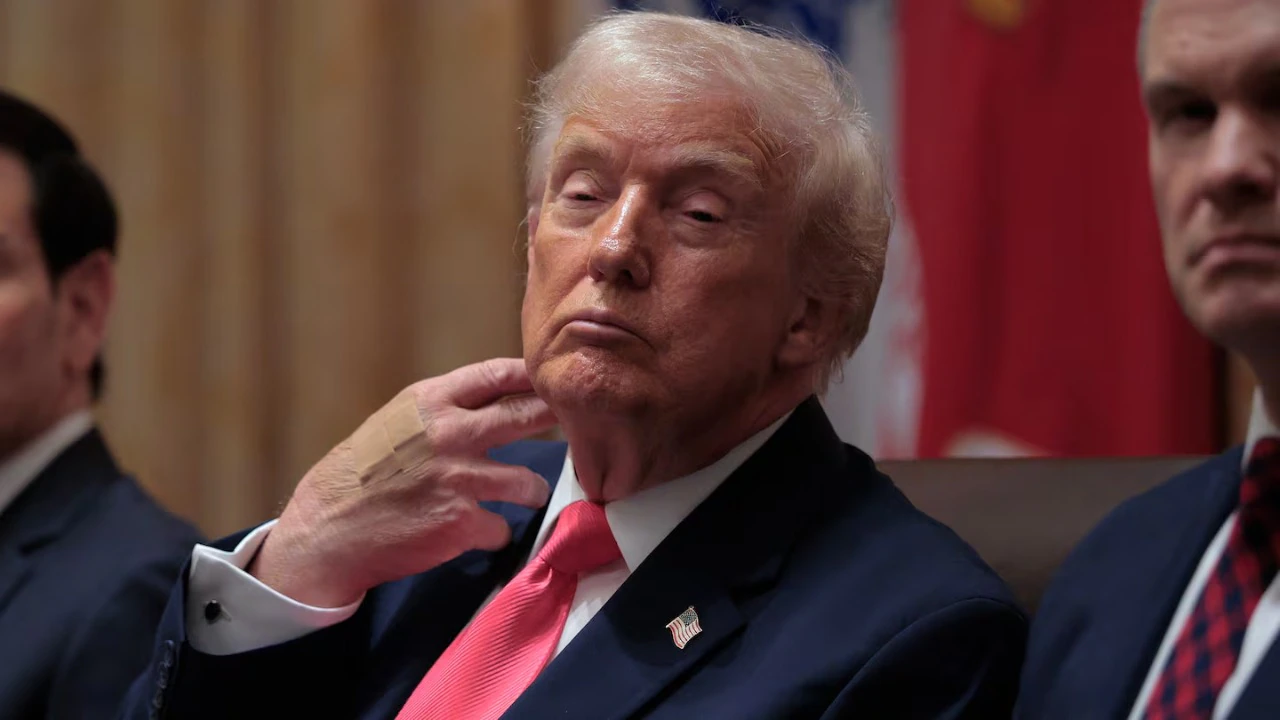
The White House has moved to quell public speculation surrounding adhesive bandages that have recently been visible on the back of President Donald Trump’s right hand, offering a straightforward explanation amid widespread attention and conjecture. Administration officials emphasized that the bandages are a routine precaution and not a sign of any serious medical concern, underscoring that the president remains in good overall health.
Questions about the bandages began circulating after multiple public appearances in which the president’s right hand appeared bruised and partially covered. Photographs from official events and media coverage prompted online discussion and commentary, with some observers speculating about potential underlying health issues. In response, the White House addressed the matter directly during a press briefing.
White House spokeswoman Karoline Leavitt told reporters that the bandages are related to minor hand irritation and are part of normal preventative care. She stressed that such issues are not unusual for someone with the president’s demanding schedule and constant public engagement. According to Leavitt, the administration has already addressed similar questions in the past and sees no reason for alarm.
“The president is in good health,” Leavitt said, reiterating that his medical condition is closely monitored and regularly evaluated by his healthcare team. She noted that minor bruising or skin irritation can occur easily, particularly given the volume of public interactions that are part of Trump’s daily routine.
Leavitt explained that one contributing factor to the bruising is the president’s long-standing habit of frequent handshaking. Known for his extended and energetic greetings at rallies, official functions, and diplomatic meetings, Trump engages in near-constant physical contact during public appearances. Over time, repeated pressure and contact can cause visible marks on the skin, particularly on the hands.
Another factor, according to the White House, is Trump’s daily aspirin regimen. Aspirin is commonly prescribed or recommended to reduce cardiovascular risk, but it can also thin the blood slightly, making bruises appear more easily and linger longer than they otherwise might. Leavitt pointed out that this has been noted in the president’s previous physical examinations.
“His physical examinations have shown in the past that aspirin use can contribute to the bruising that you see,” she said, adding that the combination of frequent handshakes and aspirin use adequately explains the discoloration and the occasional use of bandages.
Despite the administration’s explanation, attention to the president’s hands has continued, in part because of Trump’s age and the broader political context. As the oldest president ever elected in U.S. history, Trump’s health has remained a recurring subject of public interest and media scrutiny. The visibility of even minor physical details can quickly become amplified, particularly in an era of high-resolution photography and constant social media commentary.
Trump himself has been acutely aware of how his health is portrayed. Throughout his political career, he has emphasized his physical stamina and mental sharpness, often contrasting himself with former President Joe Biden. Trump has repeatedly argued that he remains energetic, alert, and capable of handling the demands of office, framing physical fitness as a key component of leadership.
The recent focus on his hand bruising prompted Trump to address the matter directly. On Tuesday night, he posted a lengthy statement on his Truth Social platform, criticizing media organizations for what he described as excessive and hostile scrutiny of his health. In the post, Trump suggested that ongoing investigations and speculation could rise to the level of “sedition, maybe even treason,” reflecting his long-standing frustration with press coverage he views as unfair or politically motivated.
The White House, however, has sought to strike a calmer and more measured tone. Officials have reiterated that minor bruising and the use of adhesive bandages are common occurrences and do not indicate any underlying medical condition. They have also emphasized that transparency about the president’s health remains a priority, while cautioning against overinterpretation of routine and inconsequential details.
Medical reporting from earlier this year supports the administration’s reassurances. In October, Trump underwent a comprehensive medical examination that included an MRI scan and extensive evaluations of his cardiovascular, neurological, and overall physical health. According to reporting by the BBC and other outlets, his physician concluded that the president was in excellent health and fit to serve.
Those findings were intended to address lingering questions about Trump’s fitness for office and to provide a clear, documented assessment of his condition. The White House has referenced these examinations in response to renewed speculation, noting that nothing observed since then contradicts those conclusions.
Health experts generally note that bruising on the hands is common among older adults, particularly those taking blood-thinning medications such as aspirin. Skin becomes thinner with age, and even minor impacts can result in visible discoloration. In many cases, bandages are applied not because of injury severity but simply to protect sensitive skin or conceal minor cosmetic issues.
From the administration’s perspective, the episode illustrates the challenge of managing public perception in a highly polarized and media-saturated environment. Even small and medically insignificant details can become the subject of intense scrutiny, forcing officials to respond to questions that would otherwise go unremarked.
Leavitt’s comments reflect the White House’s broader strategy of maintaining openness while discouraging unnecessary speculation. By offering a clear explanation and pointing to documented medical evaluations, officials aim to reassure the public without amplifying unfounded concerns.
As Trump continues to travel, campaign, and engage with supporters and foreign leaders alike, aides acknowledge that visible bandages may reappear from time to time. Given the president’s preference for direct, physical engagement with the public, minor hand irritation is likely to remain an occasional byproduct of his schedule rather than a sign of declining health.
For now, the White House insists that the explanation is simple: routine precautions, frequent handshakes, and a standard medical regimen. In an environment where every detail is magnified, officials are seeking to remind the public that not every visible mark carries deeper significance—and that, according to his doctors, the president remains in sound health as he carries out the duties of his office.

James Jenkins is a celebrated Pulitzer Prize-winning author whose work has reshaped the way readers think about social justice and human rights in America. Raised in Atlanta, Georgia, James grew up in a community that instilled in him both resilience and a strong sense of responsibility toward others. After studying political science and creative writing at Howard University, he worked as a journalist covering civil rights issues before dedicating himself fully to fiction. His novels are known for their sharp, empathetic portraits of marginalized communities and for weaving personal stories with broader political realities. Jenkins’s breakout novel, Shadows of Freedom, won national acclaim for its unflinching look at systemic inequality, while his more recent works explore themes of identity, resilience, and the fight for dignity in the face of oppression. Beyond his novels, James is an active public speaker, lecturing at universities and participating in nonprofit initiatives that support literacy and community empowerment. He believes that storytelling is a way to preserve history and inspire change. When not writing, James enjoys jazz music, mentoring young writers, and traveling with his family to explore cultures and stories around the world.