

1. The Sign in the Yard
The For Sale sign went in crooked.
The young real-estate agent pushed it into the front lawn while the November wind snapped at her blazer. The metal stake hit hard soil, tilted, then finally gave in with a reluctant shudder. She wiped her hands, took a picture with her phone, and hurried back to her car, the way people hurry away from hospitals and cemeteries.
Across the street, Mrs. Jensen watched from her window, lips pressed together. “Too soon,” she muttered. “Way too soon.”
At the end of Willow Street, the small white house with blue shutters looked suddenly abandoned. No flag fluttered from the pole by the porch. No porch light burned, though the afternoon was already dipping toward early winter dark. The rocking chair where Frank Delaney had sat each evening was empty, its cushion pulled slightly to one side as if he might come back any minute to straighten it.
Inside, the air still held the faint smell of coffee and Old Spice, and somewhere under that, the scent that lingers in houses where one person has lived a long, quiet life: paper, dust, and memories.
The ambulance had taken Frank away two nights earlier, its lights turning the quiet street into a streak of red and blue. He’d gripped the EMT’s arm and growled that he didn’t need help, then passed out before the words were even done.
Heart failure, the neighbors heard. Pneumonia, some said. “He’s ninety; it’s just time,” others added with a shrug. But none of them knew for sure. They only knew the house felt wrong now, like a church after the choir has filed out.
Next door, a seventeen-year-old girl named Emily Carter sat on her porch steps, hugging her knees under her oversized sweatshirt. She’d seen the ambulance. She’d ridden in one with him once, when he slipped coming down his porch stairs and insisted on walking to the gurney anyway.
“You’re not old,” she’d joked then. “You’re just… vintage.”
He’d barked out a laugh that turned into a cough. “Vintage Marines don’t break, kiddo,” he’d wheezed.
Now she stared at the crooked For Sale sign and felt a chill that had nothing to do with the wind.
Because she knew something the neighbors didn’t: Frank Delaney hadn’t gone to the hospital alone.
He’d gone angry.
And afraid.
And still holding onto a secret he’d never told anyone.
Not even her.
2. The Estranged Son
At an airport three states away, Michael Delaney stared at his reflection in the dark glass of a departure gate window. Forty-five years old, Army veteran, two tours in Iraq, one in Afghanistan, now working security for a logistics company that paid just enough to keep his apartment and his distance.
The message from the hospital sat like a stone in his pocket.
“Your father has been admitted with congestive heart failure… We need a family member to make some decisions… Please call us back…”
He hadn’t heard his father’s voice in nearly fifteen years, not since an argument that had ended with words neither of them could take back. The years had stacked up: deployments, missed holidays, voicemails that went unreturned on both sides until the silence became its own kind of habit.
His mother had died of cancer a decade earlier. He found out from a cousin. The obituary mentioned her “beloved husband Francis and their son, Michael,” as if they had all still been a family.
Now this. A hospital. Paperwork. Decisions.
“You going to board, sir?” the gate agent asked.
He looked down at his ticket—Chicago to Dallas—business trip that suddenly felt trivial.
He made a decision.
“Can you rebook me?” he asked quietly. “To Cedar Hollow, Ohio. As soon as possible.”
3. The Quiet House
The hospital smelled like antiseptic and overcooked green beans. Michael hated it the way only people who have spent too much time around battlefield med tents can hate a place—on some deep, cellular level.
“Family of Francis Delaney?” a nurse called.
Michael stepped forward. “Son.”
The nurse studied him—his squared shoulders, the duffel bag, the lines at the corners of his eyes. “Your father is stable, but he’s weak. Doctor’s recommending a transfer to a long-term care facility when he’s ready for discharge. We’ll need someone to discuss options… and sign forms.”
Of course. Always forms.
“Is he… awake?” Michael asked.
The nurse nodded. “On and off. He knows you’re here. Asked me if you still walk like you’ve got a rifle slung over your shoulder.”
Despite himself, Michael almost smiled. “Yeah. That sounds like him.”
She led him through a maze of curtains and quiet beeping until they reached a room where an old man lay half-upright, oxygen tubing in his nose, heart monitor tracing slow green mountains across a screen.
Frank Delaney was smaller than Michael remembered. The Marine Corps tattoos on his forearm had blurred with age, the eagle and globe softened like a watercolor left in the sun. But the eyes—sharp, assessing, stubborn—were the same.
“So,” Frank rasped, “they finally caught you, huh?”
Michael stood at the foot of the bed, suddenly unsure what to do with his hands. Salute? Hug? Shake?
“I guess they did,” he answered.
They stared at each other for a long, taut moment, a decade and a half of unsaid things piling up in the space between them.
Finally, Frank snorted. “You look old.”
“Says the guy wired to a machine,” Michael shot back before he could stop himself.
For a heartbeat, they both froze.
Then Frank’s mouth twitched. “Still got that smart mouth.”
Michael exhaled slowly. “Still got that thick skull.”
The moment passed. The monitors kept beeping. Somewhere down the hall, someone laughed, someone cried, and the world went on.
4. The Papers
Later, in a cramped office, a social worker slid a stack of forms across the desk.
“Mr. Delaney, your father can’t safely live alone anymore. He needs daily monitoring, medication management, help with meals and bathing. We recommend a skilled nursing facility. There’s one not far from his home…”
Michael rubbed his temples. “What about in-home care?”
“Even with a nurse, he’s a fall risk. The house has stairs. And…” She paused. “Frank says the house needs to be sold. To pay for his care. He was… very clear about that.”
Sell the house.
The words felt like a kick.
Michael pictured the small white place at the end of Willow Street—the porch where his father taught him to peel potatoes with a pocketknife, the living room where his mother had fallen asleep with a book on her chest, the attic where he’d hidden during thunderstorms as a scared kid.
“Does it have to be so fast?” he asked.
“I’m afraid so,” the social worker replied gently. “Long-term care is expensive. He’s worried about being a burden.”
Of course he was. Marines hated being burdens more than they hated enemy fire.
Michael signed the first form. Then the next. Initialed in six places. A squiggled M.D. that would put his father in a facility and a For Sale sign in the front yard.
He tried not to feel like he was signing away more than just a house.
5. The Girl Next Door
He arrived at the house late in the afternoon, the sky hanging low and gray. The key still worked, though the lock stuck for a second before giving way with a familiar click.
Inside, the silence roared.
Furniture sat in the same places it always had—the worn couch, the television with a rabbit-ear antenna that somehow still functioned, the coffee table with a coaster shaped like the Marine Corps emblem.
On the kitchen wall, the calendar was still turned to October, days crossed out in red pen until the square around the 11th, where someone had written: “VA—checkup” and then, beneath it, a shaky note: “Call Mike?”
He swallowed hard.
“Um… can I help you?”
He turned to find a teenage girl standing just outside the open front door, clutching a backpack to her chest. Big brown eyes, mess of curly hair pulled into a lopsided ponytail, Cedar Hollow High hoodie.
“I’m Emily,” she said cautiously. “I live next door. I… take out Mr. Delaney’s trash sometimes. Feed his cat when he’s at appointments. Who are you?”
“Michael,” he answered. “I’m his son.”
Her face shifted from suspicion to surprise. “Oh. Wow. He… he talks about you.”
That caught him off guard. “He does?”
“Yeah. Not like in a cheesy way,” she said quickly. “Just… stories. Funny ones sometimes. Sad ones, too.”
Michael looked past her shoulder to the empty yard. “I didn’t think he talked about me much at all.”
Emily shrugged. “Old people are weird. They say more to people who aren’t family, sometimes.”
He almost laughed. “You have no idea.”
She stepped inside, glancing around like she was afraid to disturb something sacred. “They put up a For Sale sign today,” she said softly. “Is he coming back?”
“To the house?” he asked.
She nodded.
He shook his head once. “Probably not.”
Emily’s throat tightened visibly. “Oh.”
They stood in the quiet kitchen for a moment.
“If you want help packing,” she said, “I’m pretty good at cleaning out old people’s stuff. Mom calls me a vulture, but, like, a helpful vulture.”
Despite everything, he smiled. “I might take you up on that.”
6. The Attic
The first two days, they stayed on the main floor. Emily tackled the kitchen with ruthless efficiency, tossing expired cans and stacking dishes. Michael sorted through his mother’s old recipe cards, his father’s collection of chipped coffee mugs, the stack of VA appointment letters on the counter.
At night, he drove back to the hospital to sit with his father.
“How’s the war zone?” Frank would ask.
“Messy,” Michael would reply.
They talked about weather. Football. The neighbor’s yappy dog. Nothing that mattered and everything that did.
On the third day, Emily pointed up the narrow hallway stairs.
“What about up there?”
Michael hesitated. The attic had always been his father’s territory.
But the house wouldn’t pack itself.
He climbed the steep, creaking steps with Emily behind him, flashlight beam cutting through the dust as he pushed open the hatch.
The attic was a time capsule. Trunks, boxes, old wedding decorations, a rocking horse, broken lamps, Christmas ornaments tangled in strings of lights that probably hadn’t worked since the Clinton administration.
At the far end, beneath a small dirty window, sat a plain metal footlocker. Michael knew it instantly.
His father’s.
He knelt in front of it, fingers hovering over the latch.
“You okay?” Emily asked quietly.
He swallowed. “I’m not sure I’m allowed to be up here.”
“You’re his son,” she said. “If anyone’s allowed, it’s you.”
He flipped the latch.
Inside was the smell of old paper and starch, the past pressing out like a ghost.
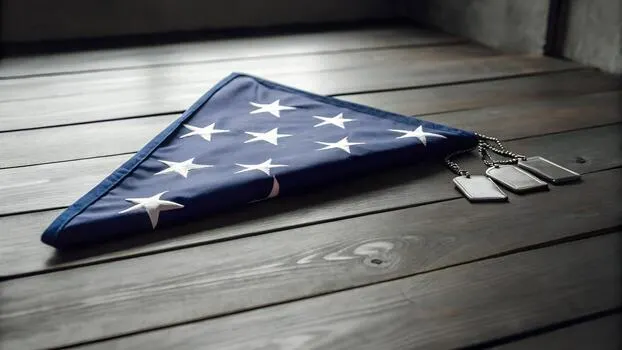
On top lay a neatly folded Marine dress uniform, still sharp along the creases. Beneath it, wrapped in tissue, was a flag folded in the triangle shape he knew too well.
Michael froze, his throat tightening.
“Is that…?” Emily whispered.
“A burial flag,” he said hoarsely. “But my dad’s still alive.”
“Maybe from a friend?” she asked.
Michael nodded slowly. “Maybe.”
Beneath the flag was a stack of envelopes tied with twine. The top one was yellowed, addressed in his father’s careful block letters.
To: PFC Michael Delaney
Location: APO AE
His hands began to shake.
He pulled the letter free, slipped out the folded pages, and read.
Son,
I heard they moved your unit north. Word is you’re seeing some rough stuff. I’d be there beside you if I could, and you know that’s not just talk…
Michael’s vision blurred. The letter went on: stories from home, jokes about the weather, a recipe his mother wanted him to have. At the bottom, a line that pierced him:
You don’t ever have to prove anything to me. You already did when you raised your right hand.
The postmark on the envelope was 2003.
He remembered that month. Mortar fire every night. Mail going missing. Him too angry at the world to write back when it did arrive.
He set the letter aside and reached for the next envelope.
-
-
His wedding. The birth of his son. His divorce. Each one written in the same firm handwriting, each one sent into silence.
-
“He wrote you every year,” Emily breathed, watching the pile grow. “Did you… get any of them?”
Michael shook his head slowly. “One. Maybe two. I never wrote back. I figured he… didn’t care anymore. After our fight.”
“What did you fight about?” she asked.
He hesitated. “When I reenlisted after 9/11, he told me… he’d already buried enough boys. Said if I went back, I’d break my mother’s heart. I told him he was a coward for wanting me safe.”
He swallowed.
“We said worse after that.”
Emily didn’t tell him it sounded like two stubborn men trying to protect the same woman. She just listened.
At the bottom of the footlocker, under the letters, lay a thin folder.
Inside was a commendation—classified once, stamped now with a faded DECLASSIFIED.
Citation for acts of valor, Republic of Vietnam, 1968. Operation name: Fallen Lantern.
Michael scanned the words: ambush, enemy fire, extraction point, wounded comrades. Then a line that knocked the breath from his lungs.
Staff Sergeant Francis Delaney refused evacuation until all members of his unit were accounted for, sustaining injuries that resulted in permanent disability…
He’d known his father had a limp. He’d never known why.
“You never asked him?” Emily ventured.
“I did once,” Michael said, voice rough. “He said it wasn’t a story worth telling.”
He stared at the paper a long time.
Suddenly, the old arguments felt different in his memory, like hearing a recording played back at a slower speed.
“Why would he keep this up here?” Emily asked softly.
“Maybe…” Michael began, then stopped.
Maybe because heroes don’t think they are.
Maybe because some wounds are easier to hide in attics than in conversations.
Maybe because he’d been waiting for someone to come looking.
7. The Storm
A storm rolled in that night, heavy clouds stacking over Cedar Hollow, blotting out the moon. By evening, sleet was tapping against the windows hard enough to rattle the old frames.
“We’re under an ice storm warning,” Emily’s mother said over the phone. “Roads are going to be bad. Stay put next door. I’ll call Mrs. Jensen to check on you—”
“I’m fine, Mom,” Emily insisted. “Mr. Delaney’s son is here. He’s… actually not terrible.”
Michael smirked from the sofa.
The power flickered once, twice, then held.
“You don’t have to stay,” he told her after she hung up. “I can finish up here.”
She shook her head. “Have you ever tried to move a box of Christmas ornaments in the dark? It’s a booby trap. I’ll stay until my phone dies.”
They worked side by side, boxing photo albums, labeling kitchenware, sorting old tools. The storm howled outside, turning the neighborhood into a place of shadows and icy branches.
At some point, the conversation shifted from small talk to something deeper.
“Did you ever think of not going into the Army?” Emily asked, stuffing dish towels into a box.
“Sure,” Michael said. “But I grew up with a Marine for a dad. Service was… the air we breathed. And after 9/11, it felt like there wasn’t really a choice. I wanted to do something.”
“Did you like it?” she asked.
“Sometimes,” he said honestly. “The guys. The sense of purpose. But war is… loud. Even when it’s over.”
He tapped his temple.
“Up here, I mean.”
She nodded slowly. “Mr. Delaney has nightmares sometimes. He yells in his sleep. I heard him once when I came to put his trash out. He woke up and… he looked so embarrassed. Like he’d done something wrong.”
“Old habit,” Michael murmured. “We’re taught to be strong. We forget that being haunted isn’t weakness.”
“Are you haunted?” she asked quietly.
He thought of convoy roads shimmering in heat, of faces he could no longer remember clearly, just the absence of them. Of his ex-wife’s tired words: You never really came home.
“Yeah,” he said. “I guess I am.”
The power went out.
Darkness swallowed the room, followed by a deep, sudden quiet broken only by the ticking of a battery clock and the storm’s rage outside.
“Well,” Emily said, “this just got spooky.”
Michael fumbled for his phone flashlight. Its beam carved a pale path through the dark.
“Want to see something?” he asked.
He led her carefully up to the attic, where the wind whistled faintly through the eaves.
He pointed the light at the footlocker, the letters, the folded flag.
“Your father kept all of these?” she whispered.
“Yeah.”
She picked up one letter at random, careful not to open it. “He wrote like my grandpa. Careful letters. Like each word has to stand at attention.”
Michael laughed softly. “That’s a Marine for you.”
“So what are you going to do?” she asked. “About all this. About him.”
He didn’t answer right away.
The storm pounded the roof. The house creaked, an old ship at sea.
“I don’t know,” he said finally. “I signed the papers. He’s going to a facility. The house will sell. I’ll go back to my life.”
“And carry a footlocker of ghosts with you,” she said.
He looked at her, surprised.
“You’re seventeen,” he said. “You’re not supposed to be that insightful.”
“TikTok makes us wise beyond our years,” she deadpanned.
They both laughed, the sound bouncing off the rafters. But the question hung between them, heavy as the flag in his hands.
8. Confessions
The storm trapped him in town another day. Roads were slick, plows slow. So he went back to the hospital.
Frank looked smaller than ever, but his eyes were bright.
“Looks like you lost a fight with the attic,” he croaked.
Michael frowned. “How did you know I was up there?”
“You have my dust on your shoulders,” Frank said. “And you smell like dead mothballs.”
Michael glanced at his shirt, then shook his head.
“I found your letters,” he said.
Frank’s jaw clenched. “You weren’t supposed to.”
“You hid them in a footlocker, not Fort Knox,” Michael replied. “Kind of on you.”
The old man stared at the ceiling.
“Did you read them?” he asked finally.
“Just a few,” Michael admitted. “Enough to know I was wrong.”
Frank’s eyes flicked to him. “Wrong about what?”
“About thinking you didn’t care,” Michael said. “About thinking you… stopped being my dad when I chose the Army.”
The monitor beeped a little faster.
Frank swallowed with difficulty.
“I never stopped being your dad,” he said. “I just didn’t know how to be one to a man who wanted to run toward the same fire I’d spent my life trying to forget.”
He closed his eyes briefly.
“When you called me a coward,” he continued, voice rough, “I thought… maybe I was. I’d spent years telling other people’s sons not to go. But when my own son put on a uniform, it felt like the war had come back to collect interest.”
Michael sank into the chair beside the bed.
“I didn’t understand,” he said. “Back then, all I saw was a man who didn’t want me to serve. It felt like betrayal.”
“I watched you march off in a dress uniform,” Frank said, a tremor in his words. “You looked just like the boys I left in the jungle. I promised myself after Vietnam I’d never bury a kid I knew. Then I realized I might bury my own.”
A silence stretched between them, filled with the soft whoosh of oxygen and the hum of fluorescent lights.
“I got hurt on a mission,” Frank added quietly. “Operation Fallen Lantern. We were supposed to extract a recon team. Things went sideways. I dragged two boys out who didn’t make it anyway.”
“I read the commendation,” Michael said. “You were a hero.”
Frank gave a short, bitter laugh. “Hero. That’s a word people use so they don’t have to ask what it cost.”
He turned his head slowly to look at his son.
“You went anyway,” he said. “You came back. But you weren’t really home. I could see it in your eyes the one time we tried to talk after your second deployment. You were… there and not there.”
Michael looked away.
“Mom said you sat on the porch every night,” he murmured. “After I left.”
“She told you that?” Frank asked, surprised.
He nodded. “Said you’d stare at the street like you were waiting for something.”
“Waiting for you,” Frank said simply. “Or for a car with dress uniforms and bad news. Whichever came first.”
Michael’s chest ached in a way body armor never could protect.
“I’m sorry,” he whispered.
Frank’s rough hand groped for his.
“Son,” he said, “war gives us enough guilt for three lifetimes. Don’t carry mine on top of yours.”
Their fingers closed around each other, old skin and younger, calloused palms overlapping like two pages finally pressed back into the same book.
9. The Last Request
The next morning, Frank was weaker. Doctors frowned. Nurses spoke in hushed tones. Michael heard the phrase “not bouncing back as we’d hoped.”
Frank waved off their worry.
“Quit hovering,” he told Michael. “I didn’t die in the jungle, I’m not going to die because of hospital Jell-O.”
Michael snorted. “I saw your chart, old man. You’ve had better weeks.”
“Yeah, well,” Frank said, then paused to catch his breath. “I’ve been meaning to ask you something.”
“What’s that?”
“Promise me,” Frank said, “you won’t let them just roll me into some place where nobody knows my name. If I’m going to sit in a room staring at bingo cards, I want at least one person there who knows I wasn’t always a wrinkled raisin.”
Michael frowned. “I don’t understand.”
“I put down a facility on the paperwork because I didn’t want to be a burden,” Frank explained. “But that house… it’s all I’ve got. And it’s all you’ve got left of your mother. I don’t want you to sell it just to park me somewhere to die.”
Michael’s mind spun. “But the social worker said—”
“I told her what I thought you’d say,” Frank interrupted. “That you had your own life. Your own ghosts. That you didn’t need mine.”
He coughed, then continued.
“If you want to sell it, sell it,” he said. “I won’t be around long enough to haunt you about it. But if there’s any chance…” His voice faltered. “Any chance you’d take me home. Even for a while. I’d rather fall off my own porch than fade away under fluorescent lights.”
Michael stared at him.
“Take you home?” he repeated.
“Just until the good Lord or the VA says that’s enough,” Frank said. “We’ve got a neighbor kid next door who knows how to Google things. Between her and you, maybe I can die with decent coffee and my own TV remote.”
It should have been a heavy moment. Instead, Michael barked out a laugh that turned into a choked sound.
“You’re unbelievable,” he said.
“That’s the Marine Corps for you,” Frank replied.
Michael thought of the attic. The letters. The flag. The storm trapping him in this town just long enough to find everything he hadn’t known he’d been missing.
He thought of his own loneliness—the apartment with bare walls, the son who lived three states away and texted more than he called. He thought of late nights when the quiet roared and he reached for a bottle instead of a phone.
A house with a porch. A father who needed him. A chance, maybe, to do one thing right before time ran out.
“I’ll have to un-list the house,” he said slowly. “Figure out in-home care. Talk to the social worker. It’s going to be a mess.”
Frank’s eyes softened.
“Son,” he said, “I’ve seen you navigate a convoy through a city that wanted you dead. You can handle a home-health nurse and a grocery list.”
Michael swallowed hard.
“Okay,” he said finally. “We’ll take you home.”
For the first time in days, Frank smiled all the way to his eyes.
“Semper fi,” he whispered.
10. Coming Home
The nurse helped maneuver Frank from the car to a wheelchair, while Emily bounced nervously on the porch.
“You sure he’s okay to do stairs?” she asked.
“He’s got a new ramp,” Michael said, nodding to the temporary structure a crew had installed that morning. “VA came through for once.”
Frank looked up at the house like a soldier stepping back onto familiar ground after a long deployment.
“Nice work,” he said. “Didn’t know you knew how to handle power tools.”
“I watched YouTube,” Michael replied. “You can learn anything online. Even how to be a halfway decent son.”
Frank chuckled, then coughed.
Emily rushed down the ramp halfway, eyes bright.
“Welcome home, Mr. D,” she said.
He patted her hand. “You hold down the fort while I was gone?”
“Obviously. I’m basically your unpaid security detail,” she replied.
They got him settled in the living room, recliner angled toward the window where he could see the flagpole and the street. The oxygen tank hummed quietly beside him like a loyal guard dog.
For the next week, life reshaped itself.
A home-health nurse visited each morning, checking vitals, adjusting medications, teaching Michael how to do things he never thought he’d need to know: how to measure oxygen levels, how to coax an old man to eat when nothing tasted good, how to lift without hurting either of them.
Emily came after school, dropping her backpack with a thud and launching into a running commentary on everything from history homework to social-media drama. Frank listened like she was delivering a briefing on enemy movement.
“You kids fight your battles on screens,” he grumbled one afternoon. “In my day, we used our fists.”
“In your day, you also thought leeches were cutting-edge medical treatment,” she shot back.
Michael watched them, amused. Something about their banter stitched itself around the ragged edges of his heart.
Night was harder. Frank’s breathing grew more labored after sundown. Sometimes he woke shouting, clawing at invisible vines. Michael would rush in, hand on his father’s shoulder, grounding him back to the present.
“It’s all right,” he’d say. “You’re home. It’s 2025. The war’s over.”
Frank would stare at him, tears leaking from the corners of his eyes.
“It’s never over,” he’d rasp. “Not for the ones who remember.”
Michael knew that all too well.
One midnight, after a particularly bad episode, Frank sank back against his pillows, utterly spent.
“I used to stand in your doorway when you were a boy,” he confessed. “You’d thrash in your sleep after watching those war movies. Your mom thought it was nightmares about monsters. I knew better. You were dreaming of being the hero. Didn’t realize there’s no such thing.”
Michael sat on the edge of the bed.
“Maybe there is,” he said. “Maybe it just doesn’t look like we think. Maybe it’s staying. Showing up. Changing diapers and oxygen tanks instead of the world.”
Frank gave him a long, searching look.
“You turned out all right,” he said softly. “In spite of me.”
“In spite of both of us,” Michael corrected.
11. The Ceremony
One cold Saturday, Emily arrived with a shoebox.
“What’s that?” Michael asked.
“An idea,” she said. “Maybe a stupid one.”
She set the box on the coffee table and pulled out craft supplies—construction paper, glitter, markers, stickers shaped like stars and flags.
Frank eyed them warily. “If you bedazzle my house, I’m revoking your porch privileges.”
Emily grinned. “Relax, Marine. We’re making invitations.”
“Invitations to what?” Michael asked.
“A ceremony,” she said. “For you both.”
They blinked at her.
“Look,” she said, spreading markers across the table. “You two did all the hard stuff. Fought wars. Survived. Now you’re doing this whole reconciliation arc. It’s very Lifetime movie. But you haven’t actually… celebrated any of it.”
“We’re not exactly cake and balloons guys,” Michael muttered.
“Who said anything about balloons?” she said. “I’m talking about something small. Just the neighbors. Mrs. Jensen. My mom. Maybe the pastor from the church your mom used to go to. We’ll fold new flags, tell old stories, and maybe—just maybe—give you both a chance to be honored while you’re still around to hear it.”
Frank shifted, uncomfortable.
“I don’t like people making a fuss,” he groused.
Emily stared him down. “I’ve seen your ribbons, Mr. D. You’ve done harder things than letting old ladies say thank you.”
Michael glanced at his father.
“We could do it on the porch,” he suggested. “Keeps it simple. No speeches. Just… neighbors.”
Frank’s eyes drifted to the window, where twilight painted the snow a soft blue.
“Your mother always wanted a party on that porch,” he said quietly. “Said we’d celebrate when you came home and stayed.”
“She can have it now,” Emily said gently. “Just… a little late.”
He sighed, defeated.
“Fine,” he said. “But if anyone brings potato salad with raisins in it, I’m calling the cops.”
12. The Folding of the Flag
They chose a Sunday afternoon.
The pastor came, holding a Bible older than Michael. Mrs. Jensen arrived with deviled eggs. Emily’s mom brought cookies. A few other neighbors appeared, bundled in coats, faces pink from the cold.
Frank sat in his recliner on the porch, a blanket across his knees, Marine Corps cap pulled low. Oxygen tubing traced graceful loops from his nose to the tank beside him.
Michael stood behind him, straight-backed, hands loosely at his sides.
On the small porch table lay the folded burial flag from the attic.
“Whose is it?” the pastor asked.
Frank cleared his throat.
“Corporal Jesse Ramirez,” he said. “He was nineteen. From El Paso. I promised his mother I’d keep it until I found someone who understood what it meant to carry another man’s memory.”
The crowd fell silent.
“Today,” Frank continued, voice rough but steady, “I’d like to give it to my son. Not because he needs more ghosts. God knows he has his own. But because I finally see he understands what it means to carry them and still load the dishwasher afterward.”
A ripple of soft chuckles eased the air.
Michael stepped forward, heart pounding.
Frank reached for the flag with trembling hands. Michael helped lift it, the fabric heavy with everything it represented.
“Dad,” Michael began, but his voice broke.
Frank looked up at him, eyes bright.
“You went where I went,” he said. “You saw what I saw. And still you came back to sit with an old man on his porch. That’s more courage than I ever had.”
Michael shook his head, tears spilling now.
“You’re the bravest man I know,” he whispered.
They held the flag between them, generations bridged by thirteen folds.
The pastor said a few words about sacrifice, service, and coming home. Neighbors bowed their heads. Emily snapped photos discreetly, knowing some moments need witnesses.
As the ceremony ended, Frank pressed the flag into Michael’s arms.
“Take care of it,” he said. “And when it’s your time, give it to someone who’ll understand.”
Michael nodded.
“I will.”
13. The Last Night on the Porch
Winter deepened. Frank’s body grew more fragile, his mind drifting more often. Some days he thought it was 1970. Some days he asked about Michael’s long-grown son as if he were still a toddler.
One crisp evening, Michael wheeled him onto the porch, blanket tucked around his legs.
Snowflakes drifted lazily from a quilt-gray sky. The street was quiet, Christmas lights twinkling on a few roofs. Emily sat on the railing, swinging her legs, humming a carol under her breath.
Frank gazed at the flagpole, where the Stars and Stripes fluttered gently.
“You ever think about leaving?” he asked suddenly.
“Cedar Hollow?” Emily asked.
“The war,” Frank clarified. “The memories. Just… walking away.”
Michael looked at him.
“I tried,” he said. “Moved cities. Changed jobs. Ignored calls. But it followed me.”
Frank nodded. “Same.”
He breathed shallowly for a moment.
“You know what finally helped?” he asked.
“What?” Emily said.
“Stopping,” he replied. “Sitting on this porch long enough for the ghosts to feel welcome. Once they knew I wasn’t running, they quieted down some.”
Michael frowned. “Are you saying I should just… sit on a porch?”
“I’m saying,” Frank said, “you can’t outrun what made you who you are. You can only invite it to sit beside you, pour it a cup of coffee, and tell it that you’re driving now.”
Emily smiled. “That’s actually… kind of deep.”
Frank smirked. “Don’t tell anyone. I have a reputation.”
The cold crept in. Michael wheeled him back inside.
That night, as the house settled and the wind rattled the eaves, Frank called for Michael.
“I’m here,” Michael said, appearing in the doorway.
Frank’s eyes were clearer than they’d been in days.
“I was wrong,” he said simply.
“About what?”
“About thinking the only way to protect you was to keep you from being who you are,” Frank answered. “You’re a soldier. But you’re also… my boy. I should’ve said I was proud, not scared.”
Michael’s throat closed.
“And I was wrong,” he replied, “for thinking I had to choose between being your son and being a soldier. You’d already shown me how to be both.”
They looked at each other a long time.
“Thank you,” Frank whispered.
“For what?” Michael asked.
“For bringing me home,” he said. “For letting me see the porch one more winter.”
Michael squeezed his hand.
“Sleep, Dad,” he said. “I’ll be here.”
Frank did.
14. The Morning After
He passed quietly just before dawn.
The nurse said his breathing had slowed, then simply stopped. No struggle. No machines failing in a flurry of alarms. Just a man whose heart had finally decided it had carried enough.
The funeral was small but full.
Old veterans came, jackets heavy with pins. Neighbors filled pews. Emily sat between her parents, clutching a crumpled tissue.
The folded flag from the casket was handed to Michael, who already had another triangle waiting at home. Two flags now. Two lives. Two sets of memories he would have to carry.
After the service, the pastor clasped his hand.
“Your father was very proud of you,” he said.
“I hope so,” Michael murmured.
On the way back to the house, Emily walked beside him.
“What are you going to do now?” she asked.
He looked at the porch as they approached—the empty chair, the ramp, the flagpole swaying gently in the winter breeze.
“I don’t know,” he said. “But I think… I’m going to stay.”
She blinked. “Here? In Cedar Hollow?”
“Someone has to keep the porch warm,” he said. “And I heard there’s a neighbor girl who needs a grumpy adult to roll his eyes at her TikToks.”
Emily smiled through her tears.
“You’re not that grumpy,” she said. “Yet.”
He laughed.
“Give me time.”
15. The New Light
That evening, as the sky deepened into a blue-black bowl studded with stars, Michael stood at the doorway with the porch light switch under his thumb.
He remembered the storm. The attic. The letters. His father’s last smile. The ceremony with the flag. The way the porch had always been more than just steps and wood—it had been a border between past and present, between war and peace, between leaving and coming home.
Emily stepped out beside him, coat zipped up to her chin.
“Are you going to leave it on all night?” she asked.
He nodded.
“For who?” she pressed.
He thought of young soldiers passing through town. Of neighbors with quiet burdens. Of his own son, who might one day find his way to this small Ohio street.
“For anyone who needs to know there’s a place they can still come home to,” he said.
He flipped the switch.
The porch light glowed softly, washing the worn boards in warmth, casting a gentle halo around the wooden chair that had once held a stubborn old Marine.
For a long moment, they stood there, watching the light push back the darkness.
Then Michael sat down in the chair, hands resting on his knees, gaze steady on the quiet street.
“Vintage Marines don’t break,” Emily said softly, echoing words she’d heard years before.
“No,” Michael agreed. “They just… pass the porch along.”
And as the cold night settled over Cedar Hollow, the light burned on—
not as a beacon of war,
but as a promise of peace,
and of a home where the fallen, the haunted, and the weary might finally rest.

Emily Johnson is a critically acclaimed essayist and novelist known for her thought-provoking works centered on feminism, women’s rights, and modern relationships. Born and raised in Portland, Oregon, Emily grew up with a deep love of books, often spending her afternoons at her local library. She went on to study literature and gender studies at UCLA, where she became deeply involved in activism and began publishing essays in campus journals. Her debut essay collection, Voices Unbound, struck a chord with readers nationwide for its fearless exploration of gender dynamics, identity, and the challenges faced by women in contemporary society. Emily later transitioned into fiction, writing novels that balance compelling storytelling with social commentary. Her protagonists are often strong, multidimensional women navigating love, ambition, and the struggles of everyday life, making her a favorite among readers who crave authentic, relatable narratives. Critics praise her ability to merge personal intimacy with universal themes. Off the page, Emily is an advocate for women in publishing, leading workshops that encourage young female writers to embrace their voices. She lives in Seattle with her partner and two rescue cats, where she continues to write, teach, and inspire a new generation of storytellers.