



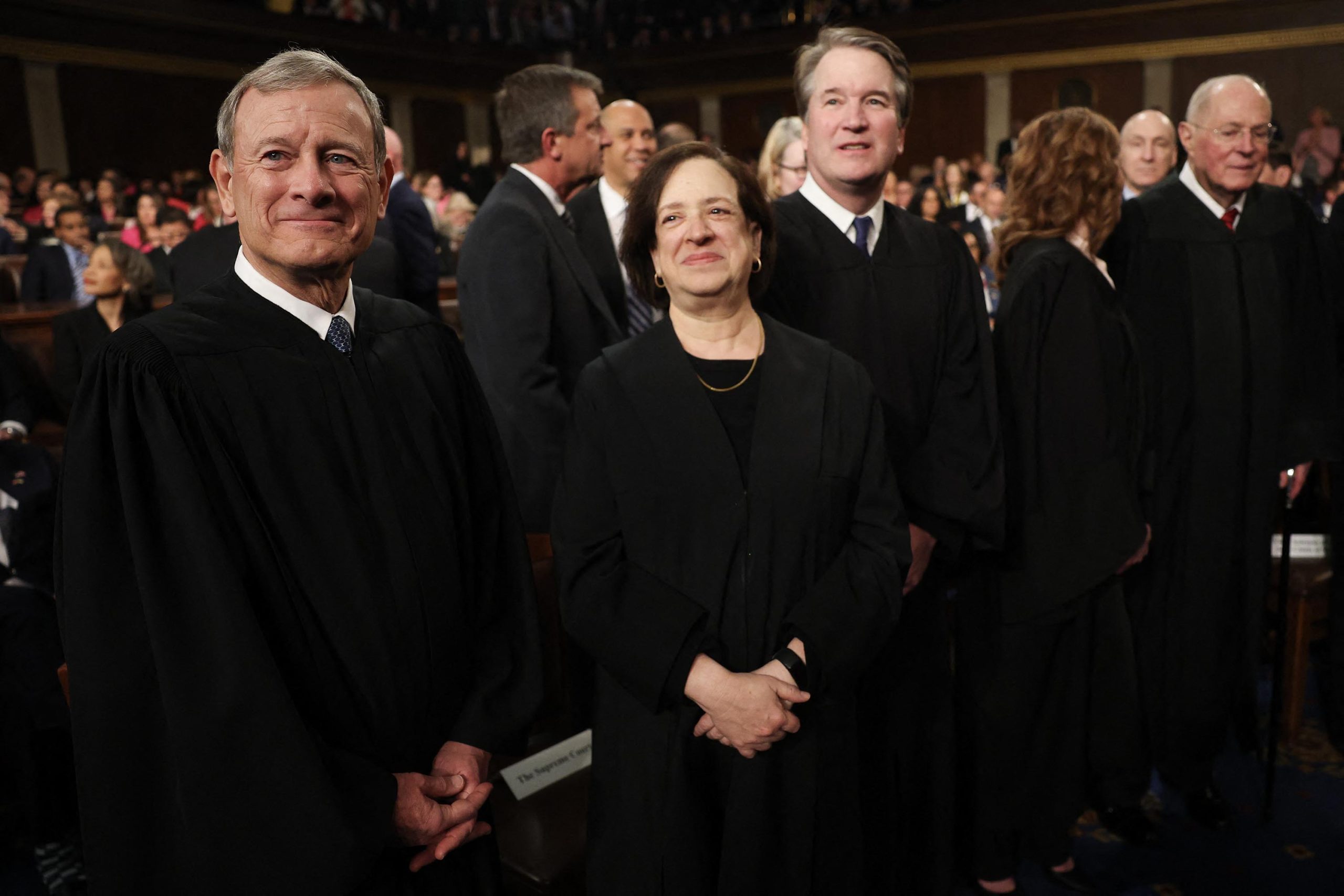
The U.S. Supreme Court has unanimously upheld the conviction of a Montana man who was found guilty of assaulting a police officer after law enforcement entered his home without a warrant. In an opinion written by Justice Elena Kagan, the Court ruled that officers did not violate the Fourth Amendment, clarifying the scope of the “emergency aid” exception to the warrant requirement.
The case, formally known as Case v. Montana, arose when William Case’s former girlfriend contacted authorities, reporting that Case had threatened to commit suicide and might be armed. Police responded to the call with a welfare check, arriving at Case’s home to ensure his safety. According to court records, Case did not answer the door or respond to officers’ calls from an open window. Officers observed signs in the house suggesting potential danger, including empty beer cans, an empty handgun holster, and what appeared to be a suicide note. Case had a history of suicidal threats and prior confrontations with law enforcement, including incidents that led officers to suspect he might provoke a “suicide-by-cop” scenario.
After a period of observation, officers entered Case’s home. During the entry, they found Case hiding in a closet with a black object officers believed could be a firearm. A confrontation ensued, resulting in one officer shooting Case in the abdomen. Another officer discovered a handgun hidden in a laundry hamper nearby. Following the incident, Case challenged the legality of the entry, arguing that police should have obtained a warrant before entering his home and that evidence discovered after the entry should be excluded.
The Montana courts rejected Case’s argument, prompting his appeal to the Supreme Court. Central to his claim was whether police must have “probable cause” that someone is in immediate need of assistance before entering a home without a warrant. Justice Kagan explained that while the Fourth Amendment generally protects the sanctity of the home and requires warrants for intrusions, there are well-established exceptions. One such exception allows officers to enter a home without a warrant when there is a reasonable belief that someone inside requires emergency aid.
Kagan referenced prior Supreme Court precedent, particularly Brigham City v. Stuart, where the Court upheld warrantless entry after officers observed a fight inside a home through a window. In that case, the Court held that officers had an “objectively reasonable basis” to believe that an occupant was seriously injured or at risk of imminent injury. Applying the same principles to Case’s situation, Kagan concluded that the officers acted reasonably. Their observations and knowledge of Case’s prior behavior created an objectively reasonable belief that intervention was necessary to prevent serious harm, even in the absence of a warrant.
The Court emphasized that the probable-cause standard, which is central in criminal investigations, does not apply in non-criminal, emergency situations such as this one. The “emergency aid” exception, Kagan noted, is specifically intended to allow officers to provide immediate assistance when someone’s life or health may be at risk. However, she also cautioned that the exception does not grant officers unlimited authority to search a home beyond what is reasonably necessary to address the emergency and ensure their own safety.
Justice Sonia Sotomayor filed a concurring opinion, highlighting the unique risks posed to individuals with serious mental-health conditions during police interactions. She noted that such individuals are disproportionately likely to be injured or killed in encounters with law enforcement. Sotomayor suggested that officers should consider alternative de-escalation strategies when responding to mental-health crises. In this case, however, she agreed that the circumstances—the combination of a reported suicide threat, a history of suicidal behavior, and signs that Case could be armed—justified the officers’ entry under the emergency-aid exception.
Justice Neil Gorsuch also wrote a concurring opinion, tracing the origins of the emergency-aid exception to common law principles that allow private citizens to intervene to prevent serious physical harm. He explained that law enforcement officers enjoy the same privileges as private citizens in such situations, enabling them to act when immediate assistance is required to protect life or prevent injury.
The Court’s decision underscores the balance between protecting constitutional privacy rights and allowing law enforcement to respond effectively in emergencies. The Fourth Amendment’s warrant requirement is foundational to American law, but it is not absolute. Exceptions like the emergency-aid doctrine recognize that rigid adherence to procedural rules could sometimes prevent officers from saving lives.
Legal experts have noted that the ruling provides clarity for law enforcement officers dealing with similar situations. By confirming that officers do not need probable cause in certain non-criminal emergencies, the Court reinforced the principle that the reasonableness of an entry is evaluated based on the totality of circumstances, including prior threats, observable dangers, and the officer’s knowledge of the individual’s behavior.
The ruling also has implications for mental health response protocols. Advocates for people with serious mental health challenges stress the importance of training officers in crisis intervention and de-escalation techniques. While the Court upheld the entry in this case, Sotomayor’s concurrence reflects a growing recognition that interactions with vulnerable individuals can be especially complex and require specialized approaches to minimize harm.
Case’s legal challenge centered on the interpretation of what constitutes a reasonable belief that emergency aid is necessary. The Supreme Court’s unanimous decision indicates broad agreement that officers’ actions were appropriate under established precedent. Kagan’s opinion carefully delineated the limits of the emergency-aid exception, emphasizing that officers’ authority is confined to what is necessary to address the immediate threat and maintain safety, rather than as a license to conduct a general search.
The case also illustrates the ongoing tension between individual rights and public safety. Homeowners are afforded strong protections under the Constitution, reflecting the importance of privacy and the sanctity of the home. At the same time, law enforcement must be able to act decisively when a life-threatening situation arises. By affirming the emergency-aid exception, the Court clarified that the law allows for rapid intervention while still imposing limits on the scope of searches and seizures.
In practical terms, the decision means that police officers responding to reports of imminent danger, such as suicide threats or medical emergencies, can enter a residence without a warrant if their belief that intervention is necessary is objectively reasonable. However, any evidence obtained beyond what is necessary to address the emergency could still be subject to exclusion under the Fourth Amendment if officers exceed the scope of the exception.
The Court’s ruling also emphasizes the importance of documentation and judgment in emergency responses. Officers must be able to articulate the basis for their belief that immediate aid is required, taking into account the observed circumstances, prior knowledge of the individual, and potential risks. Courts will review these actions to ensure that entries are justified and proportionate to the emergency at hand.
Ultimately, the decision in Case v. Montana reinforces existing principles of constitutional law while providing guidance for law enforcement on how to respond to potentially life-threatening situations. It balances the protection of individual rights with the practical need to preserve life and prevent harm. The ruling clarifies that emergency circumstances can justify warrantless entry when officers reasonably believe immediate intervention is necessary, but that such authority is limited and must be carefully exercised.
The unanimous opinion, supplemented by the concurrences of Justices Sotomayor and Gorsuch, provides a comprehensive framework for assessing similar cases in the future. It emphasizes that while the Fourth Amendment protects homes from unreasonable intrusion, the safety and well-being of individuals in crisis can justify exceptions when officers act in good faith and within the boundaries of reasonableness. The Court’s guidance ensures that officers have clear legal support for emergency actions while maintaining safeguards against overreach, ensuring both constitutional protections and public safety are preserved.

Emily Johnson is a critically acclaimed essayist and novelist known for her thought-provoking works centered on feminism, women’s rights, and modern relationships. Born and raised in Portland, Oregon, Emily grew up with a deep love of books, often spending her afternoons at her local library. She went on to study literature and gender studies at UCLA, where she became deeply involved in activism and began publishing essays in campus journals. Her debut essay collection, Voices Unbound, struck a chord with readers nationwide for its fearless exploration of gender dynamics, identity, and the challenges faced by women in contemporary society. Emily later transitioned into fiction, writing novels that balance compelling storytelling with social commentary. Her protagonists are often strong, multidimensional women navigating love, ambition, and the struggles of everyday life, making her a favorite among readers who crave authentic, relatable narratives. Critics praise her ability to merge personal intimacy with universal themes. Off the page, Emily is an advocate for women in publishing, leading workshops that encourage young female writers to embrace their voices. She lives in Seattle with her partner and two rescue cats, where she continues to write, teach, and inspire a new generation of storytellers.