The corridors of Westminster have witnessed centuries of diplomacy, crisis, and quiet negotiation, but few recent visits carried the same undercurrent of unease as the arrival of the Speaker of the United States House of Representatives earlier this week. Officially, the visit was framed as a reaffirmation of the “special relationship” between the United States and the United Kingdom — a routine yet symbolically important exchange between two long-standing allies.
Privately, however, officials on both sides of the Atlantic acknowledged that the timing was far from routine.
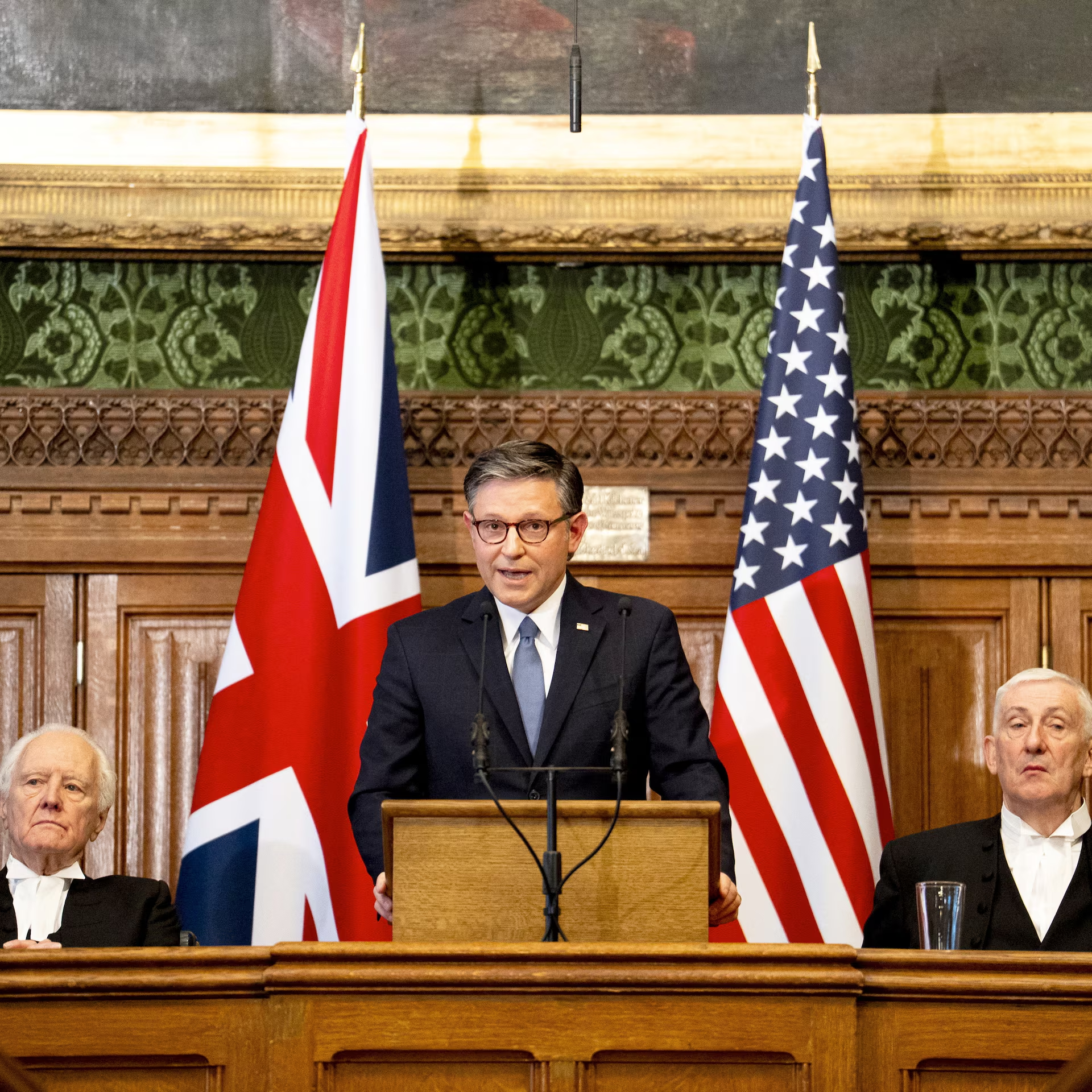
Global politics is in a period of sharp recalibration. Long-standing assumptions about security, technology, and sovereignty are being tested, not by open conflict, but by subtler, more insidious pressures. It was against this backdrop that Speaker Mike Johnson stepped into the Palace of Westminster, meeting lawmakers, committee chairs, and senior government figures behind closed doors before addressing Parliament in a rare and closely watched session.
From the outset, his tone was measured, even restrained. He praised the resilience of democratic institutions, the shared sacrifices of history, and the importance of cooperation in a “challenging era.” But beneath the formal language, there was a sense that the Speaker had come not merely to celebrate alliance, but to deliver a message that could not wait.
A Relationship Tested by a Changing World
Johnson’s speech opened with familiar references to World War II, NATO, and decades of transatlantic partnership. These were not empty gestures. For many MPs in the chamber, the presence of the US Speaker served as a reminder of how deeply entwined the two nations’ political and security interests remain.
Yet the world those institutions were built to protect has changed dramatically.
In recent years, the nature of global power has shifted away from clearly defined battle lines toward economic leverage, cyber capabilities, and influence operations that operate in legal and ethical gray zones. Governments, Johnson noted, must now contend with threats that do not arrive with tanks or missiles, but through data flows, supply chains, and information ecosystems.
He spoke of democracies facing pressure not only from within — polarization, mistrust, institutional fatigue — but from external actors who understand how to exploit those vulnerabilities. The challenge, he suggested, was not merely to defend borders, but to defend systems.
At this stage, Johnson remained deliberately vague. He spoke of “actors who do not share our values” and “forces that benefit from democratic confusion,” without naming names or specifying methods. The ambiguity appeared intentional, holding the chamber’s attention as he laid out a broader philosophical framework.
The Quiet Work of Modern Power
One of the central themes of the Speaker’s address was the changing nature of power itself. In earlier eras, influence was measured in armies, territory, and industrial output. Today, he argued, it is measured in access — access to information, infrastructure, technology, and decision-making processes.
Johnson emphasized that democracies are particularly vulnerable because of their openness. Free markets, free speech, and academic exchange are strengths, but they can also be exploited by those willing to act in bad faith. He cautioned against assuming that openness alone guarantees resilience.
“There are those,” he said, “who study our systems not to join them, but to bend them.”
The Speaker referenced recent debates within the United States over critical infrastructure, digital sovereignty, and foreign investment. He noted that similar conversations were taking place across Europe, including in the UK, as governments reassessed how interconnected economies could become points of leverage in times of tension.
Still, he stopped short of specifying what, exactly, had prompted his visit.
A Shift in Tone
It was midway through his address — after the historical references and the philosophical groundwork — that Johnson’s tone subtly changed.
The language grew more direct. The pauses between sentences lengthened. Members of Parliament, many of whom had expected a largely ceremonial speech, leaned forward. What followed was the heart of the message he had come to deliver.
For the first time, the Speaker explicitly identified the source of his concern.
Johnson warned that the United Kingdom, like the United States, was facing sustained and coordinated security threats originating from China and Russia. These threats, he said, were not hypothetical, nor were they limited to traditional military domains.
They were already underway.
Naming the Threats
According to Johnson, both Beijing and Moscow had dramatically expanded their efforts to influence, penetrate, and undermine democratic societies. While their methods differed, the objective was the same: to weaken democratic cohesion, reduce public trust, and gain strategic advantage without triggering direct confrontation.
He described a spectrum of activities ranging from cyber intrusions and espionage to economic pressure and political influence campaigns. Universities, research institutions, technology firms, and even local governments, he warned, had become targets.
“These are not acts of war in the conventional sense,” Johnson said, “but they are acts of hostility nonetheless.”
Russia, he noted, had refined its approach through years of information warfare, using disinformation and psychological operations to sow division and amplify existing social fractures. China, by contrast, was leveraging economic scale and technological integration, embedding itself deeply into global supply chains and digital infrastructure.
The danger, Johnson argued, lay precisely in the subtlety of these strategies. By the time their impact was fully recognized, critical decisions might already be compromised.
A Call for Parliamentary Vigilance
Addressing UK lawmakers directly, Johnson urged Parliament to take a proactive role in scrutinizing foreign involvement across key sectors. He emphasized that executive action alone was insufficient; democratic oversight was essential.
He called for stronger cooperation between legislatures, intelligence communities, and allied governments, stressing that transparency among allies was one of the most effective defenses against covert influence.
Importantly, Johnson was careful not to frame his warning as alarmist. He acknowledged the importance of diplomacy, trade, and engagement, particularly with China. But he insisted that engagement must be grounded in realism.
“Engagement without vigilance,” he said, “is an invitation to exploitation.”
Reactions Inside and Outside the Chamber
The response within Parliament was notably sober. Lawmakers from across the political spectrum later described the speech as “sobering” and “necessary,” even if uncomfortable. Several MPs acknowledged privately that Johnson had articulated concerns already being discussed in classified briefings, but rarely addressed so openly in a public forum.
Outside Westminster, analysts noted the significance of the Speaker — rather than a cabinet official — delivering such a warning. As head of a co-equal branch of the US government, Johnson’s remarks underscored that concerns about Chinese and Russian activity were not limited to any single administration or party.
“This wasn’t policy positioning,” said one UK security expert. “It was a signal.”
A Message Beyond Britain
While the immediate audience was the UK Parliament, Johnson made clear that his message was intended for all democratic allies. He framed the challenge as collective, requiring shared standards, shared intelligence, and shared resolve.
The era, he suggested, when democracies could address security threats in isolation had passed.
As he concluded, Johnson returned to the theme with which he began: the endurance of democratic institutions. But now, the praise carried an implicit warning. Survival, he said, was not guaranteed by history alone.
“It is guaranteed only by vigilance,” he told the chamber, “and by the courage to confront uncomfortable truths.”
The applause that followed was polite rather than exuberant — fitting for a speech that was less a celebration than a caution. As MPs filed out of the chamber, many understood that they had not merely heard a foreign dignitary speak, but had been placed on notice.
The warning had been delivered. What came next, Johnson made clear, was up to them.

Emily Johnson is a critically acclaimed essayist and novelist known for her thought-provoking works centered on feminism, women’s rights, and modern relationships. Born and raised in Portland, Oregon, Emily grew up with a deep love of books, often spending her afternoons at her local library. She went on to study literature and gender studies at UCLA, where she became deeply involved in activism and began publishing essays in campus journals. Her debut essay collection, Voices Unbound, struck a chord with readers nationwide for its fearless exploration of gender dynamics, identity, and the challenges faced by women in contemporary society. Emily later transitioned into fiction, writing novels that balance compelling storytelling with social commentary. Her protagonists are often strong, multidimensional women navigating love, ambition, and the struggles of everyday life, making her a favorite among readers who crave authentic, relatable narratives. Critics praise her ability to merge personal intimacy with universal themes. Off the page, Emily is an advocate for women in publishing, leading workshops that encourage young female writers to embrace their voices. She lives in Seattle with her partner and two rescue cats, where she continues to write, teach, and inspire a new generation of storytellers.