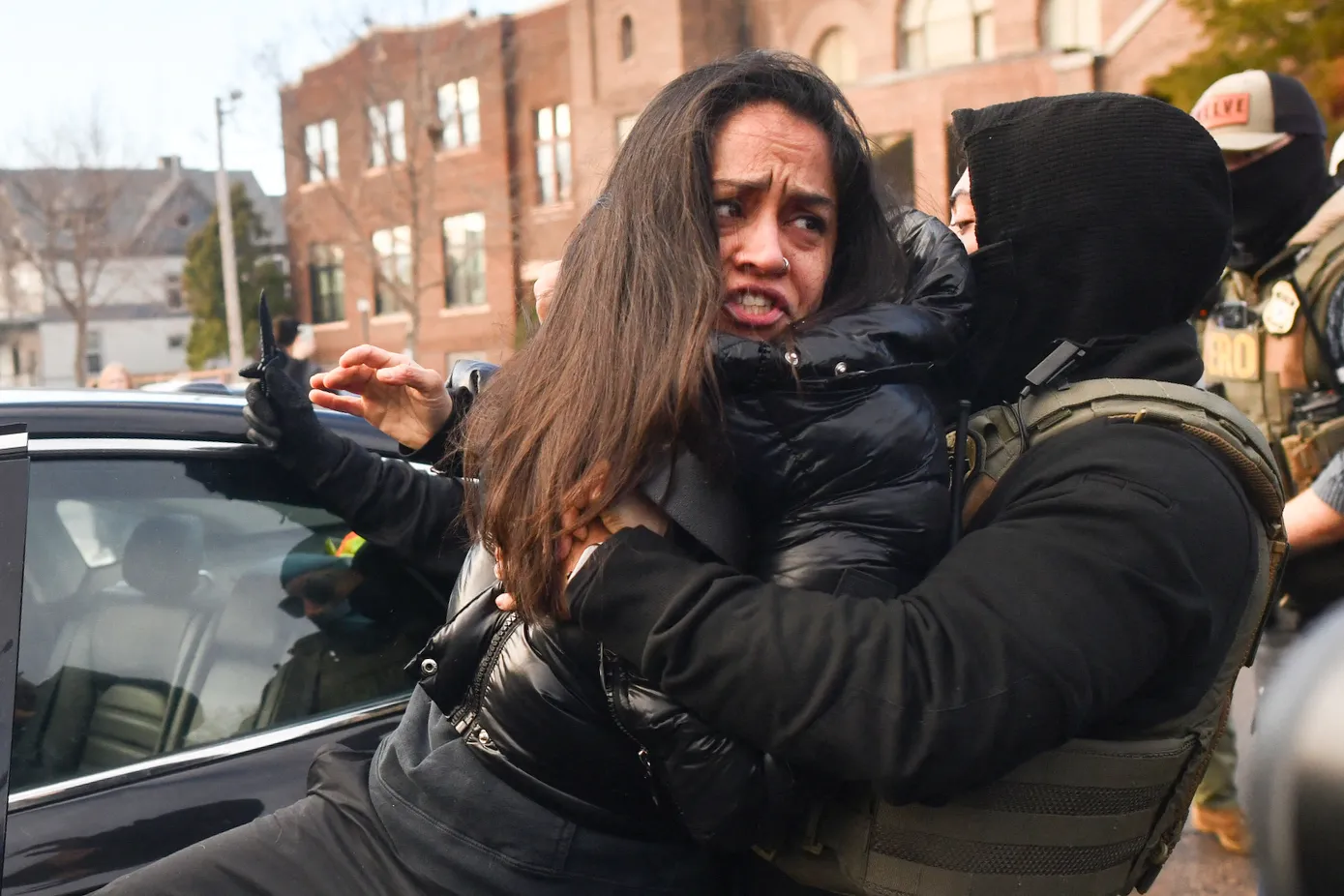
A video that swept across social media this week has ignited national outrage and renewed scrutiny of the Trump administration’s sweeping immigration operation in Minnesota. The footage shows masked federal agents smashing the window of a car, cutting a woman’s seatbelt, and dragging her into the street as protesters scream in horror.
The woman in the video, Aliya Rahman, is a U.S. citizen. She says she was on her way to a medical appointment when she became trapped at an intersection overtaken by federal immigration officers and protesters. Within moments, she was yanked from her vehicle and hauled into custody.
What happened next, Rahman says, nearly cost her life.
In a statement released Thursday, Rahman said she was taken to a detention center, denied medical care despite repeatedly asking for a doctor, and ultimately lost consciousness in her cell. Only after collapsing, she said, was she transported to a hospital.
The Department of Homeland Security offered a sharply different account. Officials described Rahman as an “agitator” who obstructed Immigration and Customs Enforcement agents during an enforcement operation. DHS said she ignored repeated commands to move her vehicle and was arrested along with several others accused of interfering with federal officers.
The conflicting narratives have become emblematic of the growing rift between federal authorities and residents in Minneapolis, where thousands of immigration agents have flooded the city in what officials describe as the largest enforcement operation in the agency’s history. Local leaders have compared the deployment to a “federal invasion.” Protesters say it feels like a city under occupation.
And now, millions of Americans have seen what that occupation looks like.
“Dragged from My Car”
In the viral video, whistles pierce the air as protesters crowd the street. Car horns blare. Shouts echo in every direction. Masked agents in tactical gear surround Rahman’s vehicle.
One officer smashes the passenger-side window. Another cuts her seatbelt. Agents reach inside and pull her through the driver’s door. Her body goes limp as she is dragged across the pavement. Several officers hoist her by her arms and legs and carry her toward an ICE vehicle.
“I’m disabled. I’m trying to go to the doctor,” Rahman can be heard saying. “That’s why I didn’t move.”
Rahman later explained that she was headed to a routine appointment at a Traumatic Brain Injury Center when she encountered the blockade. She said she was trapped between federal vehicles and protesters and had nowhere to go.
Her attorney, Alexa Van Brunt of the MacArthur Justice Center, described the situation as “terrible and confusing.”
“Her only options were to move her car forward in the direction of ICE officers and risk being accused of trying to harm them—which led to Renee Good’s death—or stay stationary, which in the end led to physical violence and abuse,” Van Brunt said.
To Rahman, remaining still felt like the safest choice. To federal agents, it was obstruction.
DHS maintains that Rahman ignored multiple commands to move her vehicle and was lawfully detained. The department has not clarified whether she faces charges, nor has it responded directly to her claim that she was denied medical treatment.
A City Under Watch
Rahman’s arrest did not occur in isolation. It unfolded against the backdrop of an unprecedented federal operation that has transformed daily life in Minneapolis.
Nearly 3,000 immigration agents have been deployed across the region. Armed officers conduct raids in neighborhoods, workplaces, and private homes. Residents report seeing unmarked vehicles, masked agents, and tactical teams at intersections, grocery stores, and apartment complexes.
The presence has triggered constant demonstrations. Protesters blow whistles to alert neighbors. Cars honk in warning. People rush outside when agents appear, filming encounters and demanding to see warrants.
The killing of Renee Nicole Good earlier this month intensified everything.
Good, a 37-year-old mother of three, was shot by an ICE officer during an encounter that officials initially portrayed as a violent threat to federal agents. Video later emerged that appeared to show Good attempting to drive away when she was shot. The incident ignited fury across the city and hardened resistance to the federal presence.
Since then, Minneapolis has become saturated with recordings: agents dragging people from cars, pepper-spraying crowds, smashing windows, and forcing entry into homes.
Rahman’s video is simply the most widely seen.
A Barrage of Viral Encounters
Across Minneapolis, residents and bystanders are documenting what they see.
In one widely shared clip, heavily armed agents batter down the door of a home where a man’s wife and 9-year-old child are inside. A woman’s voice can be heard pleading, “Where is the warrant?” and “Can you put the guns down? There are kids in this house.”
Another video shows ICE agents detaining two employees at a retail store in a nearby suburb. Both were later identified as U.S. citizens and released.
In south Minneapolis, nurse Monica Bicking filmed what appears to be a federal agent kneeing a man repeatedly in the face while others pin him to the ground. Bicking says she does not attend organized protests. She simply carries a whistle now, in case she encounters agents on her way to work.
“We’re hypervigilant every time we leave our houses,” she said. “Looking for ICE. Trying to protect our neighbors. Trying to support our neighbors, who are now just on lockdown.”
For many residents, the city no longer feels normal. Parents walk children to school scanning the streets. Workers alter commutes to avoid intersections where agents often appear. Immigrant families remain indoors for days at a time.
Even citizens like Rahman say they no longer feel safe.
“I Thought I Was Going to Die”
Rahman’s account of her detention is harrowing.
“Masked agents dragged me from my car and bound me like an animal, even after I told them that I was disabled,” she said.
She said she repeatedly requested medical attention after being taken into custody. Instead, she was transported to a detention center. Her condition deteriorated.
“It was not until I lost consciousness in my cell that I was finally taken to a hospital,” she said.
Her attorneys say she was treated for injuries consistent with assault. She has since been released.
Rahman expressed gratitude to the hospital staff who cared for her.
“They gave me hope when I thought I was going to die,” she said.
Her experience has resonated widely, especially among people who believed that citizenship or medical vulnerability would shield them from such treatment.
Instead, Rahman’s case suggests that in a city gripped by enforcement and protest, those distinctions can vanish in seconds.
Competing Realities
Federal officials insist the operation is lawful and necessary. DHS says agents are targeting people suspected of being in the country illegally and individuals with criminal histories. The department argues that protesters are interfering with legitimate law enforcement actions and putting officers at risk.
Local leaders and civil rights groups counter that the scale and tactics of the operation are reckless, destabilizing, and constitutionally suspect. They argue that aggressive enforcement is sweeping up citizens, traumatizing children, and turning neighborhoods into flashpoints.
Between these positions lies a widening gulf of trust.
Residents see masked agents and shattered windows.
Federal authorities see obstruction and disorder.
Every video becomes evidence in a battle over narrative: Who is the aggressor? Who is in danger? Who is telling the truth?
Rahman’s case crystallizes those questions.
Was she a disabled woman caught in chaos, or an agitator defying lawful commands?
Was her detention an unfortunate necessity, or a violation of basic human dignity?
The video offers no easy answers. It shows only force.
A National Reckoning
The events in Minneapolis are no longer local.
Rahman’s arrest has been viewed millions of times. Comment sections are filled with shock, anger, and disbelief. For many Americans, the footage is their first glimpse of what large-scale immigration enforcement looks like on the ground.
It is one thing to debate border policy. It is another to watch a woman pulled from her car while begging for help.
The Trump administration has framed its immigration crackdown as a restoration of order. In Minneapolis, many residents experience it as the opposite: a rupture of everyday life, enforced at gunpoint.
As more videos surface, the question is no longer whether people are watching.
It is how long the country can ignore what they are seeing.

Emily Johnson is a critically acclaimed essayist and novelist known for her thought-provoking works centered on feminism, women’s rights, and modern relationships. Born and raised in Portland, Oregon, Emily grew up with a deep love of books, often spending her afternoons at her local library. She went on to study literature and gender studies at UCLA, where she became deeply involved in activism and began publishing essays in campus journals. Her debut essay collection, Voices Unbound, struck a chord with readers nationwide for its fearless exploration of gender dynamics, identity, and the challenges faced by women in contemporary society. Emily later transitioned into fiction, writing novels that balance compelling storytelling with social commentary. Her protagonists are often strong, multidimensional women navigating love, ambition, and the struggles of everyday life, making her a favorite among readers who crave authentic, relatable narratives. Critics praise her ability to merge personal intimacy with universal themes. Off the page, Emily is an advocate for women in publishing, leading workshops that encourage young female writers to embrace their voices. She lives in Seattle with her partner and two rescue cats, where she continues to write, teach, and inspire a new generation of storytellers.