


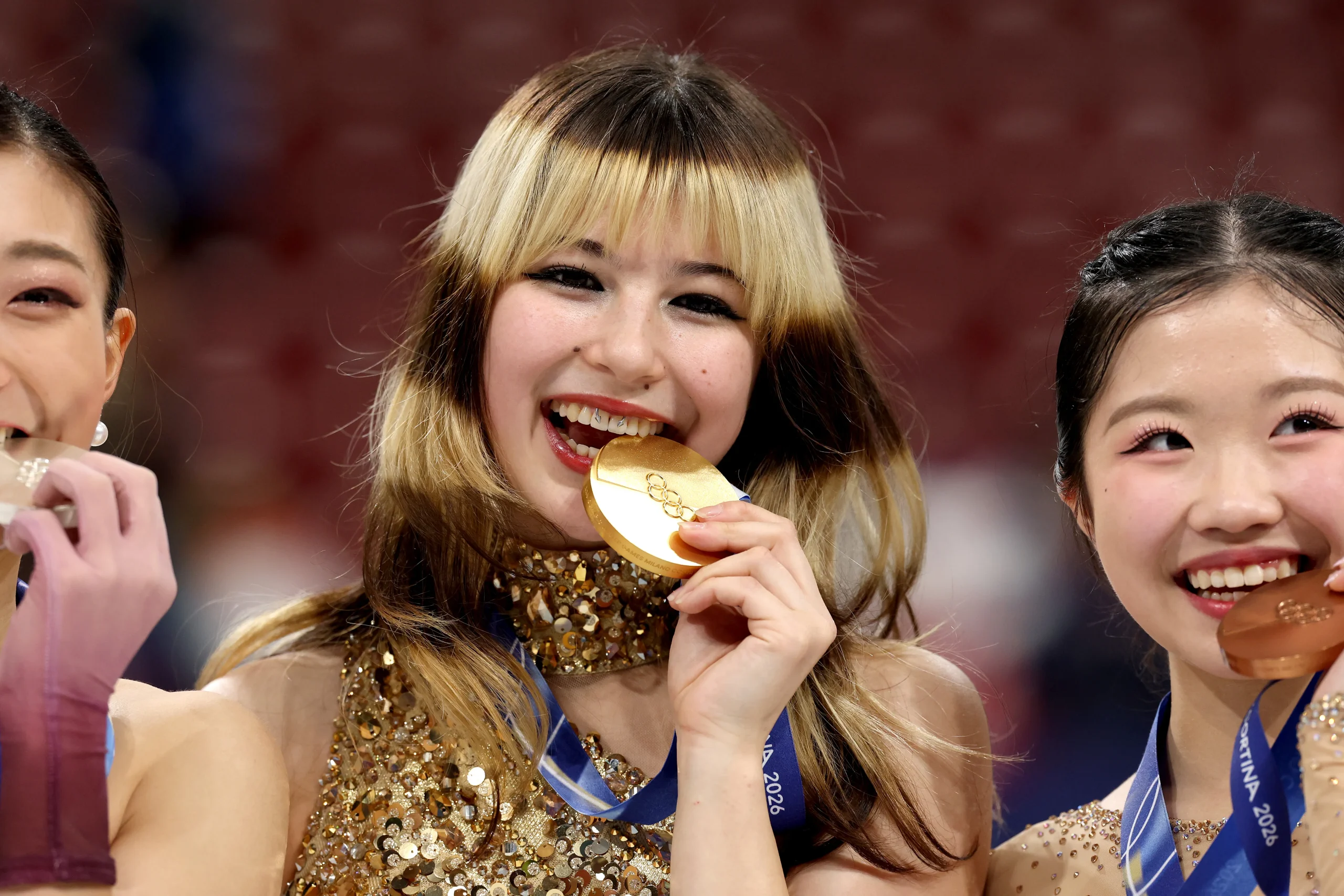
At the 2026 Winter Olympics, a striking new trend caught attention not for athletic technique, but for something far more personal: a unique smile accessory that made headlines alongside podium victories. During her gold-medal-winning performances, viewers noticed silver spikes gleaming from the front of a U.S. figure skater’s mouth. These spikes are part of a dental piercing, commonly referred to as a “smiley” piercing, placed on the tissue connecting the upper lip to the gum and only visible when smiling widely.
The skater, Alysa Liu, captured the gold in the women’s singles event, adding to her team-event success and becoming the first American woman to claim an individual Olympic gold in figure skating since 2002. Her path to the podium was dramatic: entering the free skating phase in third place, Liu surged past Japan’s Kaori Sakamoto and Ami Nakai to achieve a top score of 150.20, clinching victory by just 2.43 points. While her athletic achievements were the headline, it was her smile and its accessory that quickly drew social media attention.
The piercing itself has a fascinating backstory. Liu revealed in a January interview with NBC’s TMJ4 News that she performed the procedure herself with the help of her sister, over two years prior. She described holding her lip, positioning the needle, and completing the piercing with careful attention. Unlike traditional piercings that are always visible, the smiley piercing is subtle, appearing only when the wearer smiles, which has added an element of intrigue and novelty to her public persona.
Despite its visual appeal, health professionals caution that attempting a DIY smiley piercing carries serious risks. The mouth harbors millions of bacteria, and even small procedures can lead to infection, swelling, or more severe complications. The American Dental Association (ADA), in collaboration with MouthHealthy, outlines potential side effects including bleeding, scarring, unusual discharge, damage to teeth and gums, and metal allergies. These warnings are particularly relevant for those who might be tempted to replicate Liu’s bold style without professional supervision.
The ADA highlights that oral piercings can cause swelling significant enough to obstruct the airway or pose a choking hazard if the jewelry breaks. Repeated contact between metal jewelry and teeth can erode enamel over time, and improper placement may even result in embedded jewelry requiring surgical removal. More serious, albeit rarer, outcomes include infections such as hepatitis or endocarditis. Consequently, experts strongly advise consultation with a dentist before considering oral piercings, emphasizing that these adornments require diligent maintenance and cannot be treated casually.
Beyond health concerns, Liu’s piercing has ignited conversations about personal expression in professional sports. Athletes have long experimented with hairstyles, apparel, and accessories to cultivate their individual brand, but oral piercings in competitive settings remain rare. By incorporating a smiley piercing into her Olympic presentation, Liu has introduced a conversation about the intersection of personal style, performance, and safety.
The public reaction has been varied. Social media users have shared both admiration for Liu’s boldness and concern over the health implications of attempting a similar piercing without proper care. Experts stress that even minor variations in technique or hygiene can lead to complications, particularly given the proximity of the piercing to teeth and gums. The unique location in the mouth exposes the area to constant movement, saliva, and bacterial activity, making it far riskier than traditional piercings on the earlobe or cartilage.
In addition to the safety advisories, Liu’s piercing has also brought attention to a growing trend of self-expression among young athletes. In a field often defined by rigorous routines and strict uniformity, personal adornments like piercings, temporary tattoos, or colored blades represent a subtle rebellion and individuality. While Liu’s achievement on ice secured her place in Olympic history, her choice of accessory has further humanized her to fans, offering a glimpse of personality beyond athletic prowess.
Medical and dental experts remain clear on precautions. Anyone considering a smiley piercing should use surgical-grade metal, ensure professional sterilization, and monitor the site for any signs of infection. Regular dental check-ups are recommended to assess potential enamel wear or gum irritation. The ADA strongly discourages casual or self-performed procedures, highlighting that professional oversight is crucial for mitigating risks.
Moreover, Liu’s piercing emphasizes that even minor aesthetic choices can have broad implications in a public and high-stakes setting. For athletes, balancing style and safety is essential. The piercing’s subtlety—visible only when she smiles—demonstrates how personal flair can be incorporated without disrupting athletic focus or performance. Yet the health risks make it clear why experts advise caution against imitation.
Liu’s historic victory, paired with her striking accessory, serves as a cultural moment in Olympic history. While sports often celebrate speed, precision, and technique, Liu’s gold-medal run combined athletic excellence with a memorable personal statement, sparking discussions about fashion, individuality, and health awareness. It also provides an example of how athletes can set trends that are visually captivating but may carry hidden risks for impressionable fans attempting to emulate them.
Her teammate, Amber Glenn, placed fifth in the women’s singles event despite achieving the third-highest free skating score, highlighting the razor-thin margins that defined the competition. Yet it was Liu’s combination of technical skill, artistry, and daring personal expression that captured both the gold medal and public imagination. The smiley piercing became more than an accessory—it symbolized a willingness to stand out and embrace individuality on the world stage.
The ADA’s guidance underscores a critical point: beauty and novelty in sports must be balanced with health considerations. Oral piercings, while visually compelling, require vigilance and professional guidance. Potential complications like bleeding, infection, or damage to oral tissue are serious and sometimes irreversible. Anyone seeking to follow Liu’s lead must weigh these risks carefully and avoid self-administered procedures.
In summary, Alysa Liu’s Olympic triumph represents a convergence of athletic mastery and personal style, but her smiley piercing is not without consequence. While it has captured the attention of fans and media, dental experts warn that imitation carries significant health risks. As she celebrates a historic victory, Liu’s example illustrates both the excitement of individual expression in sports and the importance of caution when incorporating high-risk aesthetics. Her gold medal will be remembered not only for the athletic achievement but also for the statement of personality and style that accompanied her historic performance.
Fans and aspiring skaters are encouraged to admire Liu’s creativity while understanding that not every trend is safe to emulate. The combination of Olympic success and a distinctive smile ensures that her performance will be discussed for years to come—not just for the medal but for the daring individuality that came with it.
The takeaway is clear: while personal style can complement athletic excellence, medical guidance and safety cannot be overlooked. Oral piercings like Liu’s smiley may be alluring, but professional supervision and careful consideration are essential to prevent severe oral complications. Her choice has sparked fascination, conversation, and cautionary advice—cementing her legacy as both a champion and a trendsetter in the world of figure skating.

James Jenkins is a celebrated Pulitzer Prize-winning author whose work has reshaped the way readers think about social justice and human rights in America. Raised in Atlanta, Georgia, James grew up in a community that instilled in him both resilience and a strong sense of responsibility toward others. After studying political science and creative writing at Howard University, he worked as a journalist covering civil rights issues before dedicating himself fully to fiction. His novels are known for their sharp, empathetic portraits of marginalized communities and for weaving personal stories with broader political realities. Jenkins’s breakout novel, Shadows of Freedom, won national acclaim for its unflinching look at systemic inequality, while his more recent works explore themes of identity, resilience, and the fight for dignity in the face of oppression. Beyond his novels, James is an active public speaker, lecturing at universities and participating in nonprofit initiatives that support literacy and community empowerment. He believes that storytelling is a way to preserve history and inspire change. When not writing, James enjoys jazz music, mentoring young writers, and traveling with his family to explore cultures and stories around the world.