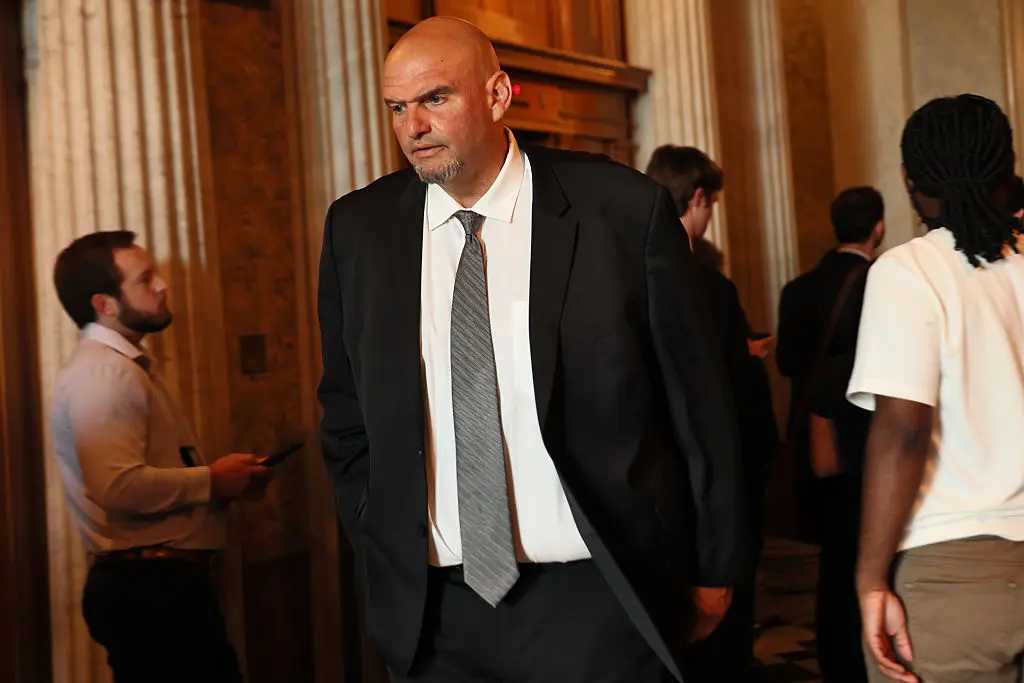
Pennsylvania Senator John Fetterman (D) has taken a stance that puts him at odds with much of his Democratic caucus, saying that requiring voters to show identification is not “unreasonable.” The comments come as Republicans intensify their push to tie provisions of the Safeguard American Voter Eligibility (SAVE) America Act — particularly voter ID requirements — to the next Department of Homeland Security (DHS) funding bill.
Fetterman made his remarks during an appearance on Fox News’ Sunday Morning Futures on February 8, addressing the looming risk of a government shutdown if DHS funding lapses. He cited the Transportation Security Administration and Federal Emergency Management Agency as agencies that could be affected by a delay, emphasizing that he wanted to avoid “jumping back” into shutdown politics.
“I do not believe that it’s unreasonable to show ID just to vote,” Fetterman said during the interview. He pointed to Wisconsin’s 2025 election, where voters approved a constitutional amendment requiring voter ID by roughly 63 percent, while also electing a liberal justice to the state supreme court. “So it’s not a radical idea for regular Americans to show your ID to vote,” he added.
Fetterman’s comments directly contrast with the messaging of Senate Minority Leader Chuck Schumer (D-N.Y.) and many other Senate Democrats, who have framed the SAVE America Act as a modern form of voter suppression. Schumer has repeatedly compared the proposed law to Jim Crow-era restrictions designed to disenfranchise Black voters in the South.
“It’s Jim Crow 2.0, and I called it Jim Crow 2.0,” Schumer said on MSNBC’s Morning Joe earlier this week. “What they’re trying to do here is the same thing that was done in the South for decades to prevent people of color from voting.” He argued that the law could unfairly block eligible voters who lack certain documentation, such as women who have changed their last names through marriage, and said no Democrats in the Senate would support the legislation.
Fetterman, however, pushed back on that framing. “It’s absolutely not Jim Crow or anything,” he said, describing the historical segregation laws as “an awful, awful legacy” of the United States. He suggested that the political obstacles to the bill’s passage were structural rather than ideological, citing the Senate filibuster.
“For me, the SAVE Act is not going to pass because of the filibuster, because they would need at least seven or eight Democratic votes to pass that,” he said.
The SAVE America Act has become entangled with the broader debate over DHS funding, which must be resolved before the Feb. 13 deadline. Republican leaders are aggressively pushing to attach the bill’s voter ID and proof-of-citizenship requirements to the final DHS funding package.
Under the proposed law, voters would be required to show proof of U.S. citizenship when registering to vote in federal elections. States would also be directed to remove noncitizens from voter rolls and to implement photo ID requirements for federal elections.
The legislation builds on the 2025 SAVE Act, which passed the House but stalled in the Senate. That earlier version primarily focused on verification of citizenship and maintaining accurate voter rolls, without introducing a separate federal voter ID requirement. Four House Democrats voted in favor of the 2025 bill — Reps. Ed Case (D-Hawaii), Henry Cuellar (D-Texas), Jared Golden (D-Maine), and Marie Gluesenkamp Perez (D-Wash.) — though it remains unclear whether they will support the updated provisions if the law is revisited.
Polling shows that voter ID requirements remain broadly popular among the American electorate. A Pew Research Center survey conducted in August 2025 found that 83 percent of Americans overall support requiring government-issued photo identification to vote, including 95 percent of Republicans and 71 percent of Democrats. The National Conference of State Legislatures reports that 36 states already require some form of voter identification at the polls, while others use signature verification or similar methods to confirm voter eligibility.
Fetterman framed his support for voter ID as a practical measure consistent with what he called basic expectations from voters. He also linked it to his broader priorities on national security and law enforcement, including securing the border and deporting criminals.
“The idea is simple: if you want to vote, show your ID,” he said. “It’s reasonable, it’s practical, and it’s what voters expect.” He emphasized that he does not want another government shutdown over partisan disputes.
The Pennsylvania senator’s comments represent a rare instance of a Democrat publicly breaking with party orthodoxy on a high-profile voting rights issue, highlighting the growing cross-party tension surrounding election integrity, voting access, and federal oversight of state elections. While many Democrats view voter ID laws as a barrier to historically marginalized communities, Republicans argue that they are a necessary safeguard against fraud.
Fetterman’s position may also reflect the political realities of his home state. Pennsylvania is considered a key swing state, and the senator has previously emphasized the importance of appealing to moderate and independent voters, who tend to support voter ID laws. Wisconsin, which he referenced in his interview, has become another critical battleground where voter ID remains a contentious but widely accepted measure.
The timing of the remarks is particularly significant as both parties attempt to negotiate DHS funding legislation. Republicans are seeking to use leverage to include voter ID and proof-of-citizenship requirements in the spending bill, while Democrats have signaled they will withhold support for funding unless certain reforms are included, particularly those affecting Immigration and Customs Enforcement (ICE) and border policy.
The partisan tug-of-war comes as Congress faces a hard deadline. Should DHS funding lapse, agencies such as the TSA and FEMA could face disruptions in operations, and federal employees may be furloughed. Both sides are using the threat of a shutdown to advance long-standing policy goals, with voter ID legislation emerging as one of the most politically charged issues in the negotiations.
While Fetterman acknowledges the political risk of breaking with his party, he appears willing to stake out a centrist position. By framing voter ID as a reasonable, non-discriminatory measure, he is signaling that some Democrats can support targeted election reforms without undermining the fundamental principle of universal suffrage.
Whether this stance will influence other moderate Democrats in the Senate remains uncertain. Senate rules, including the filibuster, will likely remain a decisive factor in determining whether the SAVE America Act or similar legislation can advance. With just days remaining before the Feb. 13 DHS funding deadline, the debate over voter ID has become inseparable from the larger budget and government funding negotiations.
As negotiations continue, voters and lawmakers alike will be closely watching how Fetterman’s comments and the broader conversation over election security affect both the legislative outcome and the political dynamics ahead of the 2026 midterm elections.

Emily Johnson is a critically acclaimed essayist and novelist known for her thought-provoking works centered on feminism, women’s rights, and modern relationships. Born and raised in Portland, Oregon, Emily grew up with a deep love of books, often spending her afternoons at her local library. She went on to study literature and gender studies at UCLA, where she became deeply involved in activism and began publishing essays in campus journals. Her debut essay collection, Voices Unbound, struck a chord with readers nationwide for its fearless exploration of gender dynamics, identity, and the challenges faced by women in contemporary society. Emily later transitioned into fiction, writing novels that balance compelling storytelling with social commentary. Her protagonists are often strong, multidimensional women navigating love, ambition, and the struggles of everyday life, making her a favorite among readers who crave authentic, relatable narratives. Critics praise her ability to merge personal intimacy with universal themes. Off the page, Emily is an advocate for women in publishing, leading workshops that encourage young female writers to embrace their voices. She lives in Seattle with her partner and two rescue cats, where she continues to write, teach, and inspire a new generation of storytellers.