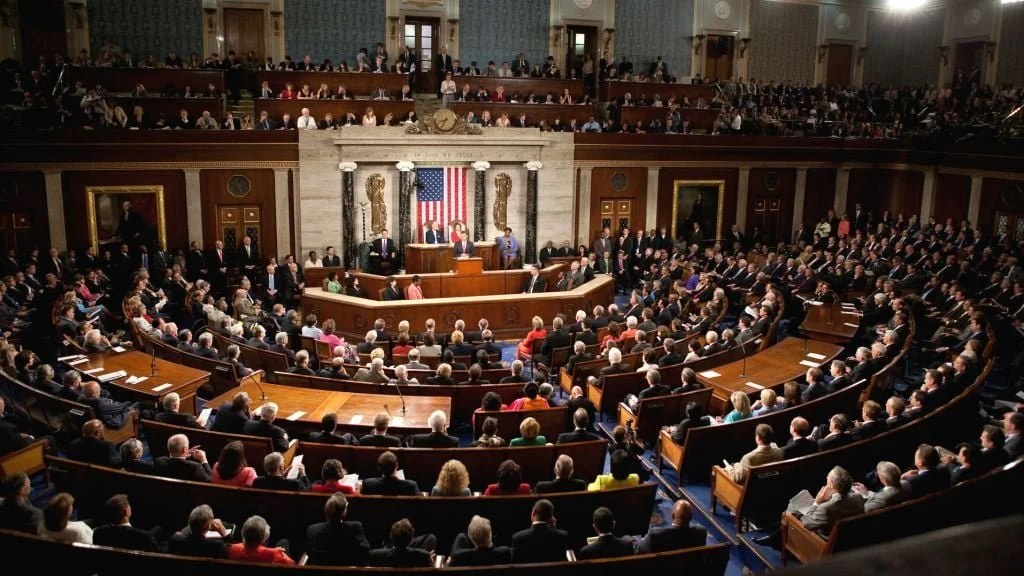
The U.S. Senate on Thursday passed a three-bill funding package designed to keep significant parts of the federal government operating, clearing the legislation before lawmakers departed for a weeklong recess. The measure, approved in an 82–15 vote, now heads to President Donald Trump’s desk, providing temporary financial certainty for several key agencies while Congress races against a looming shutdown deadline at the end of the month.
The package includes appropriations for the Departments of Commerce, Justice, and Interior, along with the Environmental Protection Agency. Together, these agencies oversee everything from economic data and business regulation to federal law enforcement, national parks, and environmental protection. With funding for these entities now secured, attention turns to the six remaining appropriations bills that must be finalized before January 30, when funding expires for large swaths of the government.
Those unresolved measures cover some of the most politically sensitive areas of federal spending: Defense; Transportation; Housing and Urban Development; Labor; Health and Human Services; Education; and Homeland Security. While the House of Representatives has already passed eight of the twelve annual spending bills, the remaining package includes departments that sit at the heart of America’s current political and cultural conflicts.
At the center of the impasse is Homeland Security, and more specifically, Immigration and Customs Enforcement (ICE). Funding for the department was expected to be included in the House package earlier this week. That plan unraveled following the fatal shooting of 37-year-old Renee Nicole Good by an ICE agent during an enforcement operation in Minneapolis.
The incident has reverberated far beyond Minnesota, igniting protests, inflaming partisan divisions, and placing ICE’s tactics under an unforgiving national spotlight. Democrats have made clear they will not support a Homeland Security funding bill without new accountability measures for the agency.
“As we approach the appropriations process related to Homeland Security funding, Democrats in the House and the Senate have demanded changes to the way in which ICE conducts itself,” House Minority Leader Hakeem Jeffries said in remarks to reporters. The message was unambiguous: the agency’s conduct, particularly in light of Good’s death, must be addressed before additional funds are approved.
The shooting of Renee Good occurred during a federal immigration operation in her neighborhood on January 7. Video footage shows Good in her car as agents approached. Moments later, gunfire erupted, killing the mother of one. Federal authorities have claimed that Good “weaponized” her vehicle, describing her as a “domestic terrorist” and asserting that the agent’s use of lethal force was justified.
Good’s family and supporters reject that characterization. Her wife, Becca, has described Renee as “pure love” and “pure sunshine,” a woman who believed deeply in kindness and the responsibility to care for one another. In an emotional statement, Becca said Renee lived by the belief that all people are here “to love each other, care for each other, and keep each other safe and whole.”
Public debate has centered on whether the ICE agent, Jonathan Ross, was actually struck by Good’s vehicle. Online analysts and local officials have scrutinized footage frame by frame. Minneapolis Mayor Jacob Frey has openly questioned the government’s narrative. Two U.S. officials have since claimed Ross suffered internal bleeding to his torso, suggesting he may have been hit. The Department of Homeland Security has confirmed only that he was injured and hospitalized briefly before being released.
The ambiguity surrounding the incident has intensified public anger and skepticism. Protests erupted across Minneapolis in the days following Good’s death, with demonstrators condemning ICE and the broader enforcement strategy being carried out under the Trump administration’s renewed immigration crackdown.
Those tensions boiled over again this week when federal agents were seen forcibly removing a woman from her car during another immigration-related confrontation in Minneapolis. Footage showed the woman allegedly blocking ICE vehicles during an ongoing protest. Agents smashed through the passenger window and pulled her out as protesters shouted accusations of “Nazis” and warned, “You will pay for your crimes.” ICE officials later said at least 60 protesters were arrested for impeding operations or assaulting officers.
The juxtaposition of those scenes with the Senate’s otherwise procedural vote underscores how deeply immigration enforcement has become entwined with the budget process. What might ordinarily be a technical debate over spending levels is now a referendum on federal power, civil liberties, and the acceptable boundaries of law enforcement.
Republicans argue that ICE agents are operating in increasingly hostile environments and require both funding and political backing to do their jobs safely. They contend that withholding funds risks undermining border security and public safety nationwide. Democrats counter that without clear guardrails, increased funding enables what they see as reckless or excessive force, particularly in communities already on edge.
This standoff comes at a moment when President Trump is attempting to advance a broad domestic agenda that includes healthcare reform, trade policy, and a reshaped federal bureaucracy. Just hours before the Senate vote, the White House unveiled what it calls “The Great Healthcare Plan,” a framework intended to lower drug prices, reduce insurance premiums, and force greater transparency from insurers and pharmacy benefit managers.
The administration says the plan would codify “most-favored-nation” drug pricing, expand over-the-counter access to medications, and replace certain subsidies with direct payments to Americans. It would also require insurers to publish denial rates, profits, and wait times in plain language. While unrelated to the funding package, the healthcare announcement illustrates the breadth of Trump’s ambitions—and the extent to which congressional gridlock could complicate them.
If lawmakers fail to resolve the remaining appropriations bills by January 30, parts of the federal government will shut down. Such an outcome would disrupt services ranging from airport security and disaster response to housing assistance and public health programs. Historically, shutdowns carry political costs for both parties, but especially for the one perceived as obstructing compromise.
Yet the Homeland Security bill may prove uniquely difficult. For Democrats, the Renee Good case has become emblematic of what they describe as systemic problems within ICE: aggressive tactics, insufficient oversight, and a culture that too readily resorts to force. For Republicans, any attempt to condition funding on new restrictions is framed as endangering officers and rewarding obstruction.
Behind closed doors, negotiators are exploring whether Homeland Security funding could become a standalone bill, separating it from the other contentious departments. That approach could allow progress on the remaining measures while buying time to hammer out a deal on ICE-related reforms. However, such a move risks prolonging uncertainty for one of the government’s largest and most visible agencies.
Public opinion adds another layer of complexity. Polling in the wake of high-profile enforcement incidents suggests Americans remain divided: many support strict immigration control, while also expressing discomfort with militarized tactics and the use of lethal force in civilian settings. The Renee Good case, with its conflicting narratives and emotionally charged imagery, has sharpened those contradictions.
For Good’s family, the budget debate is inseparable from grief. They continue to call for an independent investigation and accountability for what they view as an unjustified killing. Activists argue that congressional leverage over funding may be the only mechanism capable of forcing meaningful change within ICE.
As senators departed Washington, the mood was one of guarded urgency. The three-bill package they passed buys time, but not much. When lawmakers return, they will face a compressed calendar, entrenched positions, and a public increasingly attentive to how abstract budget lines translate into real-world consequences.
Whether Congress can bridge the gap will determine not only whether a shutdown is avoided, but also whether the federal government’s approach to immigration enforcement undergoes substantive reform. In that sense, Renee Good’s death has transformed a routine appropriations cycle into a defining test of political will.
The coming days will reveal whether compromise is possible—or whether the nation is headed toward another shutdown fueled by a clash over justice, security, and the limits of state power.

Emily Johnson is a critically acclaimed essayist and novelist known for her thought-provoking works centered on feminism, women’s rights, and modern relationships. Born and raised in Portland, Oregon, Emily grew up with a deep love of books, often spending her afternoons at her local library. She went on to study literature and gender studies at UCLA, where she became deeply involved in activism and began publishing essays in campus journals. Her debut essay collection, Voices Unbound, struck a chord with readers nationwide for its fearless exploration of gender dynamics, identity, and the challenges faced by women in contemporary society. Emily later transitioned into fiction, writing novels that balance compelling storytelling with social commentary. Her protagonists are often strong, multidimensional women navigating love, ambition, and the struggles of everyday life, making her a favorite among readers who crave authentic, relatable narratives. Critics praise her ability to merge personal intimacy with universal themes. Off the page, Emily is an advocate for women in publishing, leading workshops that encourage young female writers to embrace their voices. She lives in Seattle with her partner and two rescue cats, where she continues to write, teach, and inspire a new generation of storytellers.