Minnesota politics is facing one of its most turbulent moments in years as a sprawling welfare fraud case grows in scale and national attention. What began as a state-level investigation into misuse of pandemic-era funds has now expanded into a high-profile controversy involving federal probes, congressional oversight, and accusations of systemic failure at the highest levels of state government.
At the center of the storm is a massive COVID-era child-nutrition fraud scheme that prosecutors have described as the largest of its kind in U.S. history. The case involves allegations that a network of nonprofit organizations exploited emergency federal programs during the pandemic, siphoning hundreds of millions of dollars intended to feed children.
As more details surface, the political fallout has become just as intense as the criminal investigation itself.
A Fraud Case That Refuses to Stay Quiet
The scandal traces back to federal child-nutrition programs that were expanded during the COVID-19 emergency. With schools closed and families facing unprecedented hardship, the federal government rapidly broadened access to meal reimbursement programs.
Those emergency programs, however, soon became a target for organized fraud.
According to prosecutors, a Minnesota-based nonprofit and its associates submitted fraudulent claims on a massive scale — inflating meal counts, inventing distribution sites, and diverting taxpayer dollars meant for hungry children. What initially appeared to be isolated irregularities soon ballooned into an investigation involving hundreds of millions of dollars.
Federal agents eventually moved in, raiding offices, seizing records, and filing sweeping indictments. But even as criminal cases progressed, political questions began mounting just as fast.
Growing Questions About Oversight
As indictments were handed down, public scrutiny shifted beyond the accused nonprofits and toward the state agencies tasked with oversight. Lawmakers and auditors began probing whether warning signs had been ignored, whether complaints had been dismissed, and whether enforcement failures allowed the fraud to spiral out of control.
Multiple reports showed that state education officials had raised internal concerns early on. Yet reimbursements continued to flow.
Critics soon began asking the question that now defines the controversy: How did a fraud scheme of this scale continue for so long without being stopped?
That question has now ignited one of the fiercest political battles Minnesota has seen in years.
Mid-Article Core Political Reveal
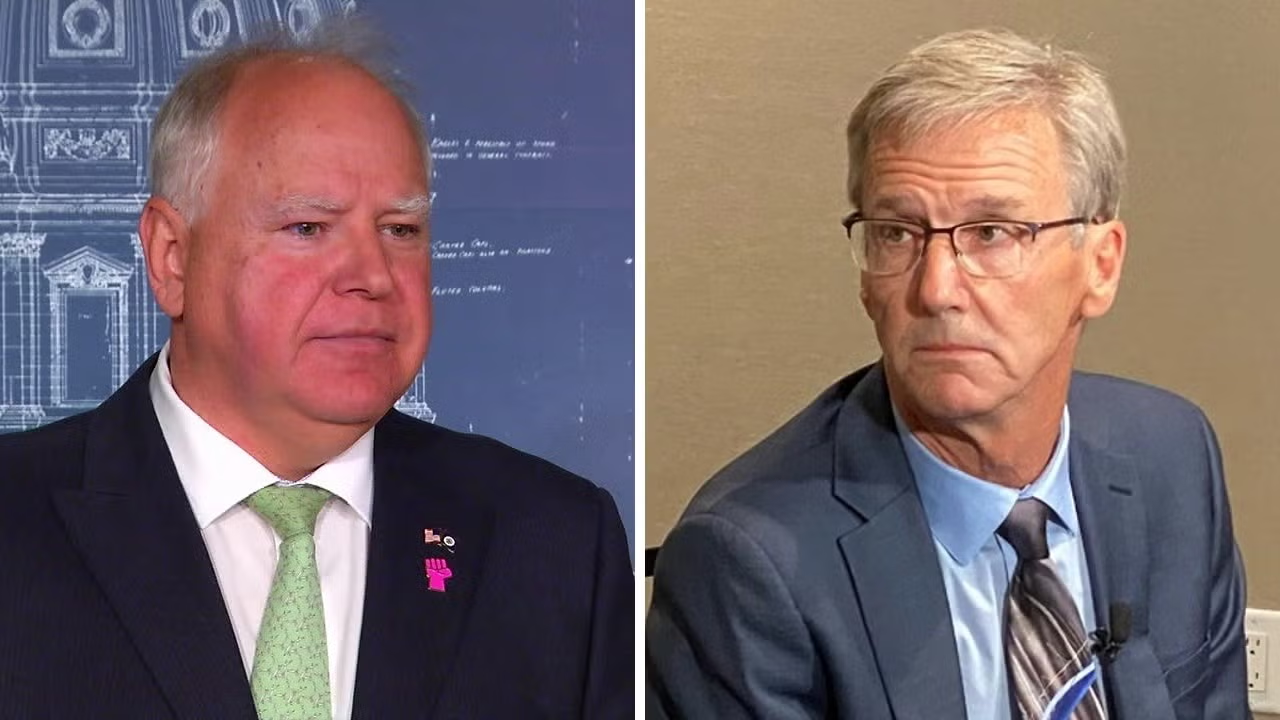
The controversy took a dramatic turn when Republican gubernatorial candidate Dr. Scott Jensen publicly accused Governor Tim Walz of being directly responsible for what he described as catastrophic failures that enabled the fraud to flourish.
Speaking with Fox News Digital, Jensen argued that ultimate accountability rests at the very top.
“In Minnesota, there’s no way to cut it other than to say the buck has to stop somewhere,” Jensen said. “And it’s always been that the buck stops at the governor’s desk. The governor is effectively the CEO of the state — and Tim Walz has been derelict in doing his duties.”
Jensen went much further, suggesting that the mishandling of the fraud scandal goes beyond incompetence and into deliberate deception.
He accused the governor’s administration of misleading the public about when officials first became aware of the fraud and how quickly law enforcement was brought in.
Disputed Timelines and Conflicting Claims
At the heart of Jensen’s accusations is a disputed timeline.
According to Jensen, state officials knew as early as 2020 that something was wrong with the nonprofit at the center of the fraud scheme. Yet, he claims, the FBI was not contacted until 2021 — a delay he argues directly contradicts public statements made by the governor’s office.
“Tim Walz and the Minnesota Department of Education knew in 2020 that there was a problem,” Jensen said. “But they didn’t get the FBI involved until 2021. And yet they’ve claimed that as soon as they learned about it, they got the FBI involved. That’s not true. Their timeline is a year off.”
Jensen characterized that discrepancy not as bureaucratic error, but as intentional deflection.
“At the end of the day, he’s demonstrated a very skilled approach to deflecting, so that he’s not being honest,” Jensen said.
Blame Shifts and Public Rebukes
As the case advanced, blame began shifting publicly — and not quietly.
After the first round of federal indictments in 2022, the governor’s office initially pointed to a district court judge as a contributing factor in why payments continued. The judge had previously ordered the state to keep reimbursing the nonprofit while legal disputes unfolded.
That explanation quickly collapsed when the judge issued what was widely described as a rare public rebuke, accusing the governor of making inaccurate public statements.
“When Judge Guthman pushed back, then you saw Tim Walz and Keith Ellison looking for someone else to blame,” Jensen claimed. “So they blamed the FBI.”
According to Jensen, the administration alleged that federal investigators had instructed the state to continue making payments so as not to interfere with the investigation. Federal officials swiftly denied that claim.
“The FBI said, ‘We didn’t make you continue fraudulent payments,’” Jensen said.
That contradiction deepened public skepticism and intensified the political firestorm.
Federal Scrutiny Expands
In recent weeks, the welfare fraud scandal has surged back into the national spotlight with multiple new federal actions.
The Small Business Administration announced it is investigating networks of Somali-affiliated organizations in Minnesota tied to the broader COVID fraud operation. Investigators say the probe is focusing on whether taxpayer funds were improperly rerouted through complex financial channels.
At the same time, the House Oversight Committee has launched its own investigation into the role of state officials. Committee Chairman James Comer stated that federal authorities are now examining whether broader negligence allowed nearly $1 billion to be stolen from pandemic assistance programs.
Comer has claimed that because of state leadership failures, criminal networks — including possible terror-linked groups — were able to exploit emergency funding while vulnerable children went without resources.
White House and Treasury Join the Fight
The controversy has now reached the executive branch.
President Donald Trump recently announced a sweeping set of new federal investigations targeting fraud operations in Minnesota, which he described as a hub for financial crime and money laundering.
Senior administration officials confirmed that the U.S. Treasury Department has opened a new probe into allegations that diverted COVID relief funds may have been linked to extremist organizations overseas.
Treasury Secretary Scott Bessent stated that the investigation is examining whether any of the misappropriated funds flowed to al-Shabaab, the terror group operating in East Africa.
If confirmed, such findings would dramatically elevate the national security implications of the scandal.
‘Worse Than Watergate’
Jensen has repeatedly described the unfolding situation in stark historical terms.
“With where it’s gone from the beginning to now,” he said, “recognizing that there’s been an interest in covering this up, for many people it has the haunting reminders of Watergate.”
But he added that the current situation may be even darker.
“This time it could be worse,” Jensen said. “Because it’s possible that there’s something far more nefarious than simply covering something up. It could be a pay-to-play scheme that involves elected officials.”
He warned that future revelations could force criminal prosecutions of Minnesota public officials.
“That’s what’s really frightening,” Jensen said. “If that’s the case, then at some level, there would have to be criminal prosecution of elected officials.”
The Political Stakes
The allegations come at a volatile moment in Minnesota politics.
Jensen, who previously ran against Walz in 2022, remains one of the governor’s most vocal critics. With renewed national scrutiny surrounding the fraud case, the controversy is once again becoming a dominant campaign issue.
When asked what he believes Walz’s legacy would be if he were to leave office now, Jensen gave a blunt answer.
“Tim Walz’s legacy right now would be fraud at an unprecedented level,” Jensen said.
He also criticized Walz’s broader ideological shift over time.
“He went from someone many people once thought was a moderate,” Jensen said, “to someone who appears to live on the five-yard line of the hard-left end of the Democratic field.”
What Happens Next
Federal investigations remain active on multiple fronts. Prosecutors continue to pursue criminal cases tied to the nonprofit network at the center of the fraud. Congressional committees are examining oversight failures. Federal agencies are tracking potential terror finance links.
Meanwhile, Minnesota voters are left watching a widening scandal that now stretches from local school meal programs to the highest levels of state and federal government.
Whether new indictments emerge, whether state officials face formal charges, or whether the controversy reshapes the political future of Minnesota leadership remains to be seen.
What is clear is that the welfare fraud scandal has evolved far beyond a question of stolen money — it is now a defining test of accountability, transparency, and public trust.

Emily Johnson is a critically acclaimed essayist and novelist known for her thought-provoking works centered on feminism, women’s rights, and modern relationships. Born and raised in Portland, Oregon, Emily grew up with a deep love of books, often spending her afternoons at her local library. She went on to study literature and gender studies at UCLA, where she became deeply involved in activism and began publishing essays in campus journals. Her debut essay collection, Voices Unbound, struck a chord with readers nationwide for its fearless exploration of gender dynamics, identity, and the challenges faced by women in contemporary society. Emily later transitioned into fiction, writing novels that balance compelling storytelling with social commentary. Her protagonists are often strong, multidimensional women navigating love, ambition, and the struggles of everyday life, making her a favorite among readers who crave authentic, relatable narratives. Critics praise her ability to merge personal intimacy with universal themes. Off the page, Emily is an advocate for women in publishing, leading workshops that encourage young female writers to embrace their voices. She lives in Seattle with her partner and two rescue cats, where she continues to write, teach, and inspire a new generation of storytellers.