A routine morning at one of Britain’s busiest airports took an unexpected turn today when ground operations were abruptly halted, prompting the evacuation of passengers from an aircraft and raising fresh questions about safety during one of the most congested travel periods of the year.
The incident unfolded shortly after mid-morning, at a time when airports, roads, and rail stations across the country are under intense strain from record holiday travel. While officials moved quickly to contain the situation, the event added to a growing list of transport disruptions affecting travelers in the final days before Christmas.
At first, details were limited, and airport authorities stressed that there was no broader impact on flight schedules. Still, for those directly involved, the experience was unsettling.
A Sudden Halt on the Tarmac
Passengers had already boarded and were preparing for departure when movement on the apron came to an abrupt stop. Ground staff converged around the aircraft, and within moments, instructions were issued for travelers to disembark.
According to accounts from those onboard, the aircraft had not been traveling at high speed, but the unexpected jolt was enough to trigger immediate concern. Cabin crew followed standard procedures, calmly guiding passengers off the plane while emergency protocols were briefly activated.
Airport officials later confirmed that the situation was assessed and stood down within seconds, with no wider operational shutdown required.
Passenger Accounts Describe a Frightening Moment
One passenger described the experience as “scary,” noting that while the pilot attempted to reassure those onboard via the intercom, it was clear something unusual had occurred.
“Thankfully we weren’t going fast,” the passenger said, adding that it was obvious the aircraft would not be continuing its journey as planned.
Others echoed that sentiment, saying the sudden interruption was alarming but praising the crew for maintaining order and preventing panic.
No injuries were reported.
What Actually Happened
Only later did officials confirm the cause of the disruption.
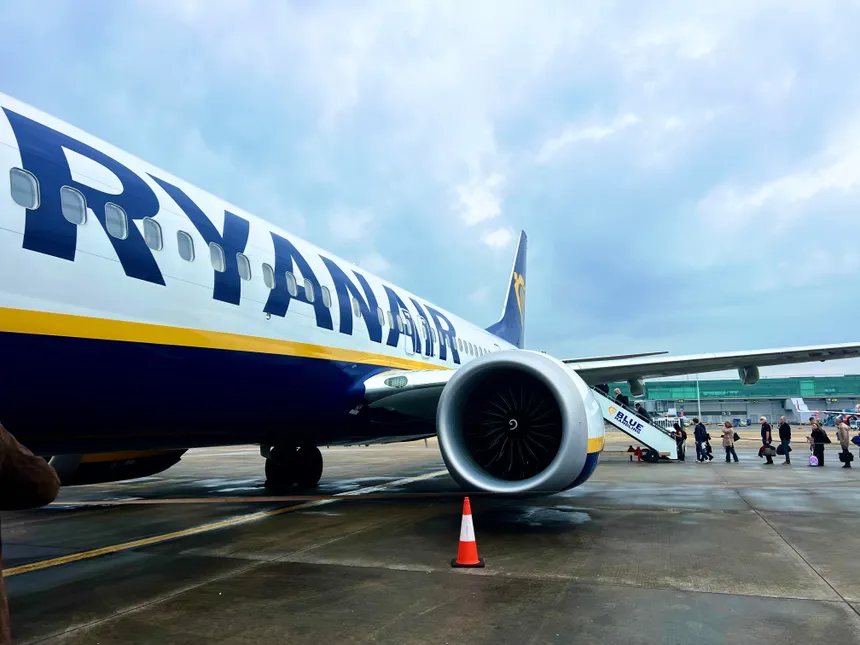
The aircraft’s wing tip had come into contact with a fuel truck during preparations for departure at Edinburgh Airport at approximately 10 a.m. The contact occurred while the plane was taxiing, and the impact involved the cab of the tanker vehicle.
The flight, operated by Ryanair and scheduled to travel to Faro in Portugal, was immediately taken out of service as a precaution. Passengers were returned to the terminal while engineers assessed the aircraft.
A replacement plane was arranged, allowing travelers to resume their journey later in the day.
Airline and Airport Response
In a statement, Ryanair confirmed the incident, emphasizing that safety procedures were followed and that passengers disembarked normally.
“This flight from Edinburgh to Faro was preparing for departure when the wing tip came in contact with the cab of a fuel truck,” the airline said. “A replacement aircraft was arranged to operate this flight.”
Edinburgh Airport officials confirmed that the incident had no impact on other flights and that normal operations continued without delay. They described the situation as resolved within 30 seconds.
Passengers eventually boarded their rescheduled flight, which departed after 12:30 p.m.
A Busy Travel Day Amplifies Attention
While the aircraft incident itself was contained, it occurred against the backdrop of one of the busiest travel periods Britain has ever experienced.
Across the country, millions of people are on the move for the festive season, creating heavy congestion on roads, crowded platforms at major rail hubs, and packed airport terminals.
Transport analysts estimate that around 24 million car journeys will take place over the Christmas getaway period, the highest number recorded since the phenomenon known as “Frantic Friday.”
The timing of the airport disruption meant it quickly became part of a larger narrative about travel chaos.
Road Disruptions Add to the Strain
Elsewhere, motorists faced delays after a crash on the M61 in Lancashire damaged the central reservation. National Highways temporarily closed a lane to carry out repairs, causing long queues during the morning rush.
Although the lane has since reopened, traffic officials warned drivers to expect continued delays as traffic volumes remain unusually high.
Experts predict the heaviest traffic will occur on Christmas Eve, with an estimated 4.2 million journeys making it the single busiest travel day of the period.
Weather Complicates the Picture
Adding to the challenges, heavy rain is forecast across parts of Britain throughout the coming week. Flood warnings are already in place in several areas, with dozens more alerts issued by authorities.
Weather-related disruptions have historically compounded holiday travel delays, particularly on rural roads and rail lines vulnerable to flooding.
Emergency services and transport agencies have urged travelers to check conditions regularly and allow extra time for journeys.
Rail Network Under Pressure
Rail passengers have also encountered difficulties. Severe delays were reported on services to Heathrow Airport after a points failure disrupted trains between Ealing and Acton.
Services on the Elizabeth Line, Heathrow Express, and Great Western Railway were affected, with some routes temporarily suspended. Transport officials said disruption was expected to last until early afternoon.
Major London stations, including Euston and King’s Cross, were reported to be significantly busier than usual as travelers headed out to spend Christmas with friends and family.
A Reminder of Holiday Travel Risks
While no one was injured in the Edinburgh Airport incident, aviation experts note that ground operations can be just as complex—and risky—as flight itself, particularly during peak travel periods when turnaround times are tight and apron activity is intense.
Airlines and airports rely on precise coordination between pilots, ground crews, and vehicle operators. Even minor miscalculations can lead to costly and potentially dangerous outcomes, which is why strict safety protocols are enforced.
In this case, officials stressed that those protocols worked as intended.
Passengers Resume Their Journeys
For those affected, the disruption ultimately resulted in a delay of a few hours rather than a cancellation. By early afternoon, most passengers were back in the air, continuing their journey to Portugal.
Still, the incident served as an unwelcome reminder of how quickly plans can change during the festive rush.
As Britain braces for several more days of intense travel, authorities are urging patience, preparation, and vigilance—on the roads, the rails, and the runways—hoping that minor incidents do not escalate into major disruptions during one of the most important travel periods of the year.

James Jenkins is a celebrated Pulitzer Prize-winning author whose work has reshaped the way readers think about social justice and human rights in America. Raised in Atlanta, Georgia, James grew up in a community that instilled in him both resilience and a strong sense of responsibility toward others. After studying political science and creative writing at Howard University, he worked as a journalist covering civil rights issues before dedicating himself fully to fiction. His novels are known for their sharp, empathetic portraits of marginalized communities and for weaving personal stories with broader political realities. Jenkins’s breakout novel, Shadows of Freedom, won national acclaim for its unflinching look at systemic inequality, while his more recent works explore themes of identity, resilience, and the fight for dignity in the face of oppression. Beyond his novels, James is an active public speaker, lecturing at universities and participating in nonprofit initiatives that support literacy and community empowerment. He believes that storytelling is a way to preserve history and inspire change. When not writing, James enjoys jazz music, mentoring young writers, and traveling with his family to explore cultures and stories around the world.