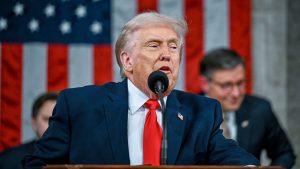

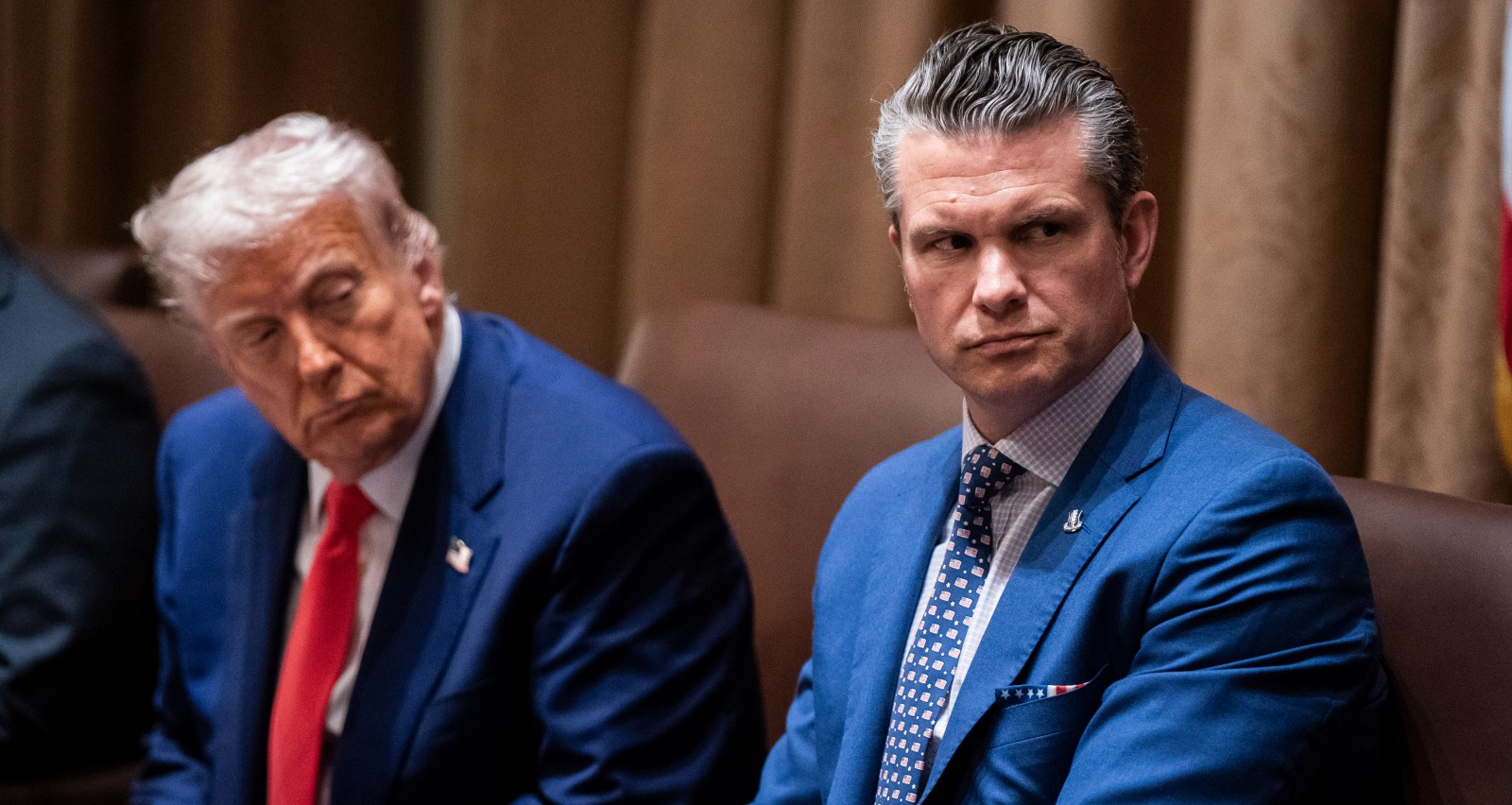
President Donald Trump returned to Washington on Sunday evening facing a fresh round of questions about a controversial military operation in the Caribbean Sea — an operation that has now become the center of one of the most contentious defense-related stories of his presidency. As reporters pressed him aboard Air Force One, Trump delivered an unmistakable message of confidence in one of his most trusted appointees: War Secretary Pete Hegseth.
The controversy erupted after a report claimed that a September counter-narcotics mission, carried out by U.S. special operations forces against a suspected drug-smuggling vessel, included an order that no survivors be allowed to remain. The allegation drew intense attention across Capitol Hill, spurring bipartisan calls for investigations and raising questions about wartime rules of engagement.
The report landed with force because it touched several political pressure points at once — national security, oversight of military power, and the broader debate over how aggressively the United States should confront the explosion of narco-terrorist networks threatening American shores.
A Sudden Flashpoint in the War on Narco-Terrorism
The underlying operation took place on September 2, when Joint Special Operations Command forces conducted what officials have described as a “lethal, kinetic strike” against a speedboat believed to be tied to the notorious Venezuelan-Tri-Border criminal syndicate known as Tren de Aragua. The group has become a priority target of the Trump administration, blamed for violent criminal networks stretching from South America to the southern border of the United States.
According to the report first published by The Washington Post, a JSOC commander allegedly ordered a second strike after spotting two individuals clinging to debris from the destroyed vessel. The most explosive assertion was that this second strike was prompted by a verbal directive from War Secretary Hegseth to “kill everybody” onboard.
Such language — if accurate — would raise profound legal and ethical questions. But Trump made clear Sunday night that he did not accept the report’s account.
“Pete said he did not order the death of those two men,” the president told reporters. “And I believe him.”
This was more than a casual statement of confidence; it was a line drawn in the sand.
A President Standing by His War Secretary
Hegseth, a longtime ally of Trump and former Army officer known for pushing an assertive national defense posture, immediately denied the report when it surfaced. Posting on X shortly after publication, he accused the media of inventing sensational narratives to undermine U.S. forces and weaken public support for the administration’s counter-narcotics strategy.
“As usual, the fake news is delivering more fabricated, inflammatory, and derogatory reporting to discredit our incredible warriors fighting to protect the homeland,” Hegseth wrote.
He emphasized that the mission’s intent was explicit: to eliminate terrorist-aligned traffickers funneling lethal narcotics into the United States.
“The declared intent is to stop lethal drugs, destroy narco-boats, and kill the narco-terrorists who are poisoning the American people,” Hegseth said. “Every trafficker we kill is affiliated with a Designated Terrorist Organization.”
The Trump administration has been unambiguous about its view that drug cartels, maritime smugglers, and their international partners constitute a national security threat that must be met with military force when necessary. But even within that framework, lawmakers insist the rules of engagement must comply with U.S. and international law.
That is where the political battle now turns.
A Capitol Hill Reaction That Spanned Both Parties
The allegations produced a rare moment of bipartisan alignment on the oversight committees responsible for military affairs. Lawmakers on both sides quickly demanded more information, though their motivations differ.
Rep. Mike Turner (R-Ohio), speaking on CBS’s Face the Nation, made clear that if the directive described in the report were ever proven true, it would represent an extraordinary breach.
“Obviously, if that occurred, that would be very serious,” Turner said. “I agree that that would be an illegal act.”
Turner’s statement was careful — acknowledging both the seriousness of the allegation and the importance of not drawing conclusions until investigations run their course. Republicans were already frustrated by what they viewed as politicized leaks and media exaggeration. Still, oversight remained their responsibility.
Democrats struck a much harsher tone.
Sen. Tim Kaine (D-Va.), also speaking to CBS, said he would reintroduce legislation aimed at restricting the administration’s ability to use military force in the Caribbean Sea without congressional authorization.
“If that reporting is true,” Kaine argued, “it’s a clear violation of the DOD’s own laws of war, as well as international laws about the way you treat people who are in that circumstance. And so this rises to the level of a war crime if it’s true.”
Kaine’s comments point to a broader Democratic concern: that the Trump administration’s accelerated counter-narcotics operations operate too close to the legal line.
Inside the September Operation
Although the Post report framed the operation as a potential violation of the laws of war, the administration maintains that the target vessel was operated by a designated terrorist organization, not a civilian fishing craft or an unarmed smuggling vessel. Since the Trump administration took office, Tren de Aragua has been officially labeled a transnational terrorist threat, enabling military involvement under counterterrorism authorities.
On November 6, Hegseth posted aerial footage of a similar strike, describing it as an operation against a maritime target carrying cartel-linked personnel. That clip, though unrelated to the September 2 strike, reinforced the administration’s narrative that these missions are conducted against hostile combatants, not incidental smugglers.
While the exact details remain classified, defense officials have consistently said that the operations are intended to stop heavily armed narco-terrorist boats that often travel at high speeds and are known to fire on interdiction forces.
A President Defending His Team — and His Policies
Trump’s support for Hegseth fits a long-term pattern: he tends to back appointees who pursue aggressive policies aligned with his America First security agenda. He also frequently pushes back against media reporting before investigations conclude, arguing that coverage of defense operations is often skewed by political motives.
“I wouldn’t have wanted that — not a second strike,” Trump said Sunday, making clear that he neither approves of unnecessary force nor dismisses the seriousness of such allegations. But his trust in Hegseth remains firm.
“He said he did not say that,” Trump added. “And I believe him, 100%.”
The president acknowledged the need to “look into” the issue further, but emphasized his belief that critics are attempting to undermine an effective campaign against an increasingly dangerous drug-crime syndicate.
Washington’s Next Steps
What happens now will depend on a series of parallel investigations already forming across Capitol Hill and inside the Pentagon. Both the House and Senate Armed Services Committees are preparing inquiries, and officials say classified briefings will begin soon.
Among the key questions lawmakers intend to explore:
• What exactly were the rules of engagement for the September 2 strike?
• Did a verbal directive from Hegseth occur — or was it misinterpreted?
• What authority governs U.S. military action in the Caribbean Sea?
• Should counter-narcotics missions be subject to heightened congressional oversight?
• Were all targets legally classified as members of a designated terrorist organization?
These inquiries will shape not only Hegseth’s future but the administration’s broader war on narco-terrorism.
For now, the president has made his stance unmistakable: he trusts his war secretary and sees the reporting as another attempt to undermine the administration’s efforts to secure the homeland.
With Congress newly energized, the Pentagon under scrutiny, and the media locked on the controversy, the next phase of this conflict is only beginning.

Sarah Mitchell is a bestselling novelist recognized for her insightful and emotionally resonant stories that explore the complexities of human relationships. Originally from Denver, Colorado, Sarah grew up in a family of teachers who nurtured her curiosity and love for storytelling. She studied psychology at Stanford University, where she became fascinated by the intricacies of human behavior—an interest that would later shape her writing career. Sarah’s novels are praised for their nuanced characters, intricate plots, and ability to capture the subtle tensions that define love, friendship, and family ties. Her breakthrough novel, The Spaces Between Us, became an instant bestseller, lauded for its honest portrayal of strained family relationships and the fragile bonds that hold people together. Since then, she has published several works that continue to captivate audiences around the world. Outside of her writing career, Sarah is passionate about mental health advocacy and often partners with organizations to promote awareness and support for those struggling with emotional well-being. Her personal life is quieter—she enjoys hiking in the Colorado mountains, practicing yoga, and spending time with close friends. With each new book, Sarah Mitchell cements her reputation as a writer who illuminates the beauty and struggles of human connection.