

A towering figure of the American civil rights movement, a two-time presidential candidate, and a relentless advocate for economic and social justice has died at the age of 84, closing a chapter on one of the most influential eras of modern American activism.
For decades, he stood at the intersection of politics, faith, and grassroots organizing—working to expand the promises of equality and opportunity for those who felt left behind. His death marks the loss of one of the last major leaders directly tied to the generation that marched, organized, and sacrificed during the height of the civil rights struggle in the United States.
A life rooted in the civil rights movement
His rise to prominence began during one of the most transformative periods in American history. As a young organizer in Chicago, he built a reputation for mobilizing communities around issues of jobs, education, and economic access—causes that would define his life’s work.
That work led him into the inner circle of Martin Luther King Jr., whose philosophy of nonviolent protest and moral persuasion shaped the direction of the movement. He later joined the Southern Christian Leadership Conference, where he became a key voice in expanding the movement’s reach beyond the South and into urban centers across the country.
He was in Memphis in April 1968, summoned to meet King at the Lorraine Motel just hours before King was assassinated. In the aftermath of that tragedy, he emerged as one of the most visible figures seeking to carry the movement forward, emphasizing not only racial equality but also economic justice and political empowerment.
Expanding the fight beyond civil rights
As the decades passed, his work evolved to address a broader spectrum of issues—ranging from employment discrimination and education access to health care and international human rights.
He founded Operation PUSH (People United to Save Humanity), which later became the Rainbow/PUSH Coalition, an organization designed to bring together diverse communities under a shared banner of justice and opportunity.
Through this platform, he pressured major corporations to diversify their leadership and invest in underserved communities, while also advocating for policies aimed at reducing poverty and expanding economic mobility.
His activism also extended to the global stage, where he engaged in diplomatic missions, met with foreign leaders, and negotiated on behalf of hostages and political prisoners. His approach reflected a belief that human rights were universal, transcending borders and political systems.
A historic political presence
His influence reached new heights when he entered presidential politics, launching campaigns that reshaped the Democratic Party and expanded the possibilities for representation in American government.
In 1984 and again in 1988, he ran for the Democratic presidential nomination, building a multiracial coalition that energized millions of voters. In 1988, he won several primaries and caucuses, demonstrating the growing power of a coalition built on shared economic and social concerns.
Those campaigns did more than seek electoral victory—they changed the conversation, placing issues like voting rights, income inequality, and social justice at the forefront of national debate.
The man behind the movement
It was in the midst of these achievements that Jesse L. Jackson became one of the most recognizable and enduring voices of American activism.
His ability to speak across divides—racial, economic, and political—made him a singular figure in public life. He combined the cadence of a preacher, the strategy of an organizer, and the persistence of a seasoned political campaigner.
At rallies, churches, and community centers, he delivered a message centered on dignity and self-worth, often repeating the refrain that became synonymous with his legacy: “I am Somebody.” The words resonated deeply with those who felt excluded from the nation’s promise, reinforcing a belief that every person had value regardless of their circumstances.
A bridge across generations
Over the years, he served as a bridge between the original civil rights movement and newer generations of activists. He mentored emerging leaders, lent his voice to modern causes, and continued to push for reforms in criminal justice, health care, and education.
His advocacy helped institutionalize civil rights concerns within corporate boardrooms and political institutions, ensuring that the movement’s priorities would remain embedded in national policy debates long after the protests of the 1960s had ended.
A legacy that endures
Though his career included moments of controversy and criticism, his broader impact on American society remains undeniable. He expanded the scope of civil rights advocacy, bringing economic justice and global human rights into the mainstream conversation.
He also helped pave the way for a more diverse generation of political leaders, demonstrating that candidates from historically marginalized backgrounds could compete at the highest levels of national politics.
His passing is not only the loss of an individual leader, but also a reminder of a generation that fought to reshape the moral and political landscape of the United States.
Remembering a lifetime of service
As tributes pour in from across the country and around the world, his life is being remembered as one defined by purpose, persistence, and an unwavering belief in the power of collective action.
From the streets of Chicago to presidential campaign stages, from corporate boardrooms to international diplomatic meetings, his work left an indelible mark on the pursuit of equality and justice.
And while his voice is now silent, the message he championed continues to echo—an affirmation of dignity, resilience, and hope that remains as relevant today as it was when he first spoke it aloud.
“I am Somebody.”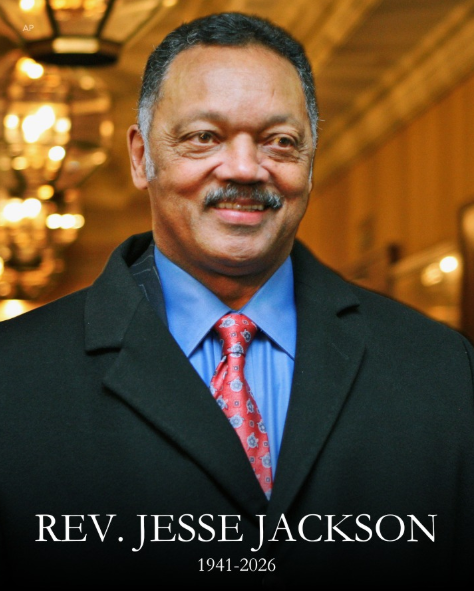

Emily Johnson is a critically acclaimed essayist and novelist known for her thought-provoking works centered on feminism, women’s rights, and modern relationships. Born and raised in Portland, Oregon, Emily grew up with a deep love of books, often spending her afternoons at her local library. She went on to study literature and gender studies at UCLA, where she became deeply involved in activism and began publishing essays in campus journals. Her debut essay collection, Voices Unbound, struck a chord with readers nationwide for its fearless exploration of gender dynamics, identity, and the challenges faced by women in contemporary society. Emily later transitioned into fiction, writing novels that balance compelling storytelling with social commentary. Her protagonists are often strong, multidimensional women navigating love, ambition, and the struggles of everyday life, making her a favorite among readers who crave authentic, relatable narratives. Critics praise her ability to merge personal intimacy with universal themes. Off the page, Emily is an advocate for women in publishing, leading workshops that encourage young female writers to embrace their voices. She lives in Seattle with her partner and two rescue cats, where she continues to write, teach, and inspire a new generation of storytellers.