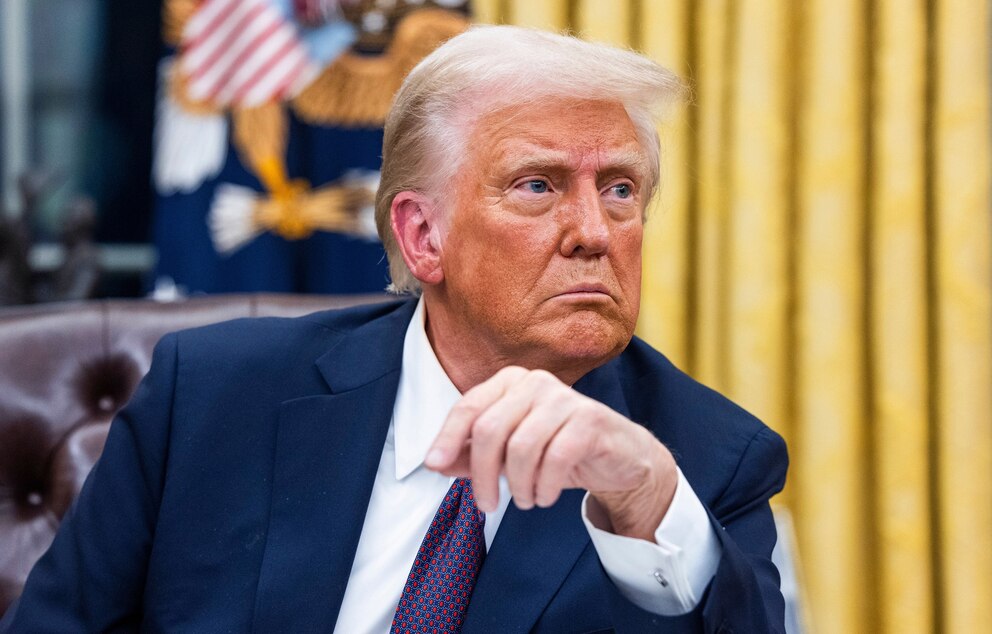
President Donald Trump has declared that he has been “totally exonerated” following the release of millions of documents connected to convicted sex offender Jeffrey Epstein, pushing back against renewed scrutiny stemming from his name appearing repeatedly throughout the files.
Speaking to reporters during a press briefing aboard Air Force One, the 79-year-old president dismissed suggestions that the latest document dump implicates him in any wrongdoing. In a video later circulated on X, Trump said: “I have nothing to hide. I’ve been exonerated. I have nothing to do with Jeffrey Epstein.”
He continued: “They went in hoping that they’d find it and found just the opposite. I’ve been totally exonerated.”
The comments come after the January 30 release of approximately 3.5 million files under the Epstein Files Transparency Act, legislation passed following sustained public pressure for broader disclosure of materials tied to federal investigations into Epstein and his associates. The release included millions of pages of documents, thousands of images and videos, and a wide range of records collected over years of inquiries.
Trump’s name appears repeatedly throughout the materials. However, legal experts stress that the presence of a person’s name in investigative files does not, on its own, indicate criminal conduct or wrongdoing. The documents encompass decades of interviews, tips, contact lists, flight logs, correspondence, media references and third-party allegations — many of which were unverified or ultimately unsubstantiated.
Still, the scale of the release has reignited debate.
Representative Jamie Raskin, the senior Democrat on the House Judiciary Committee, said after reviewing portions of the unredacted material that Trump is referenced “over a million times.” Other media outlets have reported lower but still substantial figures. A search within the released database reportedly produces thousands of results tied to Trump’s name, including references to his properties and family members.
According to reporting from The New York Times, more than 5,300 references to Trump were identified in the publicly released files, including mentions of his Mar-a-Lago estate in Florida and his wife, Melania Trump. Sky News separately reported that database searches returned thousands of entries containing Trump’s name in varying contexts.
The raw numbers, however, require careful interpretation. Investigative files often include duplicated references, passing mentions, third-party claims, media clippings and unrelated contextual entries. Experts note that high frequency alone does not demonstrate involvement in criminal activity.
The Department of Justice previously addressed this issue when releasing a large batch of documents in December. In a statement posted to its official account, the United States Department of Justice cautioned that some of the materials contained “untrue and sensationalist claims” about the president.
The department stated that certain allegations referencing Trump had been submitted to the FBI shortly before the 2020 election and were determined to be unfounded. Officials emphasized that the release was conducted in accordance with transparency obligations and included legally required protections for victims.
“To be clear: the claims are unfounded and false,” the DOJ wrote at the time, adding that if any allegations had carried credible evidence, they would have been pursued earlier.
Trump has consistently denied any wrongdoing related to Epstein. While the two men were photographed together on multiple occasions during the 1990s and early 2000s, Trump has maintained that their relationship was limited and that they had a falling out years before Epstein’s arrest.
Epstein, a financier with connections to political leaders, celebrities and business executives, was arrested in 2019 on federal sex trafficking charges involving underage girls. He died in a Manhattan jail cell later that year while awaiting trial. His death was ruled a suicide, though it sparked numerous conspiracy theories and ongoing public skepticism.
The newly released documents form part of a broader effort by lawmakers to increase transparency surrounding Epstein’s activities and any individuals who may have had knowledge of or involvement in his crimes. The material spans years of investigations and includes submissions from tipsters, witness interviews, travel records, internal memoranda and other evidence collected by federal authorities.
Many of the documents reference prominent public figures across politics, entertainment, academia and international circles. Observers caution that inclusion in the files often reflects little more than proximity within social or professional networks during the period when Epstein cultivated high-profile relationships.
Legal scholars emphasize that investigative records are not equivalent to findings of guilt. In large-scale federal probes, names may appear because individuals were interviewed, mentioned by others, listed in contact books or cited in media coverage attached to case files.
Trump’s assertion that he has been “totally exonerated” reflects his broader argument that prior investigations into his conduct have failed to produce evidence of criminal wrongdoing. His allies argue that repeated document releases have not altered that fundamental conclusion.
Critics, meanwhile, contend that the sheer number of references warrants continued scrutiny and transparency. They point to the historical photographs of Trump and Epstein together at social events and argue that public officials should welcome full disclosure to dispel lingering doubts.
The political implications are significant. With the 2026 midterm elections approaching, Democrats have signaled they may continue pressing for hearings or further analysis of the files. Republicans, in turn, have accused opponents of attempting to weaponize document releases for political gain.
The controversy also highlights broader public distrust surrounding the Epstein case. Years after his death, questions persist about how he amassed influence, who enabled his activities and whether powerful figures escaped accountability. The volume of documents released — millions of pages and media files — underscores the complexity and scope of the investigations.
For now, no charges related to the newly released materials have been announced against Trump. The DOJ has not indicated that the president is under investigation in connection with the latest disclosures.
Trump’s statement aboard Air Force One appears aimed at closing the issue politically. By declaring himself “totally exonerated,” he is attempting to frame the document release as confirmation rather than cause for concern.
Whether that framing holds will likely depend on how lawmakers, media organizations and independent analysts continue to review the massive trove of records. The process of analyzing millions of documents is expected to take months, if not years.
It remains essential to distinguish between being named in a document and being implicated in criminal conduct. As legal experts repeatedly note, investigative transparency does not equate to evidence of guilt. Context, corroboration and prosecutorial findings ultimately determine legal responsibility.
For Trump, the immediate objective is clear: reinforce his denial and move the narrative forward. For critics and political opponents, the volume of references ensures the controversy will not disappear quickly.
As the public and policymakers sift through the unprecedented release, the debate surrounding transparency, accountability and political consequence is likely to continue — even as the president insists the matter has already been settled.