



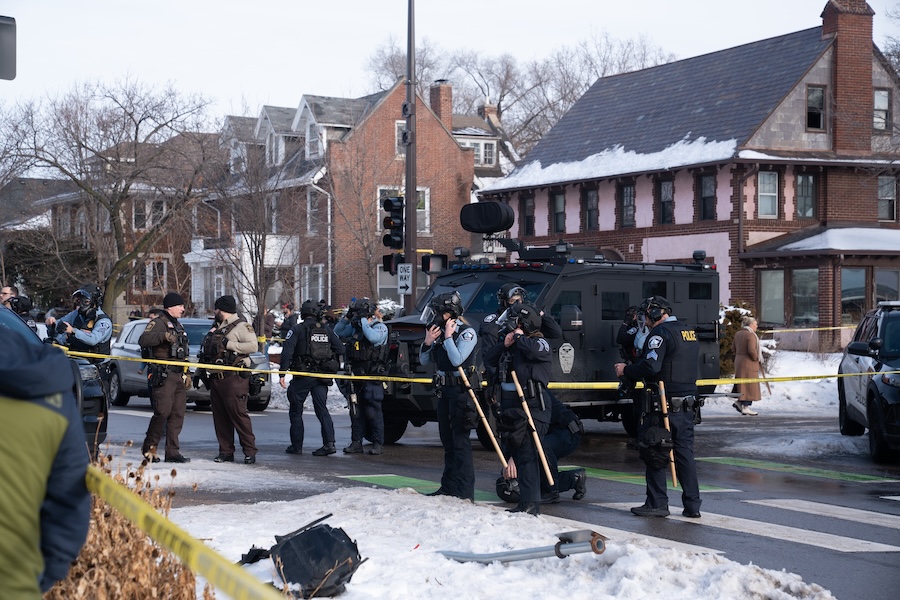
A tense confrontation between law enforcement and demonstrators in a Minnesota suburb has reignited national debate over the tools police use to manage large-scale unrest, particularly when protests intersect with highly charged immigration enforcement actions. At the center of the controversy is the deployment—or threatened deployment—of a long-range acoustic device, a powerful sound projection system originally developed for military and maritime security purposes.
The incident unfolded after several days of protests connected to federal immigration activity in the region. Demonstrators gathered outside a hotel in Maple Grove, believing that federal immigration officers were staying there amid an intensified enforcement operation. What began as a protest soon escalated into a standoff, with state troopers attempting to disperse a crowd that refused repeated orders to leave the area.
As tensions rose, law enforcement warned that a long-range acoustic device, commonly referred to as an LRAD, could be activated if the crowd did not comply. Officers issued verbal countdowns, a move that drew immediate attention both on the ground and online. Videos circulated rapidly, sparking claims that police were preparing to unleash a “battlefield weapon” against civilians.
The LRAD is a highly directional sound system capable of projecting amplified voice commands over long distances with remarkable clarity. Unlike conventional loudspeakers, it concentrates sound into a narrow beam, allowing messages to cut through crowd noise. The technology also includes a deterrent tone function, designed to produce an intensely uncomfortable sound that can compel dispersal without physical contact.
Originally developed for naval use to deter piracy and manage hostile encounters at sea, LRAD systems have since been adopted by law enforcement agencies around the world. In domestic settings, they are typically used to issue dispersal orders during protests, riots, or emergency situations where communication is otherwise impossible.
Medical experts and civil liberties advocates, however, have long raised concerns about the potential health effects of acoustic devices. At close range or high volumes, exposure can cause temporary or permanent hearing damage, disorientation, headaches, nausea, and panic responses. Because of these risks, many departments maintain strict protocols governing when and how the devices may be used.
According to state patrol officials, the device in Maple Grove was not activated in deterrent mode. Authorities stated that its volume settings were checked and that it was used, if at all, only to amplify verbal warnings. They denied claims circulating on social media that piercing sirens or incapacitating tones were deployed against protesters.
Despite those assurances, the confrontation ended with multiple arrests. Law enforcement described the gathering as an unlawful assembly after property damage and aggressive behavior were reported. Officials emphasized that while peaceful protest is protected under the First Amendment, violence and destruction are not.
The protest followed a fatal shooting earlier in the week involving a man who was killed during an encounter with federal officers. That incident intensified public anger and fueled demonstrations across the region. Compounding the situation was uncertainty surrounding leadership within federal immigration enforcement in Minnesota, with reports indicating that several officials were preparing to leave the state amid mounting scrutiny.
Authorities later said it was unclear whether any federal agents were actually staying at the hotel targeted by protesters, raising further questions about how misinformation can escalate volatile situations.
The presence of LRAD technology added another layer to the controversy, particularly as political rhetoric surrounding “sonic weapons” has gained traction in recent months. The device has been described in dramatic terms by commentators and former military officials alike. One defense analyst famously remarked that being caught directly in its focused sound beam can feel overwhelming, likening the experience to an all-encompassing voice descending from above.
Such descriptions, while evocative, have contributed to public confusion. Experts stress that LRAD systems are not secret weapons, nor are they designed to cause physical injury when used properly. Rather, they are intended as non-lethal alternatives to tools like tear gas, pepper spray, or rubber projectiles—methods that carry their own risks of injury.
Still, the line between communication tool and coercive force can appear blurry, especially to those on the receiving end. Civil rights groups argue that even the threat of using such technology can have a chilling effect on lawful protest, particularly in communities already wary of law enforcement.
The debate has also been fueled by broader speculation about advanced acoustic or “sonic” weapons in military contexts. In recent public remarks unrelated to the Minnesota protest, political leaders have alluded to advanced U.S. capabilities that are not widely understood. Those comments, combined with unverified accounts from foreign operations, have led some to conflate standard crowd-control technology with experimental or clandestine weapons.
Security analysts caution against such conflation. While research into directed-energy and acoustic systems exists, there is no publicly available evidence that law enforcement agencies are deploying exotic or classified sound weapons domestically. The LRAD, they note, is a known, commercially produced device whose capabilities and limitations are well documented.
Nevertheless, the Maple Grove incident highlights the growing challenges facing law enforcement in an era of rapid information spread and deep public mistrust. Videos taken out of context can quickly fuel narratives that are difficult to counter, even when official statements attempt to clarify what actually occurred.
At the same time, critics argue that agencies must do more than issue reassurances. Transparency about equipment, training, and deployment standards is essential to maintaining public confidence—especially when dealing with technologies that can cause real discomfort or fear.
The events in Minnesota underscore a broader national reckoning over protest policing. As demonstrations increasingly center on emotionally charged issues like immigration, race, and federal authority, the tools used to maintain order come under heightened scrutiny. Each deployment, or threatened deployment, becomes a test case for how far the state can go without infringing on constitutional rights.
For supporters of the LRAD’s use, the device represents a measured response in situations that might otherwise escalate to physical confrontation. For opponents, it symbolizes an unsettling militarization of domestic policing.
As investigations and reviews continue, the Maple Grove confrontation is likely to remain a reference point in discussions about crowd control, civil liberties, and the balance between public safety and the right to dissent. What is clear is that technology alone cannot resolve the underlying tensions driving such protests—and that how these tools are perceived may matter as much as how they are actually used.

Emily Johnson is a critically acclaimed essayist and novelist known for her thought-provoking works centered on feminism, women’s rights, and modern relationships. Born and raised in Portland, Oregon, Emily grew up with a deep love of books, often spending her afternoons at her local library. She went on to study literature and gender studies at UCLA, where she became deeply involved in activism and began publishing essays in campus journals. Her debut essay collection, Voices Unbound, struck a chord with readers nationwide for its fearless exploration of gender dynamics, identity, and the challenges faced by women in contemporary society. Emily later transitioned into fiction, writing novels that balance compelling storytelling with social commentary. Her protagonists are often strong, multidimensional women navigating love, ambition, and the struggles of everyday life, making her a favorite among readers who crave authentic, relatable narratives. Critics praise her ability to merge personal intimacy with universal themes. Off the page, Emily is an advocate for women in publishing, leading workshops that encourage young female writers to embrace their voices. She lives in Seattle with her partner and two rescue cats, where she continues to write, teach, and inspire a new generation of storytellers.