



NOTE: VIDEO INSIDE THE ARTICLE.
A chilling new video has captured the exact moment a Russian military transport aircraft broke apart in mid-air before crashing into a reservoir, killing everyone on board in a catastrophic incident that has raised fresh questions about the condition of Russia’s aging air fleet.
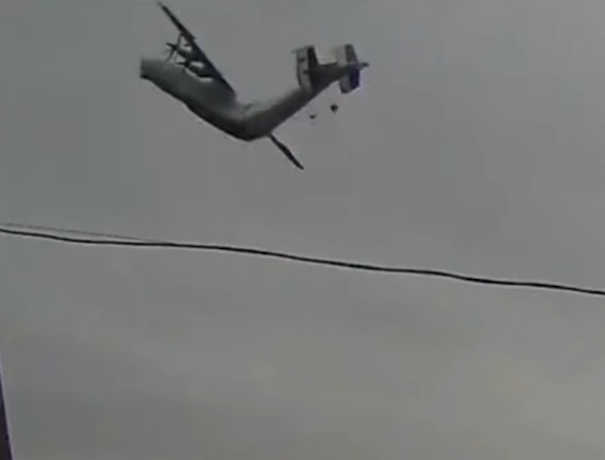
The footage, filmed from a rural settlement, shows the enormous aircraft flying steadily across a clear sky before suddenly suffering a catastrophic structural failure. Within seconds, the tail section appears to shear away from the fuselage, sending the plane spiraling uncontrollably toward the ground.
Moments later, the aircraft slams into the waters below in a violent splash, leaving no chance of survival for the seven crew members onboard.
Aircraft Disintegrates Without Warning
The aircraft involved was an Antonov An-22 Antey, a massive Soviet-era military transport plane that was once the largest aircraft in the world when it entered service in 1969. Designed to carry heavy military equipment, tanks, and large cargo loads, the An-22 was a symbol of Soviet engineering ambition during the Cold War.
According to preliminary reports, the aircraft disintegrated mid-flight, with the rear section detaching from behind the wing before the plane plunged toward a reservoir in Russia’s Ivanovo region, northeast of Moscow.
Notably, the crash occurred far from the war zone in Ukraine, dispelling early speculation that it may have been linked to combat activity. Officials confirmed the flight was a routine test flight following maintenance and repairs, not a combat or transport mission.
First Video Reveals Full Horror
Although the crash occurred five days earlier, the newly released footage is the first to show the moment the aircraft broke apart in mid-air.
The video was reportedly filmed from a dacha settlement near the reservoir, with witnesses initially unsure of what they were seeing. The aircraft can be seen descending rapidly after the structural failure, with no visible fire or explosion prior to impact.
Experts note that the absence of flames suggests a mechanical or structural failure, rather than a fuel-related explosion or missile strike.
All Seven Crew Members Killed
Russian authorities confirmed that all seven people on board were killed in the crash. Emergency services have been conducting daily recovery operations in freezing conditions, diving into the reservoir in search of remains and debris.
The reservoir—known locally as the Uvodskoye Reservoir—is a large artificial lake with depths believed to reach around 23 feet in parts. Divers have faced poor visibility and cold water temperatures while attempting to recover evidence that could help determine the exact cause of the crash.
At the time of the incident, local news outlet Mash reported that the crew made a desperate effort to steer the aircraft away from populated areas, potentially preventing further loss of life on the ground.
However, aviation analysts say it remains unclear how much control the pilots actually had once the aircraft began to break apart.
Oldest Aircraft of Its Kind Still Flying
The An-22 involved in the crash is believed to have been around 51 years old, making it the oldest operational aircraft of its type still in service with the Russian Armed Forces.
Pro-war Russian social media channels expressed disbelief that such an “ancient” aircraft was still being flown, particularly after years of wear and limited access to spare parts due to international sanctions.
“This was the last operational An-22 in active service,” reported pro-Kremlin SHOT media outlet, highlighting how few of the aircraft remain airworthy.
Originally scheduled to be phased out by last year, the plane had remained in service as Russia increasingly relies on older equipment to maintain military and logistical capacity.
Speculation Over Cause of Crash
While the official investigation is still underway, early speculation has focused on several possible causes, including structural fatigue, maintenance failures, or overloading during the test flight.
Reports indicate the aircraft did not catch fire before breaking apart, which may point to a failure in the airframe rather than the engines or fuel system.
Russia’s 308th Air Repair Plant, which had reportedly worked on the aircraft before the test flight, has publicly denied responsibility for the crash. A spokesperson said it was “incorrect” to assume the repairs directly caused the failure.
Nevertheless, a Russian Defense Ministry commission has been dispatched to the crash site to conduct a formal investigation.
Sanctions and Strain on Russia’s Aviation Fleet
The crash comes amid mounting concerns over the state of Russia’s military and civilian aviation fleets, which have faced severe challenges since the start of the war in Ukraine.
International sanctions have restricted access to spare parts, maintenance support, and technical expertise, forcing Russia to extend the operational life of older aircraft well beyond their intended service limits.
Russia has already lost dozens of aircraft since the war began, both through combat losses and accidents, increasing pressure on remaining planes to stay operational.
Aviation experts warn that relying on aging platforms like the An-22 significantly raises the risk of catastrophic failure, especially during high-stress operations or test flights following repairs.
A Giant of the Skies
With a NATO reporting name of “Cock,” the An-22 is a colossal aircraft, measuring approximately 187 feet in length with a 210-foot wingspan. It is powered by four turboprop engines, each driving massive contra-rotating propellers designed to lift extremely heavy payloads.
At peak capacity, the An-22 can carry up to 80 tonnes of cargo, making it invaluable for transporting armored vehicles, helicopters, and oversized equipment.
Despite its impressive capabilities, the aircraft’s design dates back more than half a century, and experts say maintaining such platforms safely becomes exponentially harder with age.
Public Reaction and Military Silence
Footage of the crash has circulated widely online, triggering shock and anger among Russian military commentators and aviation enthusiasts.
Many questioned why the aircraft had not been permanently grounded, while others pointed to broader systemic issues within Russia’s defense infrastructure.
The Defense Ministry has so far released limited information, citing the ongoing investigation. No timeline has been provided for when preliminary findings may be made public.
A Stark Reminder
The dramatic video serves as a stark reminder of the risks involved in operating aging military hardware under strained conditions. While Russia has invested heavily in showcasing new weapons systems, incidents like this highlight the vulnerabilities that remain behind the scenes.
For the families of the seven crew members, the footage is a haunting final record of a routine flight that turned deadly in seconds.
As investigators continue to analyze wreckage pulled from the reservoir, questions remain about how long Russia can continue relying on Cold War–era aircraft—and how many more tragedies may occur before change is forced.

Emily Johnson is a critically acclaimed essayist and novelist known for her thought-provoking works centered on feminism, women’s rights, and modern relationships. Born and raised in Portland, Oregon, Emily grew up with a deep love of books, often spending her afternoons at her local library. She went on to study literature and gender studies at UCLA, where she became deeply involved in activism and began publishing essays in campus journals. Her debut essay collection, Voices Unbound, struck a chord with readers nationwide for its fearless exploration of gender dynamics, identity, and the challenges faced by women in contemporary society. Emily later transitioned into fiction, writing novels that balance compelling storytelling with social commentary. Her protagonists are often strong, multidimensional women navigating love, ambition, and the struggles of everyday life, making her a favorite among readers who crave authentic, relatable narratives. Critics praise her ability to merge personal intimacy with universal themes. Off the page, Emily is an advocate for women in publishing, leading workshops that encourage young female writers to embrace their voices. She lives in Seattle with her partner and two rescue cats, where she continues to write, teach, and inspire a new generation of storytellers.