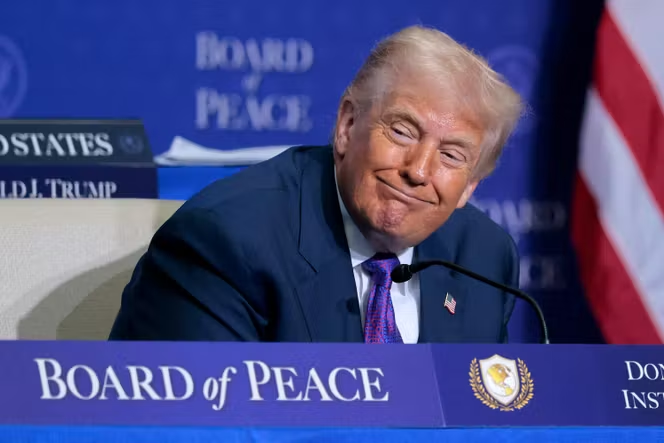
President Donald Trump delivered a headline-grabbing address on Thursday during the inaugural meeting of the Board of Peace, an event intended to showcase international cooperation and diplomatic alignment but which instead became dominated by a series of off-script remarks that quickly circulated across global media and social platforms.
The gathering brought together officials from multiple regions, including Europe, Latin America, and Asia, for discussions centered on security coordination, economic stability, and multilateral engagement. The White House framed the meeting as a cornerstone of a new diplomatic platform aimed at reducing global tensions and strengthening alliances. While the policy agenda emphasized cooperation, stability, and shared commitments among partner nations, much of the public focus shifted to the president’s delivery, which veered between prepared remarks and extended improvisation.
Trump opened the speech by welcoming delegates and acknowledging foreign leaders in attendance. During that introduction, he singled out Paraguay’s president, Santiago Peña Palacios, complimenting his youth and appearance in a remark that blended humor with a familiar rhetorical style that has defined many of Trump’s public appearances. The president’s tone quickly turned more informal, punctuated by asides and personal observations that diverged from the official talking points prepared for the event.
At one point, Trump made a comment about young male leaders that drew a mixed response from the audience. “I don’t like young, handsome men. Women, I like. Men, I don’t have any interest,” he said, prompting both laughter and visible discomfort among some attendees. The line spread rapidly online within minutes, becoming one of the most replayed segments of the speech.
Despite these diversions, Trump returned intermittently to policy themes, stressing the importance of coordinated diplomacy and asserting that his administration had improved relationships with several international partners. He pointed to increased communication channels with global institutions and argued that U.S. leadership remained essential to maintaining geopolitical balance. Yet even these sections were interwoven with anecdotal commentary that shifted attention away from the substance of the policy agenda.
The most widely discussed portion of the address came when Trump revisited a viral incident involving a malfunctioning escalator during a previous visit to the United Nations headquarters in New York. The moment, which had previously been framed by the White House as suspicious, was described by UN officials as a routine safety mechanism triggered by movement behind the president.
Trump used the anecdote as a humorous digression, recalling the abrupt halt of the escalator and the moment he lost his balance. He described placing his hand on First Lady Melania Trump to steady himself, noting that she was “in the proper location” to prevent his fall. The personal nature of the description drew immediate attention, becoming one of the defining soundbites from the event and fueling extensive commentary in political and media circles.
The president then pivoted to praise Melania, referencing her recent documentary project and noting its favorable audience reception. That transition reinforced the speech’s highly personal tone, which at times overshadowed the formal diplomatic purpose of the gathering. Observers noted that Trump’s use of anecdote and improvisation has long been a hallmark of his communication style, though critics argued that the setting — a multinational diplomatic forum — made the approach appear less appropriate.
White House officials later emphasized that the substance of the Board of Peace meeting extended far beyond the president’s remarks. According to administration briefings, delegates participated in closed-door sessions addressing conflict prevention, economic resilience, and joint security strategies. Officials described those discussions as productive and aligned with the administration’s broader foreign policy objectives, including reinforcing alliances and countering emerging geopolitical threats.
Nonetheless, media coverage focused overwhelmingly on the speech’s unscripted elements. Clips of Trump’s remarks were widely shared, with commentators debating whether the tone undermined the seriousness of the initiative or reflected a deliberate effort to humanize diplomacy through informal communication. Supporters argued that Trump’s candid style made him relatable and engaging, while critics contended that it risked distracting from critical policy messages and potentially diminishing the perceived gravity of the event.
The escalator anecdote in particular reignited discussion of the original incident, which had been widely covered at the time. Initial claims by members of Trump’s team suggested that the malfunction might have been intentional, but officials from the United Nations later clarified that a safety sensor likely triggered the stop. Outlets including BBC News reiterated that explanation in their coverage of Thursday’s remarks, contrasting the technical cause with the narrative previously suggested by the administration.
Trump also briefly mentioned his relationship with international institutions, stating that he had maintained positive working ties despite past disagreements. He characterized his administration’s approach as firm but constructive, emphasizing negotiation strength and national interest while still engaging in cooperative frameworks.
As the event concluded, administration officials sought to refocus attention on the Board of Peace initiative itself, describing it as a long-term effort to create structured dialogue among allied nations. Future meetings are expected to expand participation and address additional topics, including trade coordination and regional security concerns. Whether those meetings will be remembered for policy outcomes or public messaging remains an open question.
The response to Thursday’s address illustrates the continuing impact of Trump’s distinctive communication style on both domestic and international audiences. His willingness to depart from prepared remarks can generate immediate attention and viral moments, but it can also shift the narrative away from substantive policy discussions. In a setting designed to project unity and diplomatic focus, that dynamic became especially visible.
Ultimately, the inaugural Board of Peace meeting achieved its procedural objective of bringing international representatives together, but the public perception of the event was shaped largely by the president’s unscripted commentary. As the administration moves forward with the initiative, it will likely face ongoing scrutiny over how effectively it can balance high-level diplomatic messaging with a communication approach that often prioritizes spontaneity and personal narrative.

Emily Johnson is a critically acclaimed essayist and novelist known for her thought-provoking works centered on feminism, women’s rights, and modern relationships. Born and raised in Portland, Oregon, Emily grew up with a deep love of books, often spending her afternoons at her local library. She went on to study literature and gender studies at UCLA, where she became deeply involved in activism and began publishing essays in campus journals. Her debut essay collection, Voices Unbound, struck a chord with readers nationwide for its fearless exploration of gender dynamics, identity, and the challenges faced by women in contemporary society. Emily later transitioned into fiction, writing novels that balance compelling storytelling with social commentary. Her protagonists are often strong, multidimensional women navigating love, ambition, and the struggles of everyday life, making her a favorite among readers who crave authentic, relatable narratives. Critics praise her ability to merge personal intimacy with universal themes. Off the page, Emily is an advocate for women in publishing, leading workshops that encourage young female writers to embrace their voices. She lives in Seattle with her partner and two rescue cats, where she continues to write, teach, and inspire a new generation of storytellers.