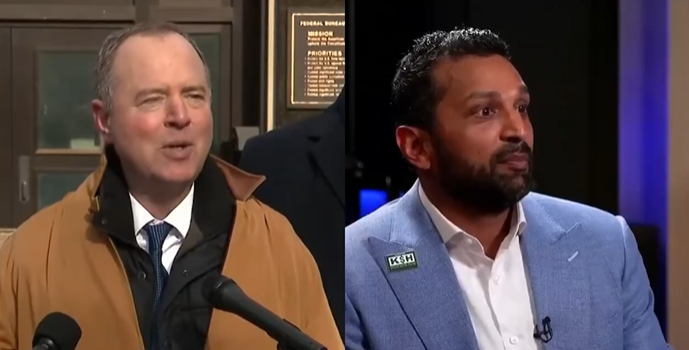
Kash Patel Fires Back at Adam Schiff During Senate Showdown
FBI Director Kash Patel appeared before the Senate Judiciary Committee on Tuesday for what became one of the most combative hearings in recent memory. What was intended as a review of the Bureau’s handling of high-profile investigations turned into a heated political battle, especially during Patel’s fiery clash with Sen. Adam Schiff (D-CA).
The nearly five-hour session touched on topics ranging from the ongoing Charlie Kirk assassination case to long-sealed Jeffrey Epstein records. But the most memorable moment came when Patel, visibly frustrated by Schiff’s questioning, directly accused the senator of deceit and exploitation.
Patel’s Clash With Schiff
Schiff opened his questioning by accusing Patel of “misleading the public” and mishandling sensitive investigations for political gain. The accusations sparked an immediate and forceful rebuttal.
Patel looked directly at Schiff and fired back:
“The American people believe the truth. What I am doing is protecting this country, providing historic reforms, and combating the weaponization of intelligence by the likes of you. We have countlessly proven you to be a liar in Russiagate, in January 6th—you are the biggest fraud to ever sit in the United States Senate, you’re a disgrace to this institution, and an utter coward.”
The exchange left the room tense, with several senators attempting to redirect the discussion. But Patel doubled down, labeling Schiff “a political buffoon at best” and accusing him of using his Senate seat for fundraising rather than governance.
Tensions Over Charlie Kirk Case
The hearing also turned to Patel’s management of the Charlie Kirk assassination investigation, which remains under intense public scrutiny.
Patel admitted he personally authorized the release of photos and surveillance footage of suspect Tyler Robinson despite resistance from local law enforcement. He defended the move as a matter of transparency.
“The public has a right to see the evidence,” Patel explained. “It’s about trust. If the Bureau doesn’t maintain openness in a case this significant, we risk further damaging public faith in law enforcement.”
He also confirmed that Discord chat groups tied to Robinson are being analyzed, with dozens of individuals under review. According to Patel, the FBI is committed to ensuring that “anyone connected in any way will face accountability.”
Epstein Records Stir Debate
Schiff and other Democrats pressed Patel on why the Bureau continues to keep certain Jeffrey Epstein records sealed. They suggested that withholding documents could be seen as an attempt to shield powerful figures.
Patel rejected the accusation, citing court restrictions. He explained that while the FBI has released substantial material, some disclosures remain legally prohibited.
A Justice Department and FBI memo made public in July found “no credible evidence” that Epstein blackmailed high-profile individuals and no justification for prosecuting uncharged third parties.
Patel described earlier decisions under the Obama-era Justice Department as an “original sin,” criticizing narrow warrants and a favorable plea deal. By contrast, he credited the Trump administration for “courageously” bringing new charges before Epstein’s death in 2019.
Transparency vs. Politicization
One of the broader themes of the hearing was whether Patel’s direct communication with the public, often through social media, undermines or strengthens the Bureau.
Democrats argued that Patel’s updates politicize ongoing cases. Patel countered that the American people deserve direct communication without the filter of partisan media.
“I will not apologize for telling the public the truth,” Patel said. “If we hide behind closed doors, we erode trust. I believe sunlight is the best disinfectant, and transparency is how we rebuild confidence.”
Fallout From the Hearing
By the time the gavel struck, Patel had not only defended his management of sensitive cases but had also taken one of the most aggressive public shots at a sitting senator in recent memory. Schiff, for his part, brushed off Patel’s remarks, accusing the FBI director of turning a legal proceeding into “a campaign rally.”
Still, the exchange highlighted the deep partisan rifts shaping America’s political and legal system. Supporters of Patel praised his candor and refusal to “play politics” with investigations, while critics accused him of undermining institutional credibility by airing grievances in such a combative manner.
The clash between Patel and Schiff is expected to reverberate well beyond the hearing room. With multiple high-profile cases still in motion—including the Kirk assassination, the handling of Discord-linked groups, and ongoing questions about Epstein’s files—Patel’s leadership will remain in the spotlight.
Whether his approach rebuilds trust or inflames political divisions further remains to be seen. But after Tuesday’s Senate showdown, one thing is clear: Kash Patel is not backing down.

James Jenkins is a celebrated Pulitzer Prize-winning author whose work has reshaped the way readers think about social justice and human rights in America. Raised in Atlanta, Georgia, James grew up in a community that instilled in him both resilience and a strong sense of responsibility toward others. After studying political science and creative writing at Howard University, he worked as a journalist covering civil rights issues before dedicating himself fully to fiction. His novels are known for their sharp, empathetic portraits of marginalized communities and for weaving personal stories with broader political realities. Jenkins’s breakout novel, Shadows of Freedom, won national acclaim for its unflinching look at systemic inequality, while his more recent works explore themes of identity, resilience, and the fight for dignity in the face of oppression. Beyond his novels, James is an active public speaker, lecturing at universities and participating in nonprofit initiatives that support literacy and community empowerment. He believes that storytelling is a way to preserve history and inspire change. When not writing, James enjoys jazz music, mentoring young writers, and traveling with his family to explore cultures and stories around the world.