
WASHINGTON — One of the key architects of the deadly 2012 assault on the U.S. consulate in Benghazi, Libya, has been arrested and brought into U.S. custody, Justice Department officials announced Friday. The suspect, identified as Zubayr Al-Bakoush, will face prosecution on multiple charges, including arson, murder, and terrorism, according to authorities.
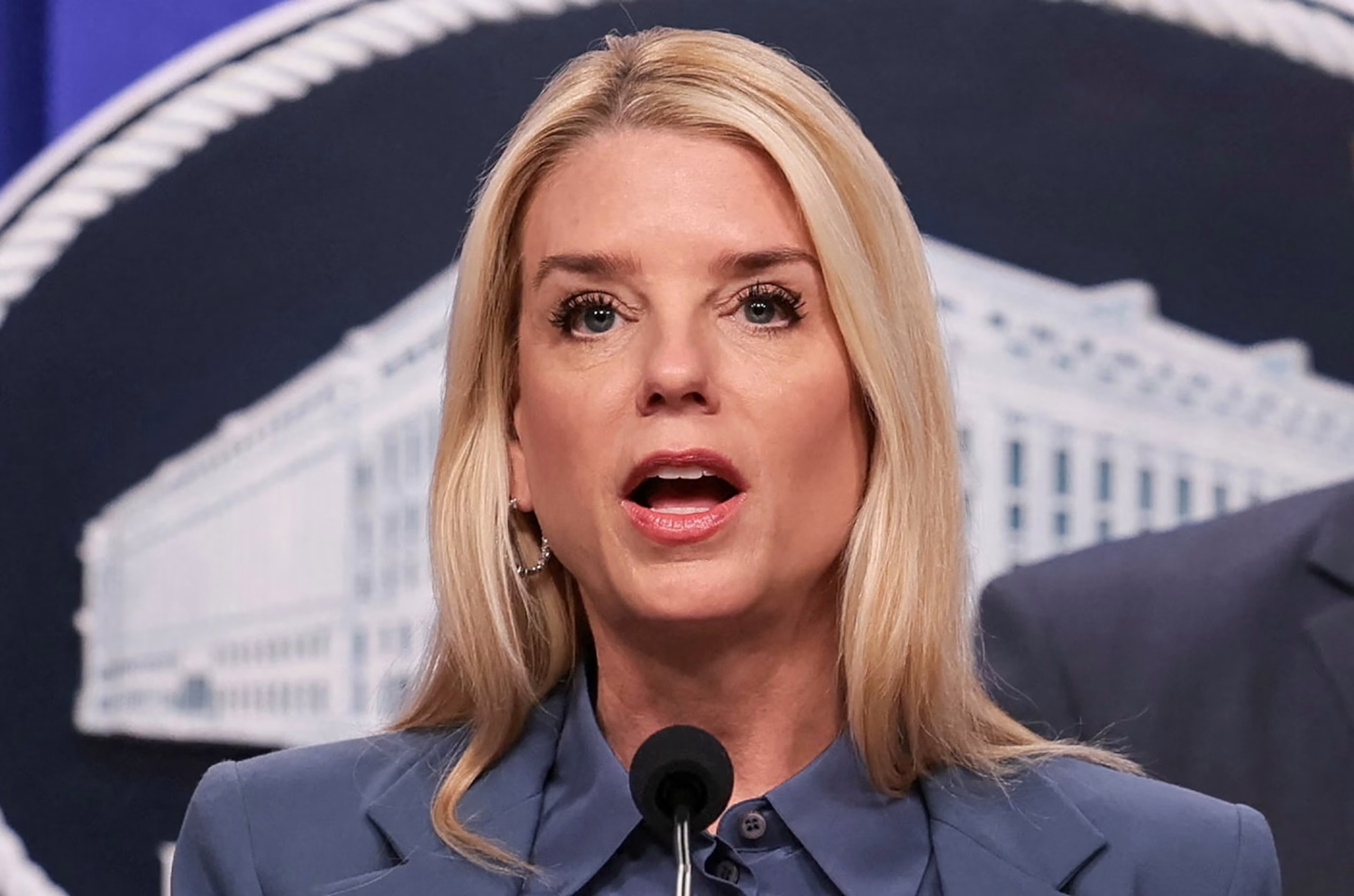
Attorney General Pam Bondi confirmed the arrest at a news conference at DOJ headquarters, stating that Al-Bakoush arrived at Andrews Air Force Base at 3 a.m. and was received by FBI Director Kash Patel and U.S. Attorney for the District of Columbia Jeanine Pirro.
“Zubayr Al-Bakoush is in our custody,” Bondi said. “He will be prosecuted to the fullest extent of the law.” Pirro added that her office would continue pursuing other individuals involved in the attack who remain at large.
Patel declined to disclose where Al-Bakoush was apprehended before being flown to the United States, citing the need to protect the integrity of the ongoing investigation.
Background of the Benghazi Attack
The 2012 Benghazi attack claimed the lives of four Americans, including U.S. Ambassador Chris Stevens, State Department official Sean Smith, and CIA contractors Glen Doherty and Tyrone Woods. On Sept. 11, 2012, armed militants stormed the diplomatic compound in Libya’s second-largest city, setting fire to buildings and launching mortars at a nearby CIA facility.
Stevens and Smith were killed while trapped inside the consulate, while Doherty and Woods were killed defending the compound. The assault prompted widespread outrage in the United States and led to years of congressional hearings and investigations into both security failures and U.S. diplomatic preparedness in Libya.
In the immediate aftermath, officials in the Obama administration suggested the attack might have been a spontaneous reaction to protests over an anti-Muslim video circulating online. However, a later House select committee investigation concluded that U.S. officials failed to deploy available military assets, despite intelligence warnings about the growing threat to American personnel in the region.
Former U.N. Ambassador Susan Rice publicly cited the video as the inciting factor for the violence, stating on Sept. 16, 2012: “What sparked the recent violence was the airing on the Internet of a very hateful, very offensive video that has offended many people around the world.”
The attack and its handling became a significant political flashpoint. During a 2013 Senate hearing, then-Secretary of State Hillary Clinton was pressed on her department’s failures and infamously replied, “What difference, at this point, does it make?”
Bondi referenced this remark during Friday’s announcement, saying, “Hillary Clinton famously once said about Benghazi, ‘What difference, at this point, does it make?’ Well, it makes a difference to Donald Trump. It makes a difference to those families.” She added, “And 14 years later, it makes a difference to law enforcement.”
Details of the Arrest
Zubayr Al-Bakoush is the third individual arrested in connection with the Benghazi assault. Two other militants, including Ahmed Abu Khatallah (also known as Ahmed Mukatallah), were previously apprehended in Libya. Khatallah was captured in June 2014 and initially sentenced to 22 years in prison in 2018. Following a federal appeals panel review, he was resentenced to 28 years in federal prison in September 2024 on terrorism and related charges.
Another suspect, Mustafa al-Imam, was apprehended by U.S. special forces in October 2017 and later sentenced to 19 years and eight months in prison on federal terrorism charges in January 2020.
At the Feb. 6 news conference, Pirro emphasized the long-standing commitment of the Justice Department to pursue those responsible for the attack. “Time will not stop us from going after these predators, no matter how long it takes, in order to fulfill our obligation to those families who suffered horrific pain at the hands of these violent terrorists,” she said.
Patel noted that he had worked on the case as a young prosecutor and described the arrest as bringing the tragic episode “full circle.” “When an act of terrorism of this magnitude strikes at the heart of our nation, we go to work,” Patel said. “The formal transfer of custody of Al-Bakoush into U.S. custody represents a critical step toward justice for the fallen.”
The Political Context
The Benghazi attack has remained a politically charged subject in the United States for more than a decade. Republican lawmakers and critics of former Secretary of State Hillary Clinton have repeatedly cited the administration’s response to the attack as evidence of leadership failures. Clinton’s 2016 presidential campaign and subsequent political discussions have been shaped in part by scrutiny over Benghazi.
Bondi underscored the political significance of the case, saying, “Let this case serve as a reminder: If you commit a crime against the American people anywhere in this world, President Trump’s Justice Department will find you. It might not happen overnight, but it will happen. You can run, but you cannot hide.”
Pirro added, “President Trump will make sure that the cavalry comes for Americans, no matter where they are in this world.” She also criticized past failures to provide timely assistance to the four Americans during the attack, noting that they waited for 13 hours for help that never arrived.
The Families and Legacy of Benghazi
The families of the victims have followed the case closely, advocating for justice for more than a decade. Pirro and Patel indicated that they maintained communication with family members during the investigation. The arrest of Al-Bakoush is being viewed as a milestone in providing some measure of closure to the families, though officials note that the full legal process will be lengthy.
“This saga was painful for Americans,” Pirro said. “Our job is to hold these individuals accountable and to send a clear message that crimes against U.S. citizens will be prosecuted to the fullest extent of the law, regardless of how much time has passed.”
Bondi highlighted the broader lesson of the case, emphasizing the persistence of U.S. law enforcement efforts. “Fourteen years later, it is still our duty to bring perpetrators to justice. This arrest shows that the U.S. will never forget those who were lost and will always seek accountability,” she said.
Security and Counterterrorism Implications
The arrest also underscores ongoing U.S. counterterrorism efforts to track and prosecute individuals responsible for attacks on American interests abroad. Experts note that the case illustrates both the challenges and persistence required in pursuing terrorists across borders, particularly in regions with limited security infrastructure.
By securing Al-Bakoush and preparing him for prosecution in the United States, authorities signal that even complex international cases can be resolved with patience, coordination, and sustained investigative work.
Looking Ahead
While the arrest is a major development, prosecutors have emphasized that the investigation into the Benghazi attack is ongoing. Additional suspects may still be at large, and authorities have pledged to pursue all leads. The case will now proceed through the U.S. legal system, where Al-Bakoush will face charges and a trial in federal court.
Officials stress that the legal process will ensure due process and a thorough examination of evidence. The arrest, however, represents a significant step toward accountability for one of the most infamous attacks on U.S. diplomatic personnel in recent history.
Conclusion
The apprehension of Zubayr Al-Bakoush, a suspected mastermind of the 2012 Benghazi attack, marks a critical milestone in the protracted pursuit of justice for the four Americans who lost their lives. More than a decade after the attack, U.S. authorities continue to demonstrate that crimes against American citizens, including acts of terrorism abroad, will not go unpunished.
Attorney General Pam Bondi, FBI Director Kash Patel, and U.S. Attorney Jeanine Pirro highlighted the case as a testament to the determination of American law enforcement and the enduring commitment to accountability for acts of terrorism.
As Al-Bakoush faces prosecution in U.S. courts, the families of the victims and the American public are reminded of the long and challenging path of seeking justice, while the broader implications for national security and counterterrorism remain significant.

Emily Johnson is a critically acclaimed essayist and novelist known for her thought-provoking works centered on feminism, women’s rights, and modern relationships. Born and raised in Portland, Oregon, Emily grew up with a deep love of books, often spending her afternoons at her local library. She went on to study literature and gender studies at UCLA, where she became deeply involved in activism and began publishing essays in campus journals. Her debut essay collection, Voices Unbound, struck a chord with readers nationwide for its fearless exploration of gender dynamics, identity, and the challenges faced by women in contemporary society. Emily later transitioned into fiction, writing novels that balance compelling storytelling with social commentary. Her protagonists are often strong, multidimensional women navigating love, ambition, and the struggles of everyday life, making her a favorite among readers who crave authentic, relatable narratives. Critics praise her ability to merge personal intimacy with universal themes. Off the page, Emily is an advocate for women in publishing, leading workshops that encourage young female writers to embrace their voices. She lives in Seattle with her partner and two rescue cats, where she continues to write, teach, and inspire a new generation of storytellers.