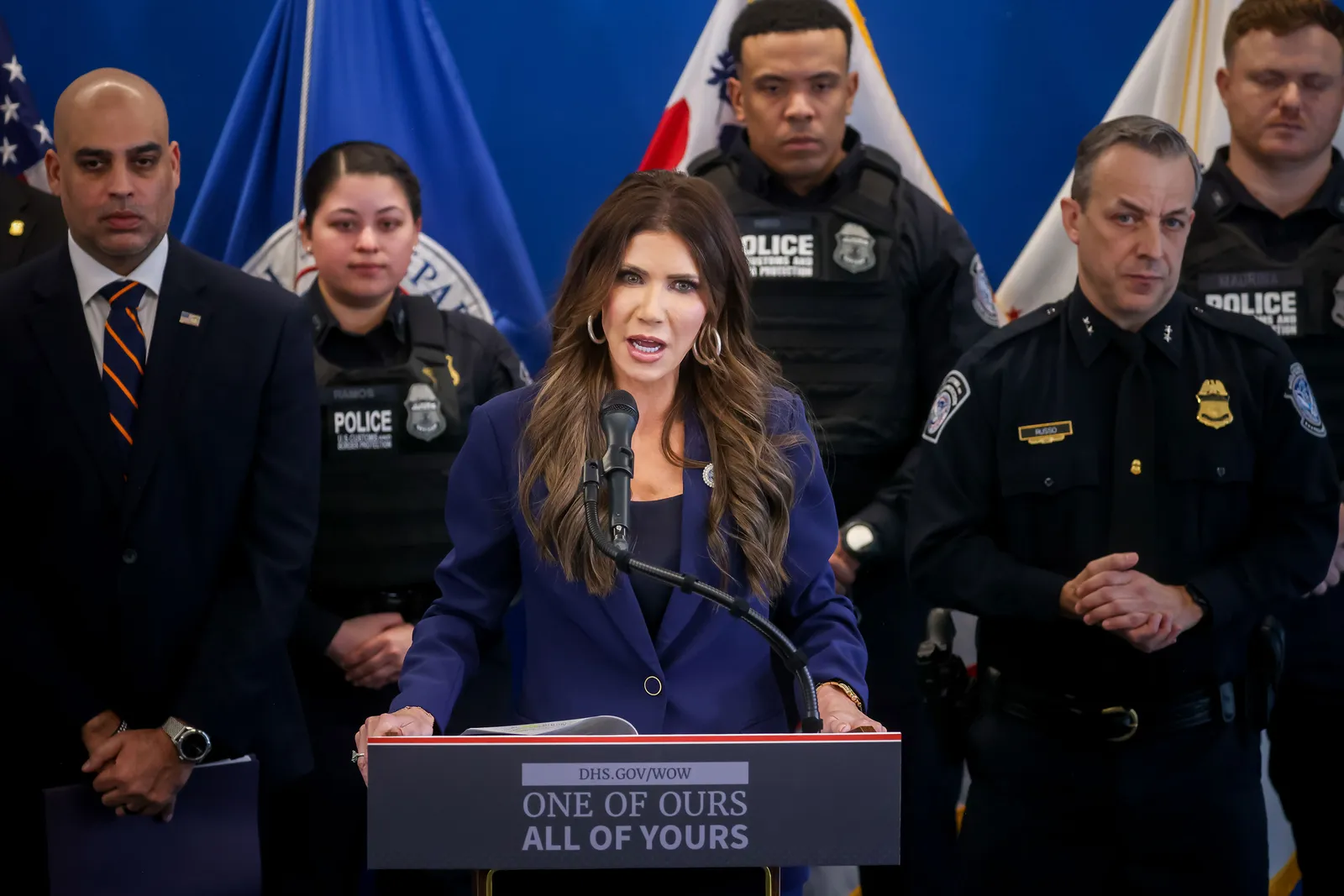
Homeland Security Secretary Kristi Noem has issued a forceful warning amid growing protests across several U.S. cities, signaling a hardline stance by the Trump administration as tensions intensify over immigration enforcement and federal policing. Her remarks, delivered during a high-profile public appearance, have quickly become a focal point in the national debate over protest rights, law enforcement authority, and the limits of executive power.
Speaking as demonstrations erupted following controversial Immigration and Customs Enforcement (ICE) operations, Noem warned that anyone who harms federal officers would face swift and severe consequences. “If you lay a finger on one of our officers, we will find you,” she said, framing her message as a direct response to what she described as escalating threats and violence directed at federal agents. The statement was widely interpreted as a warning not only to those engaged in violence, but also to protest movements challenging immigration policy.
The warning comes at a moment of heightened scrutiny for the Department of Homeland Security (DHS), which Noem oversees. Protests intensified following a fatal shooting involving an ICE agent during an enforcement operation, an incident that sparked outrage, street demonstrations, and calls for accountability from local officials and civil rights groups. While Noem has defended the agent’s actions as self-defense, critics argue that the administration is using inflammatory rhetoric to suppress dissent and shield federal agencies from oversight.
Noem’s comments were delivered against the backdrop of mounting political pressure. Several Democratic lawmakers have accused DHS of failing to provide transparency surrounding ICE operations and have questioned the administration’s handling of protest-related arrests. Some have gone further, arguing that Noem’s rhetoric risks chilling lawful protest by blurring the line between violent acts and peaceful demonstrations.
Administration officials, however, strongly reject that interpretation. They insist the warning was narrowly focused on violence against federal personnel and infrastructure, not on constitutionally protected protest activity. DHS sources emphasized that peaceful protest remains lawful, but that attacks on officers, destruction of federal property, or interference with enforcement operations will not be tolerated.
Supporters of Noem argue that her message reflects a broader effort by the Trump administration to reassert federal authority after years of what they describe as permissive enforcement and rising hostility toward law enforcement. They point to incidents in which federal officers have been injured during protests, arguing that firm warnings are necessary to deter escalation and protect public safety.
Conservative allies praised Noem’s remarks as decisive leadership in a volatile moment. Several Republican lawmakers echoed her language, stating that federal officers must be defended “without apology” and that protests crossing into violence undermine public trust. Right-leaning media outlets framed the warning as a long-overdue response to what they characterize as organized resistance against immigration enforcement.
Civil liberties organizations, by contrast, expressed concern that the rhetoric could embolden aggressive policing tactics. Advocacy groups warned that sweeping statements from top officials often translate into broader enforcement actions on the ground, potentially leading to mass arrests, excessive use of force, or surveillance of protest organizers. They argue that such warnings, even if not legally binding, send a powerful signal to law enforcement agencies nationwide.
Legal experts note that while the federal government has clear authority to protect its officers and facilities, the language used by senior officials matters. “When rhetoric escalates, it can shape operational decisions,” said one constitutional law scholar. “The danger lies in conflating protest with criminality, even implicitly.”
The warning has also intensified political fallout on Capitol Hill. Lawmakers critical of DHS have seized on Noem’s comments as evidence of what they call an authoritarian posture toward dissent. Hearings and oversight demands are expected to increase, particularly as video footage and eyewitness accounts from recent protests continue to circulate online.
Noem has remained unapologetic. In follow-up remarks, she reiterated that DHS would “never back down” in the face of threats, emphasizing that federal officers are carrying out lawful orders. She accused political opponents of exploiting tragedy to weaken border enforcement and demoralize law enforcement personnel.
The controversy underscores the broader stakes of the administration’s immigration strategy. As enforcement operations expand and protests grow more frequent, clashes between demonstrators and federal authorities appear increasingly likely. Noem’s warning, while brief, has crystallized the administration’s posture: aggressive enforcement, zero tolerance for violence, and a willingness to confront protest movements head-on.
Whether the warning will deter violence or further inflame tensions remains uncertain. History suggests that strong rhetoric can have unpredictable consequences, particularly in politically charged environments. What is clear is that Noem’s statement has become more than a simple caution—it is now a defining moment in an escalating struggle over immigration policy, protest rights, and the role of federal power in American civic life.
As protests continue and investigations into recent enforcement actions unfold, Noem’s warning will likely remain central to the debate. Supporters see it as a necessary assertion of law and order; critics view it as a troubling signal that dissent itself is being treated as a threat. In an already polarized climate, the line between security and suppression has rarely felt thinner.

Emily Johnson is a critically acclaimed essayist and novelist known for her thought-provoking works centered on feminism, women’s rights, and modern relationships. Born and raised in Portland, Oregon, Emily grew up with a deep love of books, often spending her afternoons at her local library. She went on to study literature and gender studies at UCLA, where she became deeply involved in activism and began publishing essays in campus journals. Her debut essay collection, Voices Unbound, struck a chord with readers nationwide for its fearless exploration of gender dynamics, identity, and the challenges faced by women in contemporary society. Emily later transitioned into fiction, writing novels that balance compelling storytelling with social commentary. Her protagonists are often strong, multidimensional women navigating love, ambition, and the struggles of everyday life, making her a favorite among readers who crave authentic, relatable narratives. Critics praise her ability to merge personal intimacy with universal themes. Off the page, Emily is an advocate for women in publishing, leading workshops that encourage young female writers to embrace their voices. She lives in Seattle with her partner and two rescue cats, where she continues to write, teach, and inspire a new generation of storytellers.